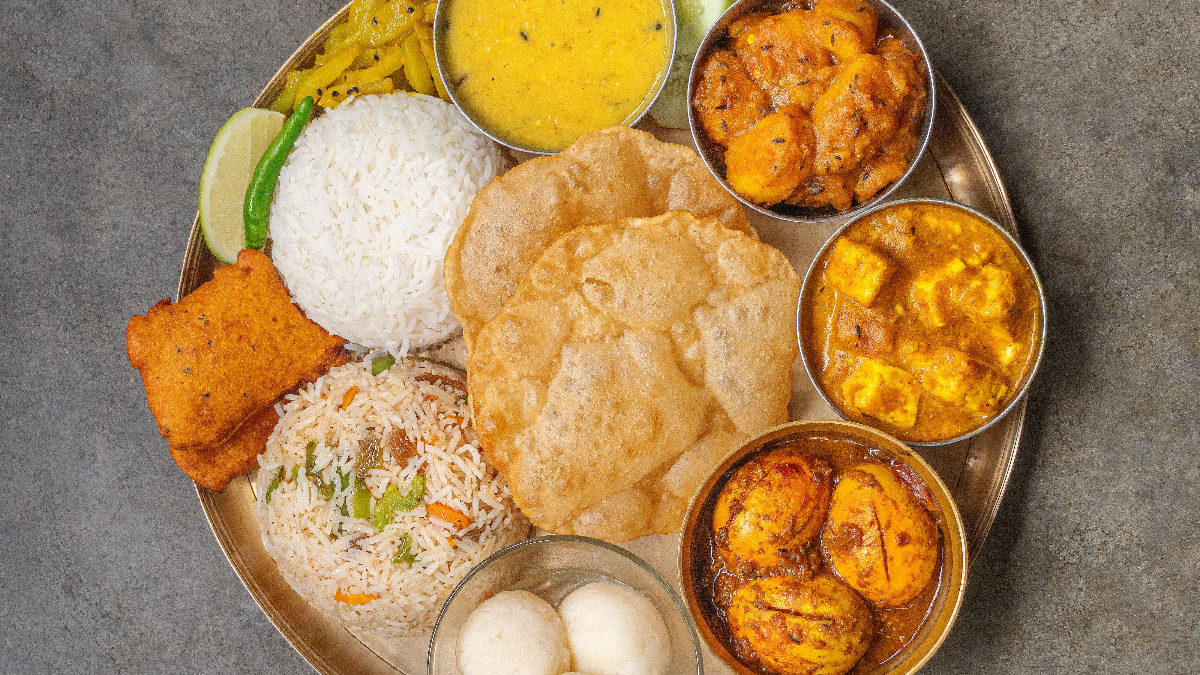
Quick Summary
Across many Indian homes, the everyday plate follows a familiar pattern: rice or roti, dal or another protein-rich preparation, vegetables, and perhaps curd, chutney or something fresh. Regional thalis are variations on this idea, shaped by local grains, cooking fats, souring agents, seasonal ingredients and food traditions.
A varied Indian plate can provide fibre, protein and other essential nutrients. But balance depends on the ingredients, proportions and preparation, not simply the number of dishes served. This series uses India’s ceremonial thalis as a map of regional food culture, separating what’s worth borrowing for everyday eating from what belongs to the feast.
The Plate Most of India Already Eats
Ask families across the country what they ate for dinner last night, and many answers would sound remarkably alike. Some roti or rice. A dal, or a curry of vegetables, fish or meat. A sabzi. Curd, a salad, perhaps a pickle. Regional names, spices and cooking fats change from home to home, and not every community eats this way, but the structure is familiar across much of India.
That shared shape is worth appreciating before anything else, because it offers a genuinely good foundation for balanced eating. Grains and pulses complement each other nutritionally, contributing protein and a mix of essential amino acids. The sabzi brings fibre, vitamins and variety. Curd contributes protein and, when it contains live cultures, microorganisms from fermentation.
Several small components can also mean more different plants on the plate. And that matters because different plant foods provide different kinds of fibre and other compounds. Research has associated greater dietary plant variety with a more diverse gut microbiome, although the relationship is still being studied.
As we explore in our guide to fibre-rich Indian foods, it isn’t one remarkable ingredient that does all the work. It’s how the everyday meal comes together.
So this series doesn’t start from the idea that Indian food needs fixing. It starts from the idea that it already offers a strong foundation, and asks what each region’s version does especially well.
Where the Everyday Plate Often Falls Short
A good structure doesn’t guarantee a good plate, and it’s worth being honest about where everyday Indian meals can slip.
- The grain takes over. A generous mound of rice or several rotis can crowd out the dal and vegetables, tilting the plate towards starch rather than a balanced mix of food groups.
- The grain gets more refined. Polished rice and refined flour such as maida generally contain less fibre than their whole-grain counterparts. Whole-wheat atta, however, remains a whole-grain flour when the bran and germ are retained.
- The dal becomes an afterthought. A token spoonful, or a serving diluted with plenty of water and very little actual dal, contributes less protein and fibre than a substantial portion.
- The salt creeps up. Not just through the cooking, but through pickles, papad and packaged accompaniments that add to the meal’s overall sodium content.
None of these are exclusively regional problems; they can turn up anywhere. And the regional thalis, read carefully, often point towards simple improvements: more vegetable preparations, a different whole grain, a proper serving of dal, a fresh chutney in place of a second pickle.
Not every traditional dish needs changing. Sometimes it’s simply a question of what takes up more space on the everyday plate.
Why Look at the Ceremonial Thali?
If everyday meals share so much, the regional differences become especially visible in the ceremonial thali: the wedding feast, the festival spread, the famous restaurant plate with its ring of katoris. That’s where a region lays out its whole palette, its grains, souring agents, seasonal specialities and dishes reserved for particular occasions.
A ceremonial thali isn’t necessarily how anyone eats on a weekday, and it would be misleading to judge it as if it were. A feast is meant to be generous. Fried dishes, rich gravies, sweets and special preparations are part of its purpose.
So each piece in this series reads the ceremonial thali as a map rather than a menu. It shows what a region’s cooks value, how its ingredients and flavours come together, and what those choices tell us about everyday food.
From that map, we can pick out the habits worth bringing into daily meals and leave the rest for the celebration.
Not Every Region Eats From a Thali
‘Thali’ is the word most of India knows, but a round steel plate is only one of the ways the country serves a meal.
In Kerala and other parts of South India, festive meals may be served on a banana leaf, with preparations arranged in particular places. Traditional Bengali meals are often eaten in courses, moving through a deliberate sequence of flavours. Across the North East, different communities have their own serving traditions, ingredients and ways of bringing dishes together.
This series uses ‘thali’ as convenient shorthand, but respects each region’s own way of putting a meal together.
What Actually Varies, and Why It Matters
The differences between regions come down to a handful of choices. Some shape the nutritional profile of a meal; others tell us more about its flavour, climate and culinary history.
- The grain. Wheat across much of the North, rice through the East and South, and millets like bajra, jowar and ragi in Rajasthan, Maharashtra, Karnataka and beyond. Different grains bring different nutrients and culinary possibilities. Millets aren’t automatically higher in fibre than whole-wheat atta, but they offer another way to introduce variety into everyday meals. Read more about where ragi, jowar and bajra fit into the fibre story.
- The cooking fat. Mustard oil in the East and parts of the North, coconut oil along stretches of the southern coast, groundnut and sesame oil in several western and southern kitchens, and ghee in many regional traditions. Each fat shapes the flavour of its cuisine and has its own nutritional profile. The amount used, the types of fat and the overall eating pattern matter more than choosing an oil simply because it belongs to a particular tradition.
- The souring agent. Tamarind in many southern preparations, kokum along the Konkan coast, curd and amchur in northern cooking, fermented bamboo shoot in parts of the North East. Sourness is one of the ways regional cuisines balance richness and build flavour. It is a culinary principle, though, not proof that a sour dish necessarily improves digestion.
- Fermentation. Curd across many parts of India, fermented batters in the South, fermented soybean and bamboo shoot in parts of the North East. Worth remembering that fermentation doesn’t always mean probiotics. Fresh curd with live cultures contains microorganisms from fermentation, while foods such as steamed idli or thoroughly cooked fermented curries generally lose their live cultures during heating. Fermentation may still change their flavour, texture and nutritional characteristics. Our guide to curd, buttermilk and gut health explores that distinction.
- The small, deliberate touches. The bitter opening course in a traditional Bengali meal, the Assamese convention of beginning with khar and finishing with a sour tenga, rasam or curd rice as part of a South Indian meal, and chaas accompanying a Gujarati spread. These are some of the most interesting food and flavour traditions in Indian cooking. Many are associated with digestive comfort in local practice, although that doesn’t automatically make them scientifically proven digestive remedies.
Each of these details tells us something about where a meal comes from and how it has evolved. And some offer easy ways to widen what we eat without abandoning what we already enjoy.
An Old Idea Behind the Plate
Many Indian food traditions share an idea that a complete meal should include a range of tastes, often described through the six tastes of Ayurvedic tradition: sweet, sour, salty, pungent, bitter and astringent.
Whether or not a family consciously thinks in those terms, the instinct shows up on the plate: a sweet alongside a sour chutney, a bitter vegetable beside a rich dal, a sharp pickle against something mild.
It’s a traditional framework rather than a scientifically established formula for digestive health, and this series treats it that way.
But it’s worth noticing how a meal built around contrasting tastes can encourage variety in ingredients and preparations. Modern nutrition research also values dietary diversity, particularly across vegetables, pulses, fruits and whole grains, even if the reasoning behind it is different.
The two ideas aren’t the same. They simply offer interesting ways of looking at the same plate.
How to Read a Thali
Each regional piece in this series asks the same three questions of its thalis:
- What’s the everyday foundation? The grains, pulses, vegetables and other foods that families in the region actually eat on ordinary days.
- What’s worth borrowing? A grain, a souring agent, a fermented side or a food tradition that could add flavour and variety to anyone’s everyday plate.
- What belongs to the feast? The ghee-rich, fried or sweet dishes that make a celebration a celebration, best enjoyed as exactly that.
None of the pieces will rank regions or declare one cuisine healthier than another. Every region’s food reflects its climate, crops, communities and history, and every one has something worth learning from.
The aim isn’t to recreate a wedding feast at lunch. It’s to notice the little things that might make an ordinary Tuesday’s meal more interesting, and perhaps more varied.
In this Series
- North India: Punjabi, Rajasthani and Himachali plates, from dal and makki roti to the traditional Himachali dham.
- South India: Banana-leaf meals and regional food traditions across Tamil Nadu, Andhra Pradesh and Karnataka, including a closer look at Kerala’s sadya.
- East India: Bengal’s carefully ordered courses, Odisha’s regional plates and the tradition of eating from bitter to sweet.
- West India: Gujarati, Maharashtrian and Goan thalis, their contrasting flavours and the place of chaas in a Gujarati meal.
- North East India: Assamese khar and tenga, fermented bamboo shoot, soybean preparations and the varied food traditions of the region’s communities.
The Honest Takeaway
India doesn’t need a new way of eating. Many homes already have the foundations of a well-built plate, and the regional thalis show how many good ways there are to vary it.
The balance still depends on what goes into the meal and how much of each food we eat. But read as maps rather than menus, these regional traditions offer a lifetime of everyday ideas: a different grain, a new souring agent, a fermented side, a familiar preparation from another corner of the country.
Sometimes, eating well isn’t about reinventing the plate. It’s about noticing everything that’s already possible on it.
Sources
Disclaimer: This article is intended for general educational and informational purposes and does not constitute medical or personalised nutritional advice. Individual dietary needs may vary according to age, health conditions, allergies and food tolerances. If you have a medical condition requiring dietary management, consult a qualified healthcare professional or registered dietitian. Persistent, recurring or severe digestive symptoms should be evaluated by a healthcare professional.
FAQs
What is a traditional Indian thali?
A traditional Indian thali is a meal made up of several preparations, often served together on a plate or platter. It may include rice or roti, dal, vegetables, curries, chutneys, pickles, curd and sweets. The dishes and serving customs vary considerably by region and occasion.
Is a traditional Indian thali healthy?
An everyday Indian thali can provide a balanced combination of grains, protein-rich foods, vegetables and other nutrients. Its nutritional quality depends on the ingredients, portions and cooking methods. Ceremonial thalis are feasts, generous by design, and need not be treated as everyday meal plans.
Which regional Indian thali is the healthiest?
There is no single healthiest regional thali. A meal's nutritional value depends more on its proportions, variety, ingredients and preparation than the region it comes from. Every regional cuisine can offer balanced meals as well as richer festive dishes.
Why do Indian thalis have so many small dishes?
Multiple dishes allow a meal to include contrasting flavours, textures and ingredients. They can also increase dietary variety when they contain different vegetables, pulses and other plant foods. The variety of dishes reflects local culinary traditions, not necessarily a fixed nutritional formula.
Does a thali need to include all six tastes?
No. The six tastes — sweet, sour, salty, pungent, bitter and astringent — belong to traditional Ayurvedic dietary thinking. They are not a medically established requirement for a balanced meal. Nutritional adequacy depends on the foods and nutrients consumed, rather than whether all six tastes are present.
Are fermented foods in Indian thalis probiotic?
Not necessarily. Some fermented foods, including curd with live cultures, contain living microorganisms. Thorough cooking usually inactivates these cultures, as happens with steamed idli. A food is only considered probiotic in the scientific sense when its microorganisms have demonstrated health benefits in adequate amounts.