South Indian Thalis: What the Banana Leaf Reveals About Everyday Eating
From Andhra's pappu and Tamil Nadu's kootu to Karnataka's kosambari and Kerala's sadya, the southern plate has more to offer than its spectacular feasts.
Table of Contents
Across many South Indian homes, an everyday rice-based meal brings together a dal or lentil-based curry, vegetables, something tangy or spiced, and often curd or buttermilk. The festive banana leaf shows what’s worth borrowing: Andhra’s pappu and roasted lentil podis, Tamil Nadu’s kootu and rasam, Karnataka’s soaked-pulse salad and ragi, and the sadya’s extraordinary range of vegetables.
These traditions offer plenty of ways to bring protein, fibre and variety to an everyday meal. Fresh curd and buttermilk can also contribute live cultures when made from curd containing them. The fried extras and the second and third payasams belong to the feast.
Ask what people in Hyderabad, Chennai, Bengaluru or Kochi ate for lunch today, and many answers will share a shape. Rice, sometimes eaten not all at once but in rounds. First with a dal or a lentil-based curry, then with something sharper, perhaps soured with tamarind, then with a thin, peppery rasam, and finally with curd or buttermilk. A vegetable or two on the side, perhaps a pickle and a papad.
It’s a familiar rhythm across many southern rice-based meals, although ingredients and eating customs vary considerably between regions and households. And there’s a good nutritional foundation here. A pulse brings protein and fibre. The vegetables bring variety. And fresh curd, when it contains live cultures, adds microorganisms from fermentation.
The sequence itself isn’t a scientifically established digestive intervention. It’s the foods that make up the meal, and their proportions, that do most of the nutritional work.
The regional differences come out at celebrations: a Telugu wedding lunch, a Tamil feast served on a full banana leaf, a Kannada festival oota, a Kerala sadya. That’s where each region lays out everything it cooks well. None of these is how everyone eats on a Wednesday, and it wouldn’t be fair to judge them as though they were.
So this piece reads each as a map, asking three questions: what the everyday foundation looks like, what’s worth borrowing, and what belongs to the feast.
It doesn’t rank one state against another.
A traditional Andhra meal often runs in clear stages. It may open with a first mouthful of rice mixed with a pickle or a podi and a little ghee. Then comes pappu, the dal, sometimes cooked with a vegetable or leafy greens. Then a koora, the vegetable dish, followed by pulusu, a tamarind-based curry, and charu, the Andhra rasam. It often ends with perugu, curd, eaten with rice.
The festive version keeps many of the same elements and simply adds more of everything. The precise order, of course, varies between households and occasions.
Andhra’s famous pickles, especially avakaya, the mango pickle, are intensely flavoured and often high in salt and oil. A little goes a long way, whether they’re eaten at an everyday lunch or a wedding feast. They work best as condiments rather than substantial portions.
Pulihora, the much-loved tamarind rice, has a special place at festivals and ceremonies, although it’s enjoyed on ordinary days too. Fried garelu and sweet stuffed flatbreads add to the festive spread.
Andhra food is also known for its heat. Chilli isn’t necessarily a problem for everyone, but people prone to acid reflux or digestive discomfort may find that very spicy meals aggravate their symptoms.
The everyday Tamil lunch follows a similar rhythm: rice with sambar or a kuzhambu, a poriyal (vegetables stir-fried, often with grated coconut) or a kootu, then rasam, then curd or mor.
At a festive meal the banana leaf fills up: vadai, appalam, several vegetable preparations, payasam, pickles, and often a finishing round of curd rice.
In many homes and wedding halls, the meal moves from dal and ghee through sambar and rasam to curd, though the exact order varies from community to community.
Vadai, appalam and the crisp fried extras are the feast’s pleasures, along with ghee-rich sweet pongal and payasam. Enjoy them at the celebration.
Mor kuzhambu, a yoghurt-based curry, is delicious too, but it is usually heated during preparation. Unlike fresh mor, it shouldn’t automatically be counted as a source of live cultures.
Everyday food in Karnataka varies strikingly from one region to another.
In parts of the south of the state, ragi mudde, a firm ball of finger millet, is eaten with saaru or bassaaru, a broth associated with cooked greens and pulses. Along the coast, rice is prominent. In the north, jowar rotis are a familiar staple.
The festive oota, served on a banana leaf in many traditions, is a long sequence: salt, pickle and kosambari at the top of the leaf, then palya, gojju and chitranna, followed by rice with saaru and huli, sweets and payasa, and often finally rice with curd or buttermilk.
The arrangement and serving order change with the region, community and occasion. The underlying abundance remains.
Holige (also called obbattu), the sweet flatbread often filled with chana dal and jaggery, laddus, chiroti and payasa are among the feast’s centrepieces.
Majjige huli, a vegetable curry in spiced buttermilk, is another regional favourite. Because its preparation commonly involves heating, it shouldn’t automatically be treated as a source of live cultures in the way fresh buttermilk can be.
The sadya is Kerala’s great feast, served at Onam, Vishu and weddings. Traditionally eaten by hand from a banana leaf, it can hold two dozen dishes or more.
In one common sequence, rice is eaten first with parippu (a mild dal) and ghee, then with sambar. Payasam may arrive partway through the meal, followed by further savoury courses such as rasam or pulissery, with moru, spiced buttermilk, often bringing the meal to a close.
The order varies across Kerala, and that’s part of what makes the tradition so interesting.
What’s worth borrowing is its range of vegetables.
Avial (mixed vegetables with coconut, sometimes finished with curd), thoran (a dry stir-fry with coconut), olan (ash gourd and cowpeas in coconut milk), kaalan, pachadi and kichadi can put an extraordinary range of vegetables and other plant ingredients on one leaf.
Inji puli, a sharp relish of ginger, tamarind and jaggery, is traditionally associated with helping the heavier dishes along. That’s a cultural understanding rather than proof of a particular digestive effect.
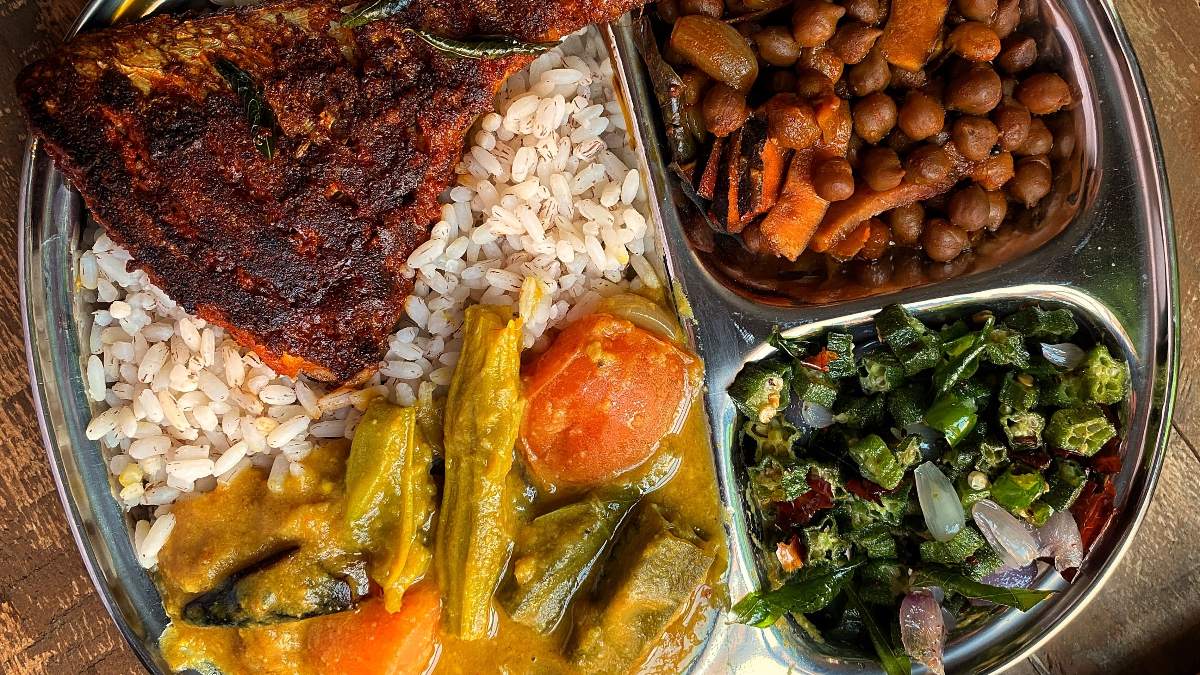
Everyday Kerala food is simpler: rice, including red matta rice in many homes, a curry, a thoran and perhaps moru. In coastal households, fish curry and rice may be just as familiar.
What belongs to the feast are the fried banana chips, sharkara varatti (jaggery-coated banana chips), pappadam and, above all, the second and third payasams.
Kaalan and pulissery are prepared with curd, but heating during cooking may inactivate their live cultures. Other curd-based preparations, such as some pachadis and kichadis, may retain cultures when curd is added without substantial heating. Fresh moru made from curd containing live cultures is a more predictable source.
For a closer look at the feast, including its culinary traditions, vegetable diversity and the science behind its gut-health reputation, read Is Onam Sadya Healthy for Your Gut? A Nutritionist Explains.
The South is wider than four plates.
Telangana has its own distinct food traditions, with jowar rotis, pulses and greens playing important roles, and sarva pindi, a spiced rice-flour preparation, a favourite snack.
Chettinad cooking, from southern Tamil Nadu, is known for its complex spice blends and its distinctive vegetarian and meat dishes, some prepared for special occasions and others enjoyed as everyday food.
Coastal Karnataka and Kerala build many everyday meals around fish curry and rice.
The same broad contrast appears across these traditions: the practical everyday meal shaped by local ingredients, and the feast that shows off.
The southern meal’s structure does a lot of quiet work: a pulse at the centre, a sharp tamarind or pepper note to balance richness, a range of vegetables, and often curd at the end.
Where it can slip is in portion balance, a large mound of white rice with small helpings of everything else, and in the salt of pickles and other accompaniments.
The feasts are worth every bit of their reputation, as long as they stay feasts.
If you borrow one thing from each leaf here, let it be Andhra’s pappu with greens, Tamil Nadu’s kootu, Karnataka’s kosambari and ragi, the sadya’s vegetable range, and the curd rice or buttermilk that closes so many southern meals.
Disclaimer: This article is intended for general educational purposes and does not constitute medical advice or a personalised diet plan. If you’re adding more pulses, millets or raw salads than you’re used to, increase them gradually and drink adequate fluids, since a sudden increase in fibre can cause gas or bloating. Prepare raw ingredients hygienically and consider cooked versions of pulse salads for people with particular food-safety vulnerabilities. Individual tolerance to dairy, spices and other ingredients varies. If you’re managing a digestive condition or following a medically prescribed diet, consult your doctor or qualified dietitian before making significant dietary changes. Persistent or recurring digestive symptoms warrant medical evaluation. Blood in the stool, unexplained weight loss, severe or persistent abdominal pain, or difficulty swallowing require prompt medical attention.
A traditional South Indian thali is a meal featuring rice or another regional staple, dal or pulse-based preparations, vegetables, curries and accompaniments such as rasam, chutney, pickle, curd or buttermilk. Festive meals are often served on banana leaves. The dishes and serving traditions vary across Andhra Pradesh, Tamil Nadu, Karnataka, Kerala and Telangana.
Rasam is traditionally treated as a digestive, and many South Indian homes serve it to anyone feeling unwell. That reputation rests on tradition rather than firm clinical research. Its warm, broth-like consistency and distinctive spices make it a comforting part of many meals, but it shouldn't be treated as a remedy for digestive disorders.
It can be part of a gut-friendly diet. Made with fresh curd containing live cultures and mixed into rice that has cooled rather than being piping hot, curd rice can retain those microorganisms. It also provides nutrients from both rice and curd. Individual tolerance varies, particularly among people who have difficulty digesting dairy.
A traditional Kerala feast, often served on a banana leaf at Onam, Vishu and weddings and eaten by hand. It can include two dozen dishes or more: rice, parippu, sambar, vegetable preparations such as avial, thoran and olan, pickles, pappadam, payasam and buttermilk. The menu and serving sequence vary by region and occasion.
Not necessarily. Spicy food affects people differently. Some people, especially those prone to acid reflux or digestive discomfort, find very hot meals uncomfortable. If that's you, go easy on the pickles and spiciest preparations, and enjoy milder dishes such as pappu and curd according to your tolerance.
Neither is simply better. They offer different nutrients, and their fibre content depends on the variety, processing and preparation. Eating both, along with other grains, is a way to introduce variety. If ragi is new to you, start with a small portion of mudde or a ragi rotti and see how your stomach responds.