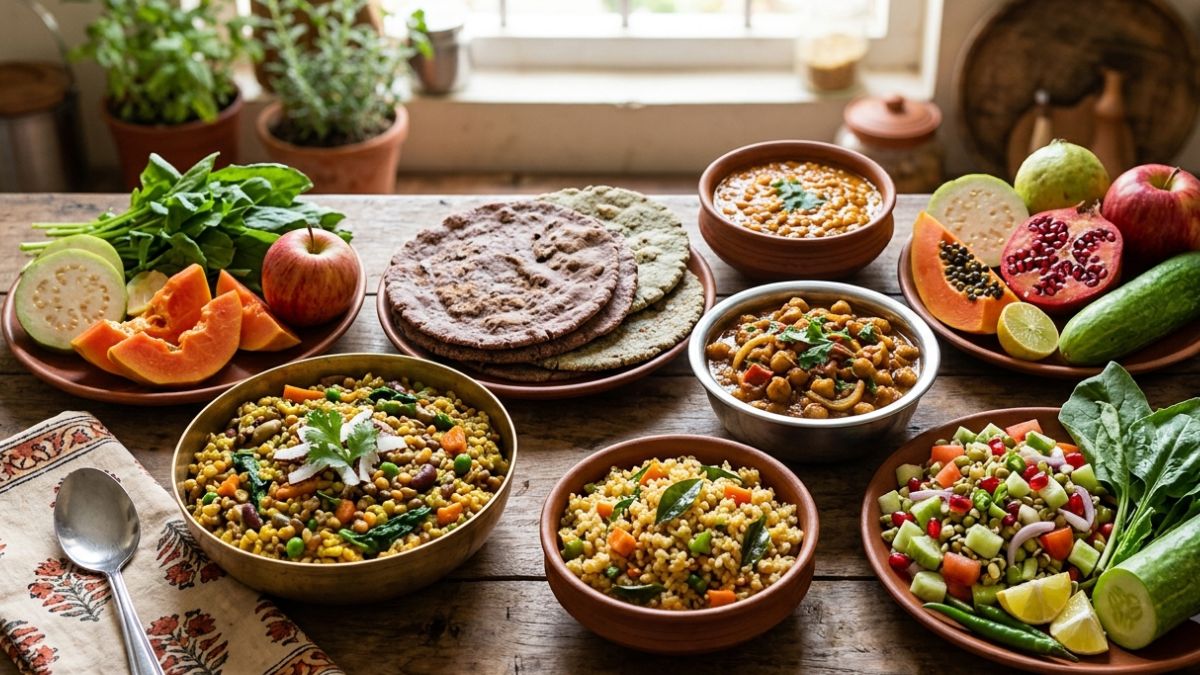
Fibre-Rich Foods in India: Where Your Fibre Should Actually Come From
Where should your daily fibre come from? Explore the Indian foods that do the heavy lifting, from dal and vegetables to fruits, whole grains and millets.
Table of Contents
Where should my fibre actually come from? Not from a supplement aisle — from your existing Indian plate, which is already better-designed for fibre than most diets in the world. Dal, vegetables, whole grains, fruits: the architecture is already there. The question is usually whether these foods are showing up in enough quantity, and enough variety, at enough meals.
Meet Kavitha. She was told by her doctor to eat more fibre, so she bought a bag of psyllium husk and started taking it every morning. Her digestion improved slightly, but not dramatically. When she mentioned this to a nutritionist friend, the friend asked her what her typical lunch looked like. Kavitha described it: rice, a small helping of dal, maybe a sabzi if she had time. “How much dal?” “One small katori.” “And the sabzi?” “A couple of spoonfuls.”
That’s your fibre gap, said the friend. Not a missing supplement. A missing meal.
ICMR-NIN guidelines for Indian adults recommend about 40g of fibre a day. Most Indian adults get significantly less — not because good fibre sources are rare or expensive, but because the portions have shrunk and the refined-food proportion has grown. The architecture of a traditional Indian meal is genuinely fibre-friendly. It’s the execution that tends to drift.
Psyllium husk is fine — it works — but it’s a supplement, meaning it’s filling a gap that could also be filled by eating the meal properly. Starting with the plate is almost always more useful, more satisfying, and cheaper.
Fibre comes from different parts of the plate, and each source brings a different profile. Here’s where to actually look:
Dal and pulses: One of the reasons traditional Indian meals are smarter than most people give them credit for. Dal doesn’t just add protein and flavour — it contributes meaningful fibre, especially whole pulses. Chana, rajma, whole moong and kala chana are among the most fibre-rich everyday Indian foods you’ll find. Kavitha’s one small katori of dal wasn’t doing what a proper bowl of dal could do.
Vegetables: This is where most Indian plates quietly fall short — not because we don’t eat vegetables, but because the portion is often too small to move the needle. A couple of spoonfuls of sabzi contributes very little. Vegetables need to be a meaningful part of the plate, not a garnish. The more variety, the better — different vegetables contribute different types of fibre.
Fruits: Not all fruits contribute equally on fibre. Guava stands out — at 8.59g of fibre per 100g, it’s one of the highest-fibre fruits you’ll routinely find at an Indian roadside stall. Amla comes in at 7.75g per 100g. Bananas, pears and apples are solid mid-range options. The point isn’t finding the single best fruit — it’s making fruit a regular habit.
Whole grains: Switching from maida to whole grain is one of the simplest swaps on the plate. Aashirvaad Namma Chakki 100% Khapli Atta provides around 11.4g of fibre per 100g, on par with other whole wheat attas and well ahead of refined flour. Three Khapli rotis a day contribute roughly 10.3g of fibre — about a quarter of the ICMR recommendation, just from the atta.
Millets: Bajra (11.49g per 100g), ragi (11.18g) and jowar (10.22g) are all roughly comparable to whole wheat on fibre — not magic, just good variety. ICMR suggests millets can ideally make up 30–40% of your daily cereal intake, which is less about eating only millets and more about making sure they show up regularly.
Your stomach doesn’t eat nutrients — it eats meals. A practical fibre-friendly plate doesn’t need powders or anything exotic. It looks something like: a generous portion of vegetables, a proper serving of dal or another pulse-based dish, a whole grain or millet, some fruit during the day, and adequate water.
Kavitha’s revised lunch: a full bowl of rajma, a proper serving of sabzi, two rotis with whole wheat atta, and a guava in the afternoon. She didn’t need the psyllium husk after a couple of weeks of eating this way. Her plate had been the answer all along.
Before changing your diet, spend three days observing it. At lunch and dinner, check:
You don’t need a perfect score every time. The goal is to spot the pattern. If three or four of these boxes are consistently empty across most meals, you’ve found where your fibre is going missing.
Dal, veg or whole grains today? A quick tick in your Symptom Log takes ten seconds and starts to show a pattern surprisingly quickly.
“Here’s everything I ate today. Can you scan my plate and tell me where my fibre is coming from, what’s missing, and which simple Indian-food swaps might help me build a more fibre-friendly plate?”
When it comes to fibre, the answer is rarely in a supplement aisle. It’s already on the Indian plate: vegetables, fruits, dal, pulses, whole grains, millets. The question isn’t whether fibre-rich foods exist in Indian cuisine — they’re everywhere. It’s whether they’re showing up in enough quantity, and with enough variety, at enough of your meals.
Disclaimer: This article is for general informational purposes only — not medical or dietary advice.
The highest-leverage changes are usually: making dal a proper serving rather than a small accompaniment, adding more vegetables to existing sabzi dishes, and switching from maida to whole wheat or a millet-based atta. None of those requires new recipes or new ingredients.
Food first, almost always. Psyllium husk works, but it’s filling a gap your plate could also fill — with the added benefits of protein, micronutrients and variety. Supplements are useful when the food approach isn’t enough or isn’t practical, not as a first resort.
Reasonably regular, comfortable bowel movements are the most practical indicator. If stools are consistently hard, if you strain, or if you feel like you haven’t fully emptied, those are signs fibre (and water) might need to go up. Scanning your plate using the questions above often reveals the gap quickly.