Quick Summary
Across much of western India, the everyday plate brings together a roti or bhakri, dal or another protein-rich preparation, rice, vegetables, and often a salad or buttermilk. On the coast, fish curry and rice are just as familiar. The festive plates show what’s worth borrowing: Gujarat’s chaas, millet rotlas and steamed or cooked farsan; Maharashtra’s koshimbir, sprouted usal and jowar bhakri; and Goa’s vegetable-rich khatkhatem and kokum-soured curries.
The fried farsan, ghee-rich puran poli and elaborate spreads of sweets have their place at celebrations. The everyday traditions offer their own lessons in grains, pulses, vegetables and flavour.
Reading a Western Meal
Ask what people in Ahmedabad, Pune or Margao ate for lunch today, and many answers will share a shape, even if the details differ. A flatbread, perhaps wheat, perhaps millet. Dal and rice. A vegetable. Some raw salad. On the coast, fish curry and rice. And in many homes, a glass of buttermilk.
It’s a plate that can work well for the gut: a pulse for protein and fibre, vegetables for variety, and buttermilk that, when made from fresh curd containing live cultures, can carry those microorganisms.
The regional differences come out at celebrations: the famous Gujarati thali with its endless refills, a Maharashtrian wedding meal served in rows, a Goan festive table. That’s where each region lays out everything it cooks well.
None of these is necessarily how people eat on a Monday, and it wouldn’t be fair to judge them as though they were. A feast is meant to be generous.
So this piece reads each as a map, asking three questions: what the everyday foundation looks like, what’s worth borrowing, and what belongs to the feast.
It doesn’t rank one state against another.
Gujarat: Farsan, Kadhi and Chaas
The Everyday Foundation
Everyday Gujarati food is built on dal, bhaat, shaak and rotli: dal and rice, a vegetable and thin wheat rotis. In Kathiawad and rural parts of the state, thick bajra rotlas often take the place of rotli, especially in winter. Khichdi with kadhi is a classic light supper. Chaas is a familiar accompaniment to meals.
The restaurant Gujarati thali lays all of this out and then some: several shaaks, dal and kadhi (often gently sweet and sour), rotli, rice, khichdi, farsan (savoury preparations such as dhokla and khandvi), pickles, papad, chaas, and a sweet that’s often eaten alongside the meal rather than saved for the end.
Worth Borrowing
- Chaas with meals. Thin, lightly spiced buttermilk made from fresh curd is one of the West’s simplest habits to borrow. When the curd contains live cultures, the drink can carry them too. It’s refreshing and easy to make at home, although there’s no need to drink it after every meal for digestive health. For a closer look, read what changes when curd becomes buttermilk.
- Bajra rotla. Millet brings a different grain to a wheat-heavy week, and the traditional pairing — rotla with a vegetable, garlic chutney and buttermilk — brings several familiar food groups into one meal. The overall balance depends on the portions, but it’s a good example of how ordinary regional food can offer variety.
- Steamed and cooked farsan. Dhokla is steamed, while khandvi is made by cooking a besan-and-curd mixture, spreading it thinly and rolling it. Both offer alternatives to deep-fried snacks. Traditional dhokla made from fermented batter undergoes changes during fermentation, but steaming generally inactivates the live cultures. Instant dhokla may not be fermented at all. Neither should automatically be treated as probiotic food.
- Sprouted pulses and kachumber. Sprouted moong, thoroughly cooked, and a fresh kachumber of onion, tomato and cucumber bring pulses and vegetables to the plate. Sprouting can change some of a pulse’s nutritional characteristics, while cooking reduces the food-safety risks associated with raw sprouts.
- Khichdi-kadhi. The traditional supper of rice and lentils with kadhi is comforting and easy to make with familiar ingredients. The dal contributes protein, while the final nutritional balance depends on the proportions and preparation.
What Belongs to the Feast
Fried farsan such as fafda and gathiya, puris, and sweets like shrikhand, basundi and mohanthal all have a place at celebrations.
So does undhiyu, the magnificent winter mixed-vegetable preparation that’s particularly associated with festive meals. Traditional versions can be generous with oil, particularly when fried muthiyas are included, although lighter preparations are possible. Its abundance of seasonal vegetables is worth appreciating in its own right.
The gentle sweetness in everyday Gujarati dal and kadhi is part of the cuisine’s characteristic flavour balance. Some households add only a little jaggery or sugar; others prefer a sweeter preparation. It’s simply worth being aware of how added sugar contributes to the meal overall, without treating a traditional flavour preference as something that needs fixing.
Maharashtra: Varan Bhaat, Bhakri and Koshimbir
The Everyday Foundation
The everyday Maharashtrian plate pairs poli (wheat roti) or bhakri (flatbread made from jowar, bajra or, on the coast, rice) with varan or amti (dal), rice, a bhaji (vegetable), a koshimbir (raw salad), a chutney and sometimes taak (buttermilk).
The festive meal, traditionally served to guests seated in rows, often opens with varan bhaat, plain dal and rice with a spoonful of ghee and a squeeze of lime, before moving on to masale bhaat, vegetables, koshimbir, puris and sweets.
Worth Borrowing
- Koshimbir. A raw salad of cucumber, carrot or tomato, often with crushed peanuts and sometimes a little curd, is a familiar feature of Maharashtrian meals. It’s a simple way to get fresh vegetables onto the plate.
- Bhakri. Jowar and bajra bhakri bring millets into the everyday meal, and they pair naturally with a vegetable and a dry chutney. Different grains have different nutrient profiles, so there’s a good case for eating more than one rather than declaring a single grain the healthiest. Our guide to jowar, bajra and ragi looks at what each brings to the kitchen.
- Usal. Sprouted pulses, especially matki (moth beans), cooked into a spiced curry. Sprouting changes the pulse, while thorough cooking makes it safer to eat and may improve tolerance for some people. It’s an easy way to put pulses at the centre of a meal.
- Seed and nut chutneys. Dry chutneys made from peanuts, sesame or flaxseed (jawas) add a spoonful of extra protein, fat and flavour to a simple meal.
- Varan bhaat. Plain dal and rice with a little ghee and lime is one of the simplest, most comforting meals in the region. It can be a welcome choice when someone wants something plain, although individual digestive tolerance varies.
The Konkan Coast
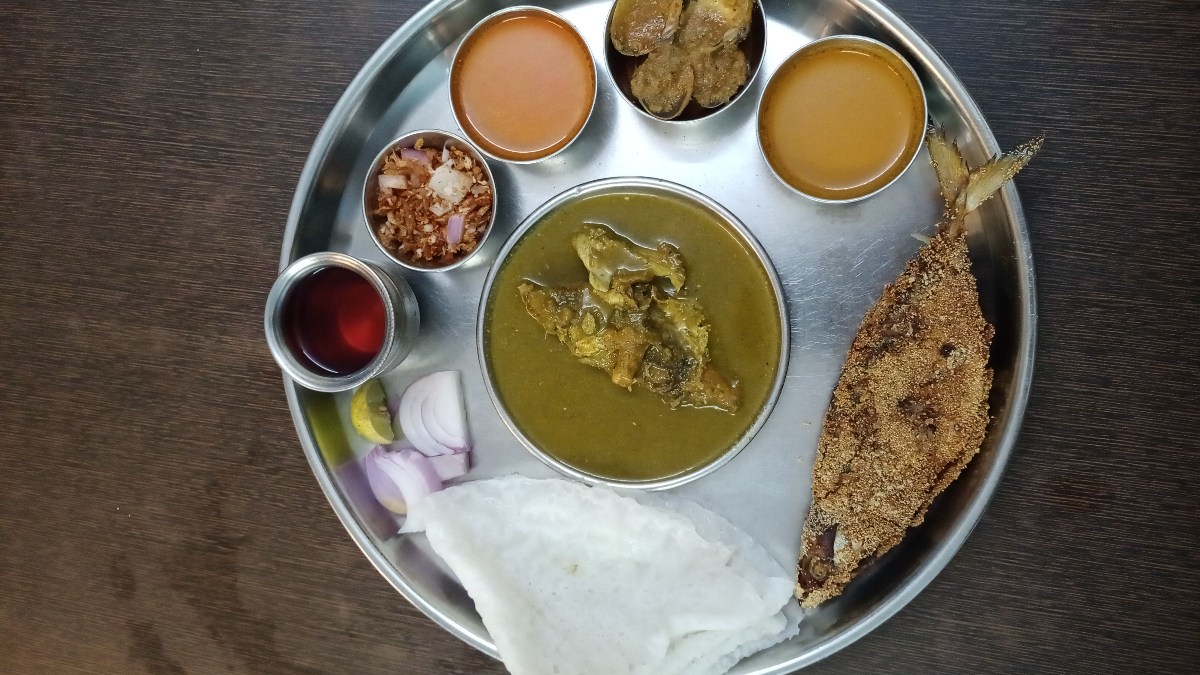
Along the Konkan coast, rice and fish curry take over, often soured with kokum and cooked with coconut.
Sol kadhi, a pink drink commonly made from kokum and coconut milk, often accompanies or follows the meal. It’s refreshing and traditionally considered a digestive, though those digestive effects aren’t firmly established by clinical research.
The familiar coconut-and-kokum version isn’t fermented, so it shouldn’t be counted as a probiotic drink. Some variations also include buttermilk, however, and may contain live cultures if the buttermilk is made from fresh curd and isn’t subsequently heated.
What Belongs to the Feast
Puran poli, a flatbread stuffed with chana dal and jaggery and often served with generous amounts of ghee, is one of the stars of Maharashtrian festivals.
Shrikhand with puri, masale bhaat, jalebi and basundi also feature in festive spreads. Some of these dishes are enjoyed on ordinary days too, but the full celebratory meal brings them together in a way everyday eating usually doesn’t.
Enjoy them at the celebration.
Goa: Curry, Rice and Khatkhatem
The Everyday Foundation
The Goan everyday meal is often summed up as curry and rice: a fish curry soured with kokum or tamarind and cooked with coconut, eaten with rice, a vegetable preparation and perhaps a pickle.
Vegetarian households and meals have their own traditions of dal, rice and vegetables cooked with coconut.
Worth Borrowing
- Khatkhatem. This mixed-vegetable stew, associated particularly with Goan Hindu weddings and Ganesh Chaturthi, is made with a variety of vegetables and a coconut-based masala. Depending on the household recipe, tamarind or kokum adds sourness, while tirphal, a fragrant regional spice, brings its distinctive character. It puts a remarkable range of vegetables into one pot, and it’s a festive dish that’s genuinely worth making on an ordinary day.
- Kokum and tamarind as souring agents. Sour flavours balance the richness of coconut-based curries, a principle that runs through much of western coastal cooking. They contribute flavour and contrast without needing to make any special digestive claims for them.
- Fish curry and rice. A simple coconut fish curry with rice and a vegetable can make a balanced everyday meal. As with all seafood, freshness, hygienic handling and thorough cooking matter.
What Belongs to the Feast
Goan festive food is varied and generous.
Catholic celebrations bring rich, slow-cooked pork dishes such as sorpotel and vindaloo, and bebinca, a layered dessert made with coconut milk, eggs, sugar and ghee.
Festivals across communities also bring sweets such as neureos and patoleo, the latter traditionally steamed in leaves.
All of these have a special place in Goan celebrations, alongside the simpler curries, rice and vegetable dishes that sustain everyday eating.
The Threads That Run Through All Three
Two things tie these plates together.
The first is buttermilk. It’s chaas in Gujarat and taak in Maharashtra, drunk plain or spiced with roasted cumin, ginger and curry leaves, and it turns up at lunch across much of the region.
Fresh buttermilk can be a refreshing drink in the heat and, when made from curd containing live cultures, can carry those microorganisms. Neither the drink nor the cultures are a guaranteed digestive remedy, but the tradition is an easy one to adapt wherever dairy suits you.
The second is sourness.
Kokum, tamarind, lime and raw mango sharpen dals, curries and chutneys all along the western coast and inland. Sour notes balance richness, whether it’s coconut in Goa, peanuts in Maharashtra or a little jaggery in Gujarat.
And they make a simple plate of dal and rice taste complete without necessarily needing a rich sauce or extra fat.
It’s a principle worth carrying into any kitchen: when a meal feels too rich in flavour, something sharp can provide a welcome contrast.
Beyond These Three
The West is wider than three plates.
Kutch and Saurashtra have their own millet-rich food traditions. Vidarbha, in eastern Maharashtra, is known for fiery Saoji curries.
And the Parsi community’s wedding feast, the lagan nu bhonu, traditionally served on banana leaves and featuring dishes such as patra ni machhi (fish coated in green chutney, wrapped in a banana leaf and steamed), is one of the West’s great ceremonial meals.
The same broad contrast runs through these traditions: a practical everyday meal shaped by local ingredients, and a feast that shows off.
What the West Teaches
- Enjoy fresh chaas or taak with meals, if dairy suits you, without treating them as compulsory digestive aids.
- Put a fresh salad on the plate regularly, the way koshimbir and kachumber do.
- Vary your grains: wheat, bajra, jowar and rice bhakri.
- Include sprouted pulses now and then, the way usal does, and cook them thoroughly.
- Choose steamed or otherwise non-fried farsan when you want an alternative to fried snacks.
- Enjoy the fried snacks, puran poli and sweets as part of celebrations, remembering that portions and overall dietary balance matter more than labelling individual foods good or bad.
The Honest Takeaway
The western plate’s strengths are the small things that come with everyday meals: a glass of buttermilk, a raw salad, a millet flatbread, sprouted pulses and a steamed snack.
Where the balance can slip is in the sweetness that runs through some everyday dishes and the fried snacks that are always close at hand. But the sweetness is part of the region’s flavour traditions, and the same recipes can be prepared in different ways.
The feasts are worth celebrating, as long as they don’t become the only picture of how a region eats.
If you borrow one thing from each plate here, let it be Gujarat’s chaas and rotla, Maharashtra’s koshimbir and usal, and Goa’s khatkhatem.
FAQs
What is a traditional Western Indian thali?
A traditional Western Indian thali varies across Gujarat, Maharashtra and Goa. It may include wheat or millet flatbreads, rice, dal, vegetables, salads, chutneys and buttermilk. Coastal meals often feature fish curry and rice. Festive versions bring additional snacks, elaborate preparations and sweets.
Is the Gujarati thali healthy?
An everyday Gujarati meal of dal, rice, vegetables, rotli or rotla and chaas can provide a balanced mix of food groups. A restaurant or festive thali may also include fried farsan, puris and sweets. Its nutritional quality depends on the ingredients, cooking methods and portions, rather than whether it is Gujarati.
Is dhokla good for the gut?
Dhokla is steamed rather than deep-fried, and traditional versions made from fermented batter undergo changes during fermentation. Instant dhokla may not use fermented batter. Steaming generally inactivates live microorganisms, so neither version should automatically be considered probiotic. Dhokla can still be part of a varied diet.
Is sol kadhi probiotic?
The common sol kadhi made from kokum and coconut milk isn't fermented and should not be considered a probiotic food. Some variations include buttermilk made from curd containing live cultures, but that doesn't automatically establish a clinically proven probiotic benefit. Sol kadhi is best enjoyed as a traditional accompaniment.
Is jowar bhakri better than wheat roti?
Neither is simply better. Jowar and whole wheat offer different nutrient profiles, and both can contribute fibre to the diet. Eating a variety of grains is a practical approach. If jowar is new to you, start with a small portion and increase it according to your tolerance.
What is Goan khatkhatem?
Khatkhatem, also called khatkhate, is a traditional Goan mixed-vegetable preparation associated with festive occasions, particularly Ganesh Chaturthi and Hindu wedding meals. It commonly uses several seasonal vegetables, coconut and regional spices, including tirphal in some recipes. Sourness may come from kokum or tamarind, depending on the family tradition.
Why is Gujarati dal sweet?
A little jaggery or sugar balances sour ingredients such as kokum, tamarind or lemon in many Gujarati dals and kadhis. The level of sweetness varies by household and recipe. It's a familiar part of the cuisine's flavour balance, although added sugar still contributes to total daily intake.