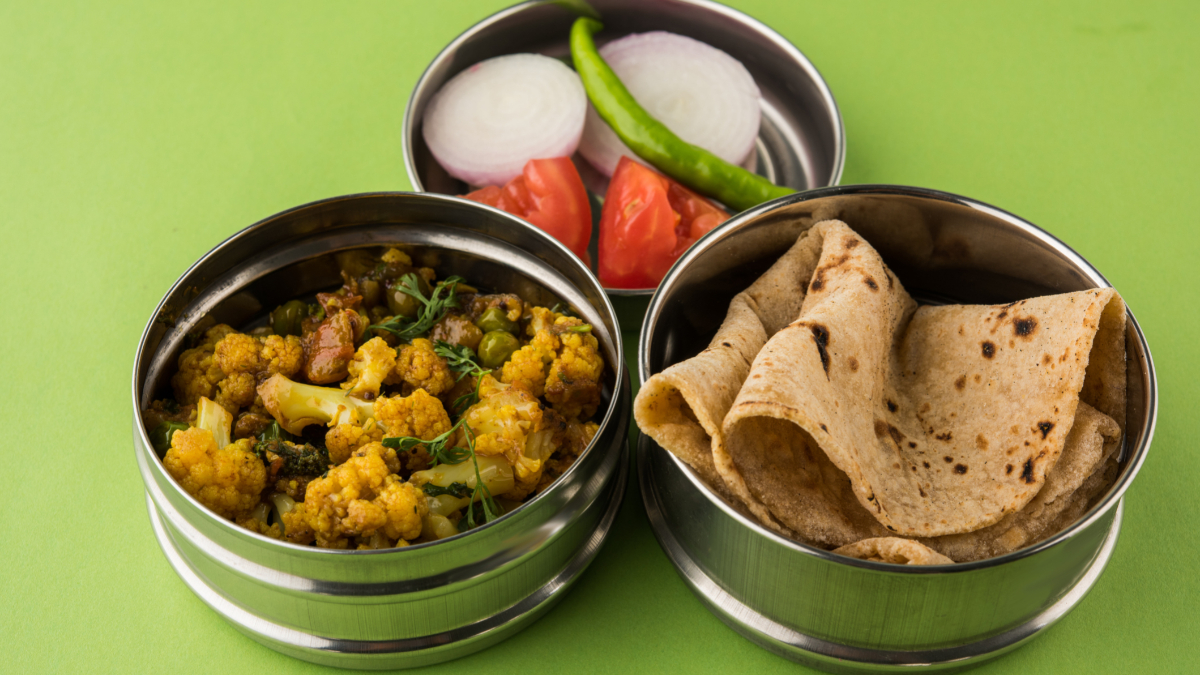
Three Dry Sabzis That Survive a Tiffin Box
The secret to a good tiffin sabzi is texture that lasts until lunch — and safe packing that does not leave cooked food warm for hours.
Table of Contents
For a dry sabzi that still tastes good at lunchtime, try bhindi ki sukhi sabzi, gawar phali with hing, or South Indian-style cabbage and carrot. The trick is to cook off excess moisture, use vegetables that hold their texture, and pack accompaniments separately. But “dry” does not mean shelf-stable: if the cooked sabzi must travel for several hours, keep it chilled below 5°C or reliably hot above 60°C rather than leaving it warm in an ordinary lunchbox.
Most recipe advice assumes food goes from stove to plate. A tiffin box breaks that assumption in a specific way: the sabzi is cooked at seven and opened at one. Between those two moments, steam can soften vegetables, a loose gravy can soak the rotis, and bhindi cooked carelessly can turn slimy. A dish that tastes excellent at dinner may be disappointing at lunch.
There is a practical nutrition angle, too. A sabzi that arrives unappetising gets half-eaten or skipped, and the fibre you carefully packed goes in the bin. Vegetables can contribute to daily fibre alongside dals, fruit and whole grains. There is no single 40g-a-day target for every Indian adult: ICMR-NIN recommendations vary with sex and activity. The aim here is simply to make everyday vegetables worth eating at lunchtime.
Texture and safety are separate jobs, however. A dry preparation may travel more neatly than a gravy, but cooked vegetables still need safe temperature control. Keep that in mind before choosing the recipe or the lunchbox.
Do not leave a cooked lunch on the counter to cool for hours, and do not assume it is safe because it still smells fine. If cooked food cannot be temperature-controlled, plan to eat it within two hours rather than relying on a five- or six-hour gap.
Bhindi is the classic tiffin sabzi and the one most often ruined. Its natural mucilage, a mixture of viscous plant polysaccharides, is what gives cut okra its slippery texture. Surface water helps the mucilage spread; cutting and heating release some of it anyway. Drying the pods well and cooking uncovered can keep the finished dish pleasantly dry.
1. Wash the bhindi first, then dry it thoroughly before cutting. Every grandmother who insisted on wiping each pod individually was onto something useful: less surface water means less slippery mucilage spreading around the pan.
2. Trim and cut into roughly 1-inch pieces. Heat the oil in a wide kadhai, add jeera and let it sizzle, then add the bhindi.
3. Cook uncovered over medium-high heat, stirring occasionally, until much of the surface moisture has evaporated and the pieces are beginning to brown. Allow roughly 8–12 minutes, adjusting for your pan, pod size and batch.
4. Add the sliced onion and continue cooking uncovered until the onion softens and the bhindi is fully tender and lightly browned. Add haldi, dhania, chilli powder and salt towards the end; stir well.
5. Finish with amchur for a brighter flavour, then switch off. Adding it at the end keeps the process simple and the cooking stage dry.
Packing note: spread the sabzi briefly in a shallow container to release steam, then chill promptly if it will not be eaten soon. A wide pan helps this recipe more than a rigid timer does.
Cluster beans bring texture and fibre to an ordinary Indian lunch. Hing and ajwain are traditional partners for beans and lentils, but tradition is not the same as proof that they prevent gas. Keep them for their flavour and use a comfortable portion if beans tend to make you bloated.
1. Parboil the gawar in lightly salted water until just tender, roughly 6–8 minutes depending on thickness. Drain thoroughly. If using potato, keep the dice small and even so they cook through.
2. Heat the oil, add jeera and ajwain and let them sizzle. Stir in the hing briefly without letting it burn.
3. Add the diced potato, if using, and cook over medium heat until it is nearly tender, stirring as needed. This may take longer than five minutes; check a piece with a knife rather than relying on its browned edges.
4. Add the well-drained gawar, haldi, dhania powder and salt. Cook uncovered, stirring as needed, until any residual moisture evaporates, the beans are fully tender and the potato is cooked through.
5. Finish with amchur and adjust the seasoning.
Indian kitchens have used hing and ajwain with beans, lentils and cabbage for generations, often on the understanding that they make these foods more comfortable to eat. They are traditionally used as carminatives, but good human evidence that the amounts used in a sabzi reliably prevent gas is limited. They are welcome for flavour; you do not need to promise them a medical result.
Packing note: if potato is included, treat the finished dish like any other cooked lunch. Cooling may change the starch, but it does not make the sabzi safe to hold at room temperature for hours.
Fast, inexpensive and pleasantly crisp when you do not overcook it. Cabbage can produce gas in some people; cooking changes its texture and may make it more comfortable for some, but it does not prevent symptoms in everyone. If cabbage reliably disagrees with you, use another vegetable.
1. Heat the oil in a wide pan, add mustard seeds and let them pop.
2. Add the urad dal and fry until light golden. Add the hing, chillies and curry leaves, taking care around the spluttering oil.
3. Add the cabbage, carrot and salt. Cook uncovered over medium-high heat, moving towards high only if your pan and hob can take it. Stir frequently until the vegetables are cooked but still have a little bite. Allow roughly 6–10 minutes and adjust to the quantity and pan.
4. Switch off. If you are using fresh coconut, fold it through only when the dish can be kept properly chilled until lunch.
Packing note: fresh coconut adds flavour but makes careful chilling especially important. Omitting it does not make the cooked cabbage safe to leave warm for half a day; the entire lunch still needs temperature control.
One small scientific aside: cooking and safely chilling some starches, such as rice and potato, can increase resistant starch through retrogradation. The amount varies with preparation and cooling conditions. That is not a reason to leave rice, potatoes or cooked sabzi on the counter. Refrigerate promptly, then transport them cold or keep them reliably hot.
A sabzi on its own is not always a full lunch. What goes alongside it can make the box more filling and varied, without adding another elaborate cooking project.
A tiffin with a sabzi, a grain, something with protein and, where practical, fruit or another vegetable is an easy template. The exact combination matters less than making one you can cook, carry safely and actually enjoy.
A good tiffin sabzi is not a compromise version of a proper one. It is a dish designed around a different constraint. Keep excess moisture out of the pan, cook the vegetables until they are genuinely done, and pack the accompaniments separately. Bhindi, gawar and cabbage-carrot all make good candidates for a lunch that still tastes like lunch.
The one part that cannot be negotiated is storage. Texture can survive a long day; cooked food should not spend that day warm in a sealed box. Get the temperature right, and the food has a much better chance of arriving both appealing and safe.
This article provides general cooking and nutrition information, not medical advice. Individual tolerance of fibre-rich vegetables varies. Increase fibre gradually and drink enough fluids. If digestive symptoms are persistent, severe or repeatedly linked to particular foods, consult a qualified healthcare professional. Follow current food-safety guidance whenever cooking, refrigerating and transporting packed meals.
• FSSAI. Food Safety at Home — safe temperatures and storage.
• WHO. Five Keys to Safer Food — cooked food, two-hour rule and safe temperatures.
• USDA FSIS. Keeping Bag Lunches Safe — ice packs and insulated lunch bags.
• Dantas et al. Okra as a source of mucilage and bioactive compounds. Plants (2021). • Sonia et al. Effect of cooling cooked white rice on resistant starch. Asia Pac J Clin Nutr (2015).
They may hold their texture for several hours, but food safety depends on temperature. For a five- or six-hour gap, use a refrigerator or an insulated bag with enough ice packs to keep the food below 5°C, or a container that reliably keeps it above 60°C. Cooked food should not sit at ordinary room temperature for more than two hours; in very hot conditions, be more cautious. Smell and taste cannot reliably tell you whether it is safe.
Okra naturally contains mucilage that is released when the pods are cut and cooked. Surface water makes it spread more readily. Dry the pods before cutting, use a wide pan and cook uncovered so moisture can escape.
It can for some people, though tolerance varies. Cooking changes the texture and may help some people feel more comfortable, but hing or any particular cooking method cannot guarantee a gas-free meal.
It is better to prep ingredients ahead and cook fresh when possible. If you cook a batch, chill it promptly in shallow containers, keep it refrigerated and use it within an appropriate short storage window. Do not keep a Sunday batch of cooked vegetables unrefrigerated or rely on reheating food that was stored unsafely.
No. It adds a familiar taste and texture but the recipe also works without it. If you use potato, cut it into small even pieces and make sure it cooks through before packing.
Cooling cooked starch under safe refrigerated conditions can increase resistant starch, but the change varies and does not turn a lunchbox into a health treatment. Safe cooling and temperature-controlled storage matter much more than chasing this effect.