C-Drama Food Has Us Hooked. How Gut-Friendly Is It?
The food can be as compelling as the romance—and in Pursuit of Jade, it is part of the story itself. Happy Tummy looks beyond the craving to ask what these screen favourites actually offer your gut.
C-drama food has a way of becoming part of the obsession: the bubbling hot pot, bedside congee, baskets of dumplings, bright bowls of paocai and inevitable bubble tea order. But how gut-friendly are these screen favourites? It depends on the dish. Paocai is fermented but not automatically probiotic. Hot pot can bring plenty of vegetable variety, although broth, sauces and food safety matter. Congee can feel gentle without being a treatment. Dumplings are only as balanced as their filling and cooking method. Bird’s-nest soup has limited human evidence, while bubble tea remains a sweet drink rather than a gut-health food.
That does not mean every beautiful bowl needs a nutritional defence. Fans are allowed to want what they see on screen. Happy Tummy’s question begins when the craving leaves the frame and reaches your table: what does each food actually offer, and where do the health claims run ahead of the evidence?
Food does a great deal of emotional work in a C-drama. A palace banquet can reveal rank without a line of dialogue. A shared hot pot can soften the distance between people. A bowl of congee left by a bedside can say what a character cannot.
In Pursuit of Jade, Fan Changyu’s butcher-shop world makes food part of work, survival and care rather than glossy set dressing. That is screen food at its best: not a nutrition lesson, but a way of showing who has enough, who is looking after whom and what home means.
C-Drama Food at a Glance: What Helps and What Does Not
Food
What it may offer
What changes the picture
Honest verdict
Paocai
Fermented vegetables and, in some batches, live lactic-acid bacteria
Microbes, salt, fermentation method, storage and serving
Fermented, but not automatically a proven probiotic
Hot pot
A wide variety of vegetables, mushrooms, tofu and protein
Broth, sauces, ingredient balance and raw-food handling
Can be a varied meal; the format alone does not make it gut-healthy
Congee
A soft, mild rice porridge that some people find easy to eat
Toppings, portion and the rest of the meal
Comforting for many, but not a digestive treatment
Dumplings
A flexible combination of wrapper and filling
Filling, cooking method, portion and dipping sauces
Judge the dumpling in front of you, not the category
Bird’s-nest soup
Cultural value and an unusual mix of proteins and glycoproteins
Limited human evidence, sourcing and allergy risk
Tradition is established; gut-health benefits are not
Bubble tea
Enjoyment—and sometimes tea or milk
Sugar level, cup size, creamer and toppings
Best understood as a sweet drink, not a gut-health food
Is Paocai a Probiotic?
Not automatically.
Paocai is a family of Chinese fermented vegetable foods, often made by submerging vegetables in seasoned brine. During fermentation, microbes—including lactic-acid bacteria—can turn sugars in the vegetables into acids that help create paocai’s characteristic sour flavour.
That makes paocai a fermented food. It does not, by itself, make every jar a probiotic food.
A probiotic must contain identified live microorganisms in an adequate amount and have evidence of a health benefit. A homemade or commercially fermented food may contain living bacteria without meeting all three conditions. The organisms can also vary from one batch to another, and some products are heat-treated before sale.
A 2019 study comparing 27 mature paocai samples with 18 Chinese spicy-cabbage samples found some overlap in lactic-acid bacteria, but differences in the dominant bacterial groups. Paocai and kimchi may both be fermented vegetables, but they are not the same food and the terms should not be used interchangeably.
Another study tested a Lactobacillus plantarum strain isolated from Sichuan paocai in mice with constipation-related changes. That is early, strain-specific animal research. It does not show that eating a usual serving of paocai prevents or treats constipation in people.
Fermentation Time Alone Does Not Prove a Batch Is Safe
Paocai’s safety and quality depend on more than the number of days in the jar. Ingredients, salt concentration, temperature, oxygen exposure, hygiene and the microbes that take over the fermentation all matter. Research also shows that nitrite levels can change during fermentation and that spoilage organisms can affect both quality and safety.
For packaged paocai, follow the storage and use instructions on the label. For homemade paocai, use a tested recipe and sound fermentation hygiene rather than judging readiness by time alone. Discard a batch if it shows signs of spoilage.
Is Hot Pot Good for Gut Health?
Hot pot can make it easy to eat a genuinely varied meal. A table with leafy greens, mushrooms, lotus root, tofu, beans and a protein you enjoy gives you far more plant and ingredient diversity than the label ‘hot pot’ alone suggests.
It can also become a meal built mainly around fatty cuts of meat, processed meatballs, noodles, rich broth and salty dipping sauces. Neither version is inevitable. The ingredients do the nutritional work.
Spice deserves the same common sense. A chilli-heavy broth is not universally bad for digestion, but it can be uncomfortable for people who know that very spicy food triggers heartburn, loose stools or abdominal discomfort for them. Personal tolerance matters more than a blanket rule.
There is one part of hot pot that is not subjective: food safety. Keep separate chopsticks or tongs for raw and cooked food. Avoid letting raw ingredients touch ready-to-eat food. When fresh broth or raw ingredients go into the pot, let the liquid return to a full boil and cook the food thoroughly before eating it.
Is Congee Good for an Upset Stomach?
Congee is rice cooked with plenty of water until it becomes a soft porridge. Its mild flavour and texture may make it easier for some people to eat when their appetite is low or richer food feels unappealing.
That does not make plain congee a treatment, a probiotic food or a nutritionally complete meal. Plain white-rice congee is usually low in fibre and protein. Egg, tofu, shredded chicken, fish or well-cooked vegetables can make the bowl more substantial, depending on what feels tolerable.
The accompaniments matter too. Preserved vegetables, salted egg and generous spoonfuls of soy-based sauces can add plenty of sodium. The honest verdict is simple: congee can be comforting and practical, but it does not need a medical halo to earn its place at the table.
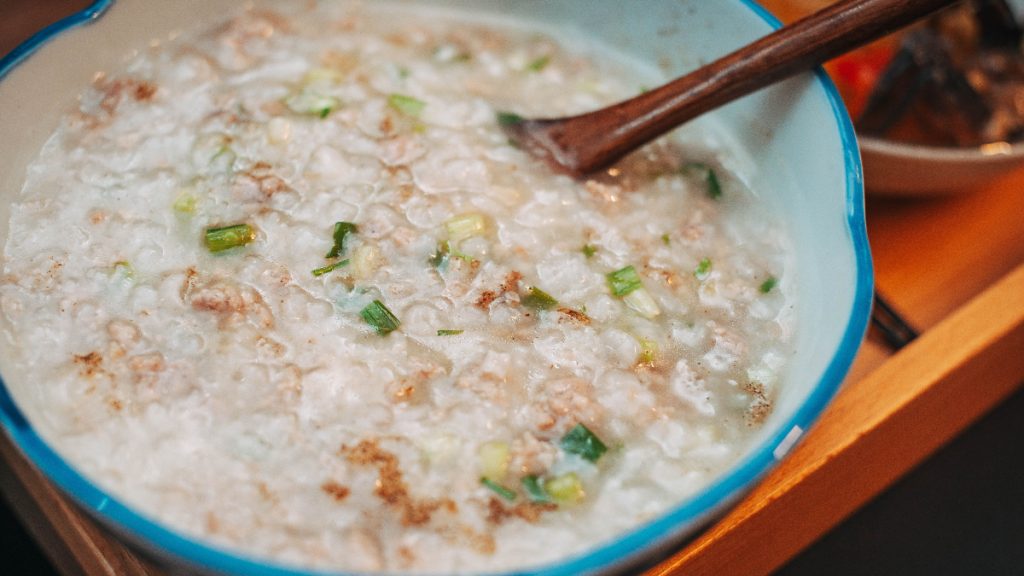
Congee often appears on screen as an expression of comfort and care. Plain congee is soft and low in fibre; its toppings and accompaniments can change the nutritional picture considerably. Image via PEXELS
Are Dumplings Healthy?
Dumplings are a format, not a fixed nutrition score. Jiaozi filled with cabbage and pork, vegetable dumplings, prawn wontons and sweet buns do not become nutritionally identical because dough surrounds them.
The filling decides how much vegetable and protein the dumpling contributes. The wrapper supplies mostly starch. Boiling, steaming or pan-frying changes the amount of added oil, while chilli oil and soy-based dipping sauces can change the overall sodium and fat in the meal.
A plate of dumplings can sit comfortably in a balanced diet. Look at the filling, cooking method, portion and what else is on the table instead of searching for a universal verdict.
Does Bird’s-Nest Soup Have Health Benefits?
Edible bird’s nest is made from the hardened salivary secretions of swiftlets and is traditionally prepared in sweet or savoury soups. It has a long cultural history and contains proteins, glycoproteins and sialic acid.
Those facts do not prove the sweeping claims sometimes attached to it. Much of the research on bird’s nest or its components comes from laboratory and animal studies. Human studies are limited, products and extracts vary, and there is no convincing human evidence that bird’s-nest soup improves gut health.
Quality control matters because contamination and adulteration have been reported in the wider bird’s-nest trade. Buy only from regulated, traceable sources and follow preparation instructions.
Allergy deserves equal attention. IgE-mediated allergic reactions, including anaphylaxis, have been reported after bird’s-nest consumption. Anyone who has reacted to it should avoid it and seek medical advice; facial or throat swelling, breathing difficulty, faintness or a rapidly worsening reaction requires urgent medical help.
Is Bubble Tea Bad for Gut Health?
Bubble tea is not one standard drink. It may contain brewed tea, milk, non-dairy creamer, flavoured syrup, fruit preparations and tapioca pearls in very different proportions.
Tapioca pearls are mainly starch and should not be treated as a meaningful source of fibre. Sugar can come from the tea base, syrup and toppings, so sweetness varies considerably between orders.
If you want a lighter order, choose a smaller cup, request less sugar and keep the number of toppings modest. If what you want is the full, sweet version, have it for enjoyment rather than asking it to perform as a gut-health drink. One drink does not need a moral verdict.
The Honest Takeaway
C-drama foods are compelling because they carry affection, status, memory and belonging. Their nutritional value still comes down to ordinary details: ingredients, preparation, portion, frequency, food safety and personal tolerance.
Paocai is fermented but not automatically probiotic. Hot pot can deliver variety but needs thoughtful ingredients and safe handling. Congee can feel gentle without being a treatment. Dumplings resist a single verdict. Bird’s-nest soup has more tradition than human gut-health evidence. Bubble tea is an enjoyable, customisable sweet drink.
The screen can tell you why a food matters to a character. The bowl in front of you tells you what it can offer your body.
Want to Put Your Own Meals Under the Same Lens?
Try this prompt in Happy Tummy GPT: ‘Can you help me sort the foods I regularly eat into fermented foods, proven probiotic foods and fibre-rich foods? Also suggest one realistic change.’
For a broader snapshot of your everyday digestive habits, you can also take the Digestive Quotient Test.
Disclaimer: This article is for general informational purposes only and is not a substitute for personalised medical or dietary advice. Individual tolerance, allergy risk and food-safety needs vary. If digestive symptoms persist or you suspect an allergic reaction, consult a qualified healthcare professional; seek urgent care for severe symptoms.
FAQs
Do pregnant women in China eat bird’s nest soup?
Some do, although it is not a universal practice. Edible bird’s nest has long been valued as a luxury tonic in Chinese food culture, and some families include it during pregnancy or postpartum. However, this is a cultural practice rather than a medical recommendation: high-quality human research has not established benefits for either the mother or baby.
Is bird’s nest soup believed to improve fertility?
Bird’s nest is sometimes promoted as an aphrodisiac or reproductive tonic, but that does not mean it helps people conceive—and this should not be presented as a universal Chinese custom. The fertility research commonly cited is largely laboratory or animal work; bird’s nest soup has not been shown to improve human fertility.
Do people in China eat congee for breakfast?
Yes. Congee—called zhōu in Mandarin and jook in Cantonese—is a common breakfast, particularly in Cantonese food culture. It may be eaten plain or with pickled vegetables, egg, fish, meat or youtiao. China’s breakfast traditions vary enormously, however, so congee is common rather than universal. In English, we would normally say people “eat a bowl of congee”, although a very thin preparation may be sipped.
Is Chinese congee the same as Indian kanji?
They are close relatives, not identical dishes. Chinese congee and South Indian rice kanji or ganji both belong to the broad family of soft rice-and-water porridges, although their grains, consistency, fermentation and accompaniments vary. Intriguingly, the English word “congee” ultimately comes from the Tamil kañci. But North Indian kanji—the fermented black-carrot or beet drink flavoured with mustard—is something entirely different.
Is Chinese hot pot healthy?
It can be. A hot pot rich in vegetables, mushrooms, tofu and a protein you enjoy can offer useful variety. Broth, sauces, processed ingredients, portion size and safe handling all affect the final meal.
Is bubble tea always high in sugar?
No, but many versions contain substantial added sugar from the drink base, syrup and toppings. Cup size, sweetness level and toppings can change the total considerably.
Is paocai the same as kimchi?
No. Both are fermented vegetable foods, but their ingredients, seasoning, production methods and dominant microbes can differ. They should not be treated as identical foods.
Is congee good for an upset stomach?
Plain congee is soft and mild, so some people find it easier to eat when appetite is low. It does not treat the cause of an upset stomach and is low in fibre and protein unless other ingredients are added.
You are now being directed to an external website https://www.callr.live/aashirvaadexperts/premium-plan.
This link is provided for your information and convenience only and ITC Limited is not
responsible for the contents or services provided by Brand Touch India or any information that
you share with Brand Touch India.