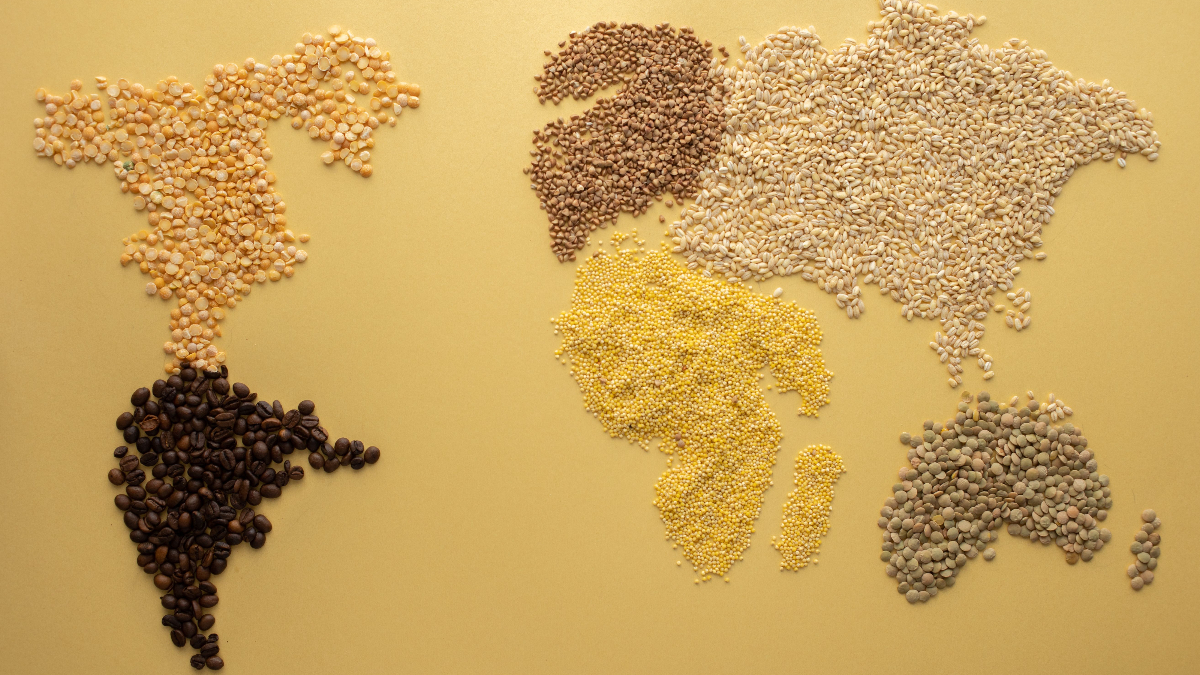
World Food Day 2026: Why Food Diversity Matters for Your Gut
World Food Day is usually about hunger, harvests and water, which feel a long way from your stomach. But follow the food system all the way down, and it ends in your gut.
Table of Contents
World Food Day falls on 16 October, and the 2026 theme is “Innovate today. Nourish tomorrow.” The gut connection is food diversity. What farms grow helps shape the range of grains, pulses, vegetables and other plants available to eat. Human research links greater plant variety in the diet with a more diverse gut microbiome, although this does not prove cause and effect. Bringing millets and other familiar plants into a varied diet is one practical place to start, alongside reducing food waste and protecting the diversity of our food supply.
Ask most of us what World Food Day has to do with our digestion and we’d probably shrug. It’s a day for big numbers: hunger, harvests, water, climate. And the numbers are big. In 2025, about 645 million people faced hunger, and 2.69 billion, nearly one in three people on the planet, couldn’t afford a healthy diet.
Those figures come from the UN’s Food and Agriculture Organization (FAO), and they describe problems with the whole food system rather than with anyone’s stomach. But your gut sits at the very end of that system. What farmers grow helps decide what reaches the market. What reaches the market helps decide what lands on your plate. And what lands on your plate influences what the microbes in your gut get to eat. So let’s follow the food all the way down.
World Food Day is marked every year on 16 October, the date the FAO was founded in 1945. This year’s theme is “Innovate today. Nourish tomorrow.”
When you hear “innovation”, you might picture drones over wheat fields or high-tech labs, and those are part of it. But the FAO’s list is broader. Alongside digital advice for farmers and better seeds, it names traditional ways of managing land and water, and recognises the knowledge of farmers, fishers, herders and Indigenous Peoples. Hold on to that idea. We’ll come back to it, because some of the most useful innovation for your plate may be very old.
Your gut is home to a large community of bacteria and other microbes, often called the gut microbiome. Some of the food they use is the part you can’t digest yourself. Certain types of dietary fibre, for instance, reach the large intestine, where microbes can ferment them.
Different plants carry different kinds of fibre and other compounds. That gives researchers a reason to investigate how plant variety relates to the variety of microbes in our guts, as the American Gut Project did. It also brings us back to the food system. You can only eat as varied a diet as your market, your ration shop, your budget and your kitchen habits allow. And in many places, the menu has narrowed.
Here’s the number that stops most people in their tracks. In its 2019 report on biodiversity for food and agriculture, the FAO reported that humans had cultivated more than 6,000 plant species for food. Fewer than 200 made major contributions to food production globally, regionally or nationally, and just nine accounted for about two-thirds of total crop production.
Think about what that means at the scale of a planet. A handful of staple crops, often grown in vast single-crop fields, supplies a large share of our food. That system has fed billions. But it puts a great many eggs in very few baskets, both for farms and for the variety of food that ends up on our plates.
India’s version of this story is written in jowar, bajra and ragi. For generations these millets were everyday staples across large parts of the country, from bajra rotis in Rajasthan to ragi mudde in Karnataka. Then the plate shifted.
A 2023 analysis by ICRISAT researchers, drawing on NSSO data, reported that rural Indians’ yearly sorghum (jowar) consumption fell by about 73% between 1991–92 and 2011–12, from roughly 10 kg to under 3 kg a person; in cities it fell by about 61%. It also reported that between 1990 and 2020, the area under sorghum shrank by 62% and the area under other millets by 36%. The authors estimated that millets and sorghum then made up about 6–7% of India’s staple diet.
Why? The researchers pointed to policies that promoted rice and wheat through minimum support prices and the public distribution system, alongside urbanisation, convenience and changing tastes. This isn’t a villain story: plentiful, affordable rice and wheat mattered for a country that needed to feed itself. But variety was part of the price.
There is a water story here too. A 2018 study in Science Advances found that rice was the least water-efficient of the cereals studied in India for producing key nutrients, particularly iron, zinc and fibre. In one district-level modelling scenario, replacing rice areas with alternatives such as millets, sorghum or maize reduced irrigation-water demand by 33% and increased iron production by 27%, with a modest reduction in calorie production. These were modelled changes in crop production, not the measured effects of swapping one meal.
On the plate, one difference shows up in fibre. Per 100 g of raw grain, the Indian Food Composition Tables 2017 list about 11.5 g for bajra, 10.2 g for jowar and 11.2 g for ragi, compared with about 2.8 g for raw, milled white rice. Cooked portions have different weights and nutrient concentrations, so these figures shouldn’t be applied directly to 100 g of cooked rice or roti.
Researchers are still working this out, so it’s worth being honest about what we know and what we don’t. The studies below examine diets and microbes; they don’t directly establish that a more concentrated global crop supply causes a less diverse human gut.
One useful piece of human evidence comes from the American Gut Project, a large citizen-science study. Participants reporting more than 30 different types of plants a week tended to have more diverse gut microbiomes than those reporting 10 or fewer. Plant variety was associated with microbial diversity beyond broad labels such as “vegan” or “omnivore”. That’s an observation rather than proof of cause, and it doesn’t establish 30 as a magic number or a clinical target.
A Stanford study in mice, published in Nature in 2016, adds a sobering twist. Mice given microbes from a human donor and then fed a diet low in fibre available to gut microbes lost microbial diversity. In the initial experiment, returning to a high-fibre diet brought only partial recovery. Across successive generations kept on the low-fibre diet, the losses compounded. By the fourth generation, a high-fibre diet alone could not restore many of the missing microbes; restoration required reintroducing microbes as well as fibre.
It’s a mouse study, so it can’t tell us that the same losses happen in people. But it raises an important question about what a persistently narrow diet might mean over time.
This is where the World Food Day theme gets interesting. Some of the ideas for nourishing tomorrow are old ones, brought back with fresh thinking.
Millets are the obvious example. The UN declared 2023 the International Year of Millets, and the FAO highlights their potential to grow in drylands and challenging conditions with relatively few inputs. Their suitability still depends on the crop and local growing conditions.
Closer to home, ICMR-NIN’s Dietary Guidelines for Indians (2024) recommend that at least half of the cereals eaten should be whole grains. They suggest millets can make up 30–40% of the recommended cereal quantity, measured by raw weight. That’s a share of cereals, not of everything on your plate. Not sure where to start? See which millet fits your kitchen.
Then there’s one of the oldest food technologies of all: fermentation. Idli and dosa batters, dhokla, kanji and home-set dahi turn everyday grains, pulses and vegetables into new foods, and Indian kitchens have been doing it for a very long time.
And there are the heritage grains and regional varieties that families and farmers have kept going, from khapli wheat to local rice and pulse varieties. Bringing these back into kitchens is innovation too, because it widens the food basket instead of narrowing it.
A food system is far bigger than any one kitchen. But the FAO’s suggestions for individuals are refreshingly simple: choose nutritious, varied diets, cut food waste, and support the protection of soil, water and biodiversity. Here’s what that can look like on an Indian plate.
Using food well matters at scale too. The FAO estimates that 13.3% of food was lost between harvest and retail in 2023. Separately, UNEP’s Food Waste Index Report 2024 estimated that 19% of food available to consumers was wasted in 2022, across shops, food service and households. The figures cover different stages and shouldn’t be added together.
None of this will fix the global food system on its own. But what we buy and cook sends a signal, and a more varied plate is a small vote for more varied fields, and for a better-fed gut.
Disclaimer: This article provides general educational information and is not a substitute for personalised medical or dietary advice. Dietary needs and tolerance vary. If you have a digestive condition, have been advised to limit fibre, or are making dietary changes for a child or during pregnancy, consult a qualified healthcare professional. Seek medical advice for persistent or worsening digestive symptoms.
The theme is “Innovate today. Nourish tomorrow.” The FAO’s idea of innovation includes new technology, better seeds and digital tools, alongside traditional farming and water practices.
It marks the date the Food and Agriculture Organization was founded, 16 October 1945. The day draws attention to hunger, food security and the future of food systems.
What farms grow helps shape what we eat, and diet influences our gut microbes. Research links greater plant variety in the diet with a more diverse gut microbiome, without proving a direct cause-and-effect relationship.
The American Gut Project’s findings do not establish a universal 30-plant target. For everyday eating, the useful takeaway is to build variety gradually across grains, pulses, vegetables, fruit, nuts and seeds, within your needs and budget.
Millets can add food and crop diversity, and many suit dryland farming. Jowar, bajra and ragi also contribute fibre when included in a varied diet.