Yoga for Constipation: Gentle Poses and What to Realistically Expect
Five simple poses, a few honest limits, and a week to notice your patterns.
Table of Contents
Yoga for constipation may be a gentle way to add movement and relaxation to your day, but it is not a proven treatment or an instant remedy. No pose has been shown to empty your bowels on demand. Research on yoga for digestive conditions is limited and mixed, and findings from irritable bowel syndrome cannot be applied to constipation.
Constipation can mean fewer bowel movements than usual, hard stools, straining or feeling that you have not fully gone. Medicines, medical conditions and problems with the muscles involved in passing stool can contribute. Stretching alone cannot address every cause.
If you feel well enough to move, Child’s Pose, Cat-Cow, Knees-to-Chest, a gentle Supine Spinal Twist and Happy Baby are options to explore. Choose comfortable movements, breathe and do not force a stretch. These are movement suggestions, not a prescription for constipation. During pregnancy, after surgery or with an injury, get advice before trying them.
Alongside movement, add fibre gradually, drink enough fluid and make time for the toilet without ignoring the urge. Kiwifruit has supportive research; prunes may also help, although evidence differs across outcomes. A pharmacist or clinician can advise if self-care is not enough.
Seek medical advice if constipation keeps returning or does not improve. Get urgent help for bleeding, constant abdominal pain, vomiting, fever or inability to pass gas. Severe pain or a swollen abdomen with vomiting and inability to pass stool or gas needs emergency assessment. Do not wait for yoga or a symptom log to help.
Search for yoga and constipation and you will find videos promising results in five minutes. They are tempting and, mostly, misleading. This guide covers five gentle poses, what yoga can and cannot realistically do, and when it is time to see a doctor instead.
Constipation can mean fewer than three bowel movements a week, hard stools, straining or a feeling that you have not fully gone. It has many causes, including medicines, underlying conditions and pelvic-floor problems. Stretching alone cannot address those.
Yoga offers movement and an opportunity to slow down. Regular physical activity, even a daily walk, is part of standard constipation self-care. A gentle yoga session may be another way to build movement into your day, if it suits your body.
The second part is calm. Slow, comfortable breathing is central to many yoga practices, and yoga may help with stress. Feeling calmer is useful in itself. It does not prove that a session has changed how your bowels work.
Research on yoga for digestion is mixed. A review of gastrointestinal conditions found potential benefits but substantial study limitations. A 2025 review of yoga for irritable bowel syndrome (IBS) found no clear improvement in digestive symptom severity compared with controls, with uncertain evidence. Neither establishes these five poses as a treatment for constipation.
These are movement options, not proven constipation remedies. Move slowly, breathe steadily and never force a position that hurts. If a pose feels wrong, leave it out. A qualified instructor can help with adjustments.
Before starting: if you are pregnant, recovering from surgery or have an injury or a condition affecting your back, hips, knees or abdomen, ask your healthcare professional about suitable movements. The instructions below are not a prenatal routine. Choose pregnancy-safe variations with a qualified prenatal yoga teacher; the NHS advises avoiding prolonged lying flat on your back, especially after 16 weeks.
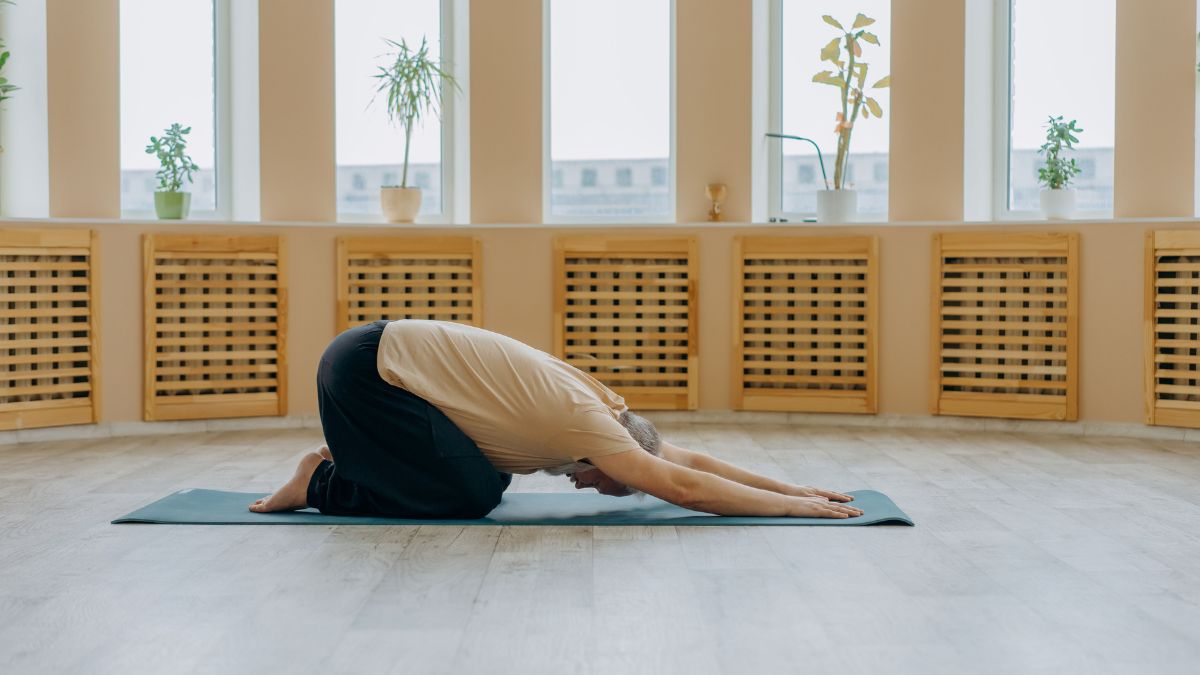
1. Child’s Pose (Balasana)
A resting position that some people find soothing at the end of a long day.
1. Kneel on the floor, with padding under your knees if needed.
2. Sit back towards your heels only as far as feels comfortable.
3. Fold forward and stretch your arms ahead or rest them beside you.
4. Support your forehead on the mat or a folded blanket, keeping your neck relaxed.
Stay for a few comfortable breaths, then come up slowly. Skip this pose if kneeling or folding forward hurts.
2. Cat-Cow Stretch (Marjaryasana-Bitilasana)
A gentle sequence that moves the spine one way and then the other.
1. Start on your hands and knees, with hands under shoulders and knees under hips.
2. As you inhale, gently lift your chest and tailbone without throwing your head back.
3. As you exhale, round your back within a comfortable range.
4. Return to a neutral position when you have had enough.
Let your breath set the pace rather than rushing through. Stop if your wrists, knees or back hurt.
3. Knees-to-Chest Pose (Apanasana)
Lie on your back and gently bring your knees towards your chest. Rest your hands around your shins or behind your thighs without pulling hard. Keep your head down, breathe comfortably and release your feet back to the floor slowly. Leave this out if it causes pain or uncomfortable pressure on your abdomen.
4. Supine Spinal Twist (Supta Matsyendrasana)
A gentle twist, done lying down.
1. Lie on your back and bend one knee towards your chest.
2. Let that knee move across your body within a comfortable range.
3. Keep your shoulders relaxed and your head in a comfortable position.
4. Return slowly to the centre, then repeat on the other side.
Do not push the knee towards the floor or force your shoulders down. Keep the movement small if that feels better.
5. Happy Baby Pose (Ananda Balasana)
A stretch done on your back, with your knees bent and feet lifted.
1. Lie on your back and bend your knees towards your body.
2. Hold the outside edges of your feet if you can reach comfortably. Holding your calves or behind your thighs is another option.
3. Open your knees slightly wider than your torso, towards your armpits, without straining.
4. Keep your head, neck and shoulders relaxed on the floor, then release slowly.
Do not pull forcefully or lift your head to reach your feet. If the position is uncomfortable, leave it out.
Do not count on it. There is no reliable evidence that a particular pose produces a bowel movement on demand. You may feel more comfortable after moving, or notice nothing straight away. Think of yoga as an optional movement habit, not an emergency measure. If you practise hoping for a bowel movement every single time, you will probably be disappointed.
The British Dietetic Association’s 2025 dietary guidelines assess specific options for adults with chronic constipation, including psyllium (isabgol), kiwifruit and certain probiotic strains. The findings vary by symptom, and much of the evidence is of low certainty. They do not mean that every fibre supplement or probiotic will help.
Kiwifruit has supportive research; prunes may also help some people. Trials have not consistently shown prunes to be better than psyllium. These foods are options to discuss with a dietitian, rather than guaranteed fixes.
For everyday self-care, add fibre gradually and drink enough fluid to help it work. A sudden increase can make bloating worse. Follow your clinician’s advice if you have a fluid restriction.
A regular toilet routine matters too: make time to go, especially after a meal, and do not ignore the urge. Regular movement belongs alongside these habits. If self-care is not helping, a pharmacist or doctor can advise on appropriate treatment. Do not stop prescribed medicines on your own.
For many people, the natural slot is the morning. A glass of water, a few minutes of comfortable movement and a short walk before the day’s rush puts several habits in one routine. It is a more realistic plan than chasing a single dramatic fix.
Speak to a doctor if constipation does not improve with self-care, keeps returning or comes with a sudden change in your usual bowel pattern. You do not need to wait several weeks or finish a log first.
Seek urgent medical advice for constipation with blood in your stool, bleeding from the rectum, constant abdominal pain, vomiting, fever, unexplained weight loss or inability to pass gas. These are warning signs that need medical assessment.
Get emergency medical help for severe or sudden abdominal pain, or a swollen abdomen with vomiting and inability to pass stool or gas. These symptoms can signal a serious problem, including bowel obstruction. Do not try to exercise through them.
Stop yoga if you develop sharp pain, dizziness, chest pain, breathlessness or worsening abdominal discomfort. Sudden chest pain that does not go away, or chest pain with breathlessness, sweating or faintness, needs emergency help. If symptoms are less severe but persist, seek medical advice before restarting.
Children, pregnant people and older adults with frailty or several health conditions may need advice tailored to their circumstances.
If you have no warning signs and movement feels comfortable, you could try one or two poses for a few minutes and keep a short log for a week. Note:
Whether you did yoga or walked, and for how long.
Whether you passed stool, how hard it was and whether you strained.
Any bloating, discomfort or sense of incomplete emptying.
Changes in food, fluid intake or medicines.
This may help you notice patterns and explain symptoms to a clinician. It cannot diagnose constipation’s cause or prove that yoga worked.
NIDDK: Symptoms and causes of constipation.
NHS: Constipation and self-care.
NIDDK: Eating, diet and nutrition for constipation.
MedlinePlus: Constipation self-care.
British Dietetic Association: Dietary guidelines for chronic constipation in adults, 2025.
BDA: Guidelines explained by the lead author.
Saab and colleagues: Yoga for IBS, systematic review and meta-analysis, 2025.
NCCIH: Yoga effectiveness and safety.
NHS: Stomach ache and emergency warning signs.
YogaRenew: Child’s Pose instructions.
The Art of Living: Cat-Cow instructions.
The Yoga Collective: Knees-to-Chest instructions.
The Yoga Collective: Supine Spinal Twist instructions.
Yoga Journal: Happy Baby instructions and variations.
This article is for general information for adults and does not replace individual medical advice, diagnosis or treatment. Yoga is not a proven treatment for constipation. Pose instructions may need adapting to your health, pregnancy status, mobility and experience; seek guidance from a healthcare professional and qualified instructor where appropriate. Do not delay medical care for persistent symptoms or warning signs, or change prescribed treatment based on this article.
No. Yoga is not a proven cure or treatment for constipation. It can be an optional way to move and relax alongside appropriate self-care or medical treatment.
There is no established best pose. Child's Pose, Cat-Cow and Knees-to-Chest are movement options, but none has been shown to reliably trigger a bowel movement. Choose comfort over a deeper stretch.
There is no evidence-based yoga schedule for constipation. A short, comfortable routine may be easier to fit into your day. Longer sessions are not necessarily better, and discomfort is a reason to stop.
No. Persistent constipation needs assessment, and warning signs need urgent care. A doctor may recommend treatments that address causes stretching cannot change.
Walking is an accessible form of regular movement and is recommended in constipation self-care. Evidence does not establish that yoga works better, or that the two have equal effects. Choose an activity you can do comfortably and safely.