Teaching Kids to Make Roti: An Age-by-Age Safety Guide
Rolling a roti is one of the first real kitchen skills many Indian children learn. Here is what to hand over when — from mixing and kneading to the belan and eventually the stove — and what they are actually learning along the way.
There is no single birthday at which a child becomes “ready” to make rotis. Toddlers can take part in simple no-heat tasks away from the cooking area; younger primary-school children may be ready to knead dough with close supervision; a belan depends as much on hand span and coordination as age; and work near a hot tawa or stove comes considerably later.
One paediatric source suggests children may begin closely supervised stove use at around 10–11 years, but age-based recommendations vary. A child’s attention, ability to follow an instruction immediately, physical reach and the particular kitchen setup matter more than the number on the birthday cake.
And one rule applies at every stage: raw flour and raw dough are cooking ingredients, not tasting or play materials. Flour can contain harmful bacteria that are destroyed through proper cooking, so children handling atta or dough should be supervised, should not put flour-covered hands in their mouths and should wash their hands afterwards.
Is This Article for You?
Read this if you would like your child in the kitchen with you and are unsure what is safe to hand over, or you have a child who wants to help and a reasonable amount of anxiety about the flame.
Please read the safety section before the rest. In Indian homes, the cooking setup can look very different from the kitchen assumed by many international parenting guides, and it is worth understanding that before attaching an age to any task.
Every household has a version of this memory: standing at the counter with a small ball of dough, making something round-ish while somebody older made something round. It is one of the few genuinely useful skills a child can acquire without fancy equipment, and it happens to teach several things at once.
What follows is a rough progression rather than a schedule. Children vary enormously, and the honest rule is that readiness is a judgement a parent makes about a particular child in a particular kitchen — not something an article can hand you.
Start Here: The Safety Picture in Indian Kitchens
Before teaching the roti, look at the cooking space.
A recent retrospective study of 191 paediatric burn admissions at a North Indian tertiary centre found that children aged one to five accounted for 52% of cases, with scalds the most common mechanism. Another North Indian study involving 475 children found that the kitchen was a common site of injury and that floor-level cooking was frequent among affected households.
The practical reading is straightforward: the highest-risk children are the ones too young for any contact with active heat, and proximity matters as much as what they are holding. Before teaching anything, the first job is creating a cooking space a small child cannot simply reach into.
Young children can still participate, but the no-heat work should happen at a separate cool preparation area, physically away from a tawa, kadai, pressure cooker, hot liquids and open flame.
EXPERT LENS | Why the cooking environment matters
Paediatric burn risk is not determined by age alone. Indian burn literature repeatedly points to hot liquids, congested cooking environments and accessible heat sources as important hazards. In one North Indian series of 475 paediatric burn patients, 52.6% of injuries occurred in kitchens and floor-level cooking was reported in 61.7% of the households studied. That is why “adult supervision” is not a complete safety strategy for very young children: changing what they can physically reach matters too.
The Progression
Stage
What they can do
What they’re learning
Toddler years
Count scoops, pour pre-measured water from a small katori and watch or talk through what is happening from a separate cool work area. No heat, no tools, and no raw flour or dough as play material.
Sensory familiarity and provenance — that food has stages, and a roti is made rather than simply appearing on the plate.
Early primary
With close supervision, knead dough, roll portions into loyas and dust the board. No tasting raw dough; wash hands afterwards.
Patience, coordination and the fact that effort changes the material.
Middle primary
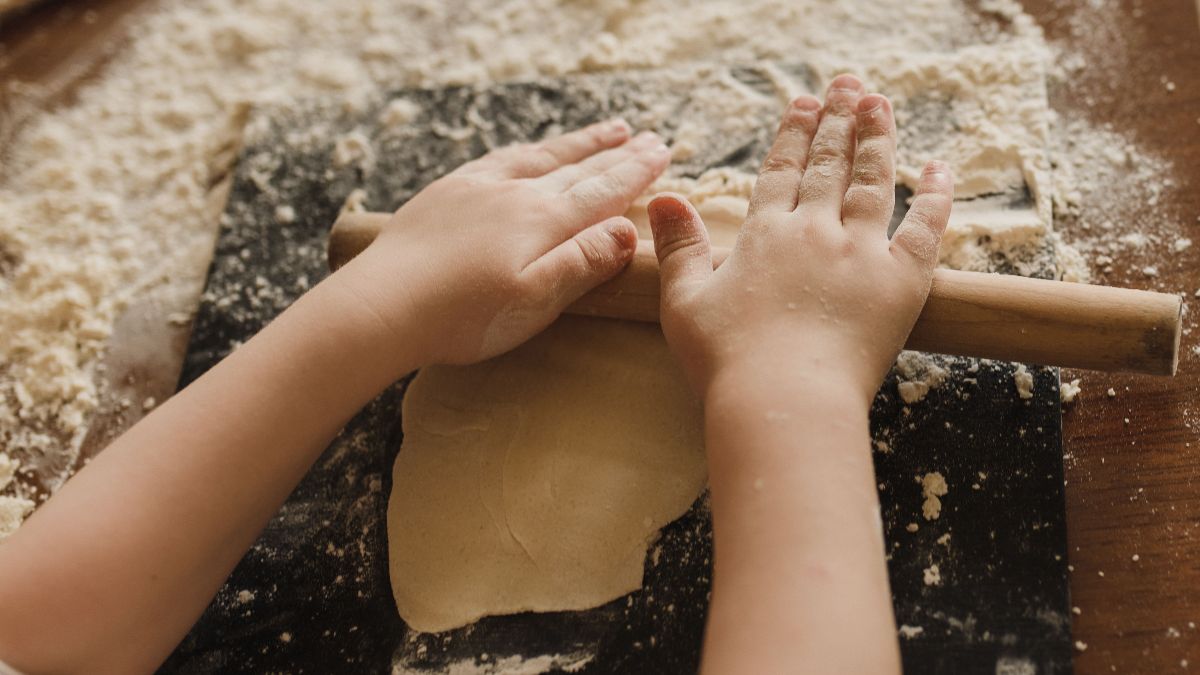
Use a size-appropriate belan once they can comfortably hold it with both hands. Roll, rotate and accept the shape that results.
Precision — and that imperfect rotis still feed people.
Older child / pre-teen
Begin closely supervised work around a stove or tawa only when behavioural and physical readiness markers are firmly there.
That heat is a tool with rules.
The table is deliberately broad. A confident eight-year-old and an impulsive eleven-year-old are not interchangeable simply because an age chart says they should be.
The Flour Years: Sensory, Not Instructional
The youngest children belong nowhere near the tawa, but there is still plenty to talk about before heat enters the picture. Dry atta and hydrated dough feel completely different, and noticing that transformation is a real observation about food.
With toddlers, I would keep direct handling of raw flour to a minimum because flour is not a ready-to-eat food and small children are particularly prone to putting their hands in their mouths. With slightly older children who can follow hygiene instructions reliably, supervised kneading becomes a much more sensible form of participation.
This is also the easiest place to introduce where food comes from, and I would keep it to story rather than instruction. Khapli is emmer wheat, an old cultivated type of wheat with a long history in India. “This is an older kind of wheat than the one in most packets” is a fact a five-year-old will accept happily and repeat to somebody else, which is the test of a good one.
The point does not need to become “this is the healthier wheat”. The useful lesson is that grains have names, histories, places and different ways of behaving in the kitchen.
The Kneading Years: The Best Skill on the List
If you hand over only one part of the process, make it this.
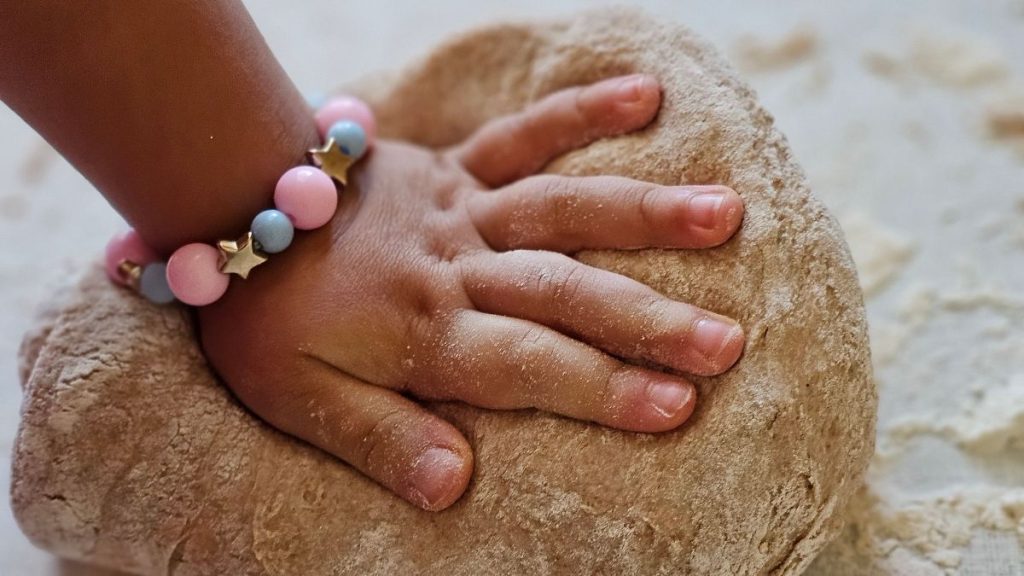
Kneading is forgiving, it requires no sharp or hot equipment, and a child can participate without the outcome needing to look perfect. It also gives them immediate physical feedback: add water and the flour changes; press and fold it and the loose mixture gradually becomes dough.
A whole-grain flour can be particularly interesting to work with because hydration is visible under the hands. Aashirvaad’s quality document reports a 73% water-absorption figure for Aashirvaad Chakki 100% Khapli Atta, which gives you a measurable version of how much water that tested flour takes up during dough formation. Telling a child that the flour is “drinking the water” is not such a bad simplification.
What I would not turn that measurement into is a digestive or blood-sugar claim. Water absorption tells us something about flour and dough behaviour; it does not tell us how a child’s metabolism will respond to the roti.
EXPERT LENS | What does 73% water absorption actually mean?
Flour water absorption is generally measured under controlled dough-testing conditions and describes how much water a flour requires to reach a specified consistency. The value is influenced by several flour characteristics, including protein, starch damage, particle size and fibre components.
Aashirvaad’s quality document reports 73% water absorption for its tested Khapli atta. That is useful evidence about the product’s dough behaviour, but it should not be read as proof of a lower glycaemic response, easier digestion or “steady energy” for children. The laboratory measure and the health claim are different questions.
There is also something pleasingly direct about kneading as a skill. A child can feel immediately when the mixture is too dry, too wet or beginning to come together, and there is rarely one instant in which an adult needs to snatch the job back and “fix” it.
Kneading is one of the safer early roti-making skills to hand over: it lets children feel flour transform into dough while practising coordination and patience, without bringing them near the tawa. Image via PEXELS
The Belan Years: Gated by Hands, Not Birthdays
A rolling pin needs two hands that can comfortably grip it while the child is positioned squarely to the board. If she has to lean across the belan or stretch to reach both ends, she will push the dough sideways instead of rolling it, and the frustration usually ends the enthusiasm before the skill arrives.
A Useful Belan Readiness Check
Sit the child at the board with the belan in front of her. If both hands rest on it comfortably with elbows relaxed and shoulders level, she is probably ready to try. If either arm is fully extended or she is rising off the seat to reach, the equipment is too large for comfortable control.
A smaller belan may solve the problem more usefully than simply waiting another year.
This is a practical household check, not a clinical developmental assessment. What it is really looking for is whether the equipment fits the child well enough for her to concentrate on rolling rather than fighting her own posture.
EXPERT LENS | Why readiness is more useful than a birthday
Cooking involves several developmental skills at once: bilateral coordination, grip, motor planning, attention and the ability to follow multi-step instructions. Paediatric cooking guidance therefore recommends assessing maturity and developmental readiness rather than relying only on chronological age. Children’s Health, for example, explicitly advises parents to consider instruction-following, motor skills, attention and enthusiasm when deciding what a child can safely do.
A rolling pin is a good example because the equipment itself can be scaled down. If the child can comfortably control a smaller belan, there is no nutritional or developmental virtue in making her struggle with the adult one.
One request, offered gently: do not correct the shape.
A child who watches her roti get re-rolled by an adult has learnt that the task was never really hers. Misshapen rotis cook perfectly well and nobody at the table will mind.
The Flame: Later Than Most Families Assume
Children’s Health suggests that children may begin using a stove at around 10 to 11 years old with close supervision, and the oven at around 11 to 12. The same guidance stresses that readiness depends on maturity and development rather than age alone.
I would treat ten or eleven as a possible earliest reference point, not a birthday-based permission slip. Other paediatric guidance is more conservative about independent hot-food preparation, and the type of stove matters enormously.
Two Indian adjustments are particularly important. First, if you cook at floor level, the entire calculation changes because an accessible flame and hot vessels create risks long before the child is developmentally ready to cook. Second, induction and gas do not teach the same skill: a child who has used an induction hob has not thereby learnt how to work safely around an open flame.
Readiness here is behavioural rather than chronological. Does she reliably turn pot handles inward when taught to? Can she identify what is hot without testing it? Does she know where the chimta or appropriate heatproof mitts are? Can she follow an instruction to stop immediately, the first time it is given? A child who cannot do the last one is not ready, whatever her age.
For early supervised stove work, use back burners where the setup permits, turn handles inward and keep loose clothing, scarves and dupattas away from the flame. The adult should remain beside the child rather than supervising from elsewhere in the room.
What the Roti Is Actually Teaching
The nutrition lesson in all of this is not really a lesson about nutrition.
It is provenance — that this came from a plant, that somebody grew it, that it was ground before it arrived, and that a person’s hands turned it into dinner. A child who knows that has a more durable relationship with food than one who has simply been given a list of what is good for her.
I would keep the language firmly on the side of curiosity rather than virtue. “This is an interesting old grain and here is where it grew” works. “This one is the healthy one” teaches a child to sort foods into good and bad, and that habit is considerably harder to undo later than it is to avoid now.
Children do not need to be told that a roti is worthy. They need to be shown that it is interesting.
And the part nobody writes down is that the bonding is not a side effect of the lesson; it is part of the lesson. Twenty minutes at a counter with somebody who is not hurrying you is what the child will remember. The roti is the excuse.
EXPERT LENS | Why participation can matter without turning food into a lesson
Research on children’s involvement in meal preparation suggests that participation can increase engagement with food. In a small controlled study involving 47 children aged six to ten, those who helped a parent prepare lunch ate more salad and reported more positive feelings and a greater sense of control after cooking than children whose parent prepared the meal alone.
That does not prove that rolling rotis prevents picky eating or future food anxiety, and there is no need to make such a large claim. The useful principle is narrower: letting children participate in ordinary food preparation can increase familiarity and ownership, particularly when the experience is curious and non-coercive rather than built around “good” and “bad” foods.
Frequently Asked Questions
At What Age Can a Child Start Helping With Roti?
Children can participate in simple no-heat food preparation from a young age, but the task needs to suit both their development and the food-safety risk. Toddlers can count scoops or pour measured water away from the stove. Children around the early-primary years may be ready to knead dough with close supervision, provided they understand not to taste raw flour or dough and wash their hands afterwards.
The rolling pin depends more on physical fit and coordination than on one prescribed age.
Is Raw Roti Dough Safe for Children to Taste?
No. Flour is a raw food and may contain harmful bacteria such as E. coli or Salmonella. Cooking destroys those organisms, which is why children should not eat raw flour or raw dough. Hands, utensils and work surfaces should be washed after handling them.
When Can a Child Use the Stove?
One paediatric source suggests around ten to eleven years as a point at which closely supervised stove use may begin, but this is not a universal readiness age. The child’s attention, ability to follow safety instructions, physical reach and the type of cooking setup matter more.
For an open gas flame, I would be more cautious than for a cool-surface preparation task or an induction hob.
How Do I Know if My Child Is Big Enough for a Rolling Pin?
Sit her comfortably at the board with the belan in front of her. If both hands can rest on it with relaxed elbows and level shoulders, she can try. If she has to stretch or lift herself to reach, use a smaller belan rather than assuming she simply needs to be older.
Which Age Group Is Most at Risk of Kitchen Burns?
A recent North Indian tertiary-centre study found that children aged one to five made up 52% of the 191 paediatric burn admissions studied, with scalds the most common cause. This does not mean 52% of Indian children who are burned are necessarily in that age group nationally; it describes that hospital population.
For very young children, physical separation from active cooking heat and hot liquids is more important than attempting to teach stove behaviour.
Should I Correct My Child’s Misshapen Rotis?
I would not. An irregular roti can still cook and feed somebody perfectly well. Letting the child keep ownership of what she made is more useful than quietly transforming it into the adult version as soon as she looks away.
Khapli is emmer wheat and can be used as one of several whole-grain wheat options in a family diet. I would not describe it as inherently superior to ordinary whole wheat for children or promise special digestive or metabolic benefits from it.
Its grain history and different dough behaviour are already interesting things to teach without attaching a health hierarchy.
How Do I Teach a Child About Nutrition Without Making Her Anxious About Food?
Talk about where food comes from, how it changes during cooking, what it tastes and feels like and how different households make it, rather than reducing foods to “good”, “bad”, “healthy” or “unhealthy”.
A child can learn that wheat becomes flour, that flour absorbs water, that heat turns dough into roti and that different grains have different histories without turning dinner into a nutrition lecture.
The Short Version
Start with no-heat jobs away from the stove. Toddlers do not belong beside active cooking heat.
Raw flour and dough are not tasting or play foods. Supervise handling and wash hands afterwards.
Kneading is one of the best skills to hand over. It is forgiving, tactile and easy to practise without heat.
The belan is gated by fit and coordination, not birthday. Use equipment the child can comfortably control.
The flame comes later. Published age guidance is only a starting point; behavioural readiness and kitchen layout matter more.
Do not correct the shape. Imperfect rotis still feed people.
Teach provenance, not virtue. Curiosity about food is more useful than sorting it into morally “good” and “bad” categories.
Safety Note
Age ranges in this article are approximate. Kitchen readiness depends on a child’s development, attention, ability to follow instructions and the layout and equipment in the home. Young children should be kept physically separate from active cooking heat and hot liquids, and any child learning to work at a stove or tawa needs continuous adult supervision.
Raw flour and raw dough should not be eaten or used as play material. Flour is a raw food and should be handled with the same attention to hand and surface hygiene as other raw cooking ingredients.
Sources
Ali SS.Epidemiology and Seasonal Trends of Pediatric Burns in North India: A Retrospective Study from a Tertiary Care Center. Journal of Indian Association of Pediatric Surgeons, 2026
Dhopte A, Tiwari VK, Patel P, Bamal R.Epidemiology of pediatric burns and future prevention strategies — a study of 475 patients from a high-volume burn center in North India. Burns & Trauma, 2017.
Children’s Health.Age-appropriate kitchen tasks for kids
US Food and Drug Administration.Flour Is a Raw Food and Other Safety Facts and Handling Flour Safely
van der Horst K, Ferrage A, Rytz A.Involving children in meal preparation: Effects on food intake. Appetite, 2014
You are now being directed to an external website https://www.callr.live/aashirvaadexperts/premium-plan.
This link is provided for your information and convenience only and ITC Limited is not
responsible for the contents or services provided by Brand Touch India or any information that
you share with Brand Touch India.