Probiotics and Prebiotics: What's the Difference, and Do You Actually Need Them?
Probiotics add beneficial bacteria to your gut, while prebiotics feed the bacteria already there. Find out how food, supplements and fibre fit into a healthy gut routine.
Probiotics add beneficial bacteria to your gut, while prebiotics feed the bacteria already there. Find out how food, supplements and fibre fit into a healthy gut routine.
Expert reviewed by Qurath Ain, Certified Nutritionist and Clinical Dietitian
TL;DR
Probiotics are live bacteria you add to your gut (through curd, buttermilk, or supplements); prebiotics are the fibre that feeds bacteria already there (garlic, onion, dal, whole grains). Most healthy people eating a varied Indian diet already get meaningful amounts of both without buying either as a special product. Specific probiotic strains help in specific situations (like after antibiotics); daily supplementation for general health isn’t well supported by evidence.
Probiotics and prebiotics do two different jobs for your gut, and mixing them up is why so much of the marketing around them feels confusing. Probiotics are live bacteria you add to your gut through food or a supplement. Prebiotics aren’t bacteria at all — they’re the fibre that feeds the bacteria already living there. You don’t strictly need either as a special product; most people get meaningful amounts of both from an ordinary varied balanced diet, but knowing which is which makes the whole aisle of yoghurts, drinks and supplements far easier to navigate.
When you pick up a packet or a tub of curd, you’re likely to come across words like live cultures, Bifidus, and inulin. They’re not exactly self-explanatory, and it’s easy to wonder whether any of them actually matter or whether you’ve simply been successfully marketed to. The terms probiotics and prebiotics get thrown around so freely these days — on food packaging, in wellness newsletters, in conversations at the gym — that it can feel as though everyone understands them except you. For the record, most people don’t. The confusion is entirely reasonable, and clearing it up is much simpler than the supplement industry would like you to believe.
The tiny world inside your gut
Your gut is home to trillions of microorganisms — bacteria, fungi and other microscopic residents that collectively make up what scientists call the gut microbiome. This community is involved in everything from digesting food to supporting your immune system.
Probiotics are live beneficial bacteria that you introduce to that community, either through food or supplements. Prebiotics are the food those bacteria eat in order to survive and do their jobs properly. Feed the right bacteria enough of the right fibre, and they produce short-chain fatty acids, which nourish the cells lining your gut wall and help maintain its integrity. A well-fed gut lining is a functional one.
Think of it like a busy kitchen, not a garden
Picture your gut bacteria as the kitchen staff at a busy, always-open dhaba. Probiotics are new cooks arriving, ready to get to work. Prebiotics are the rations already stocked in the kitchen — the atta, the dal, the vegetables — that let every cook, old and new, actually prepare something. New cooks without rations can’t do much. A well-stocked kitchen with no cooks doesn’t run either. Neither works especially well without the other, which is why fixating on one while ignoring the other tends to produce fairly underwhelming results.
The word probiotic comes from Latin and Greek roots meaning “for life,” which sounds dramatic but is fairly accurate — these are living organisms that, when consumed in adequate amounts, confer a benefit on the host (you, in this case). Prebiotics, on the other hand, are largely non-digestible fibres. Your body can’t break them down, so they travel intact to the large intestine, where your gut bacteria ferment them hungrily.
A familiar mix-up: Simran and the two tubs
Simran once spent an entire supermarket trip convinced she needed both a probiotic drink and a separate prebiotic supplement to sort out her digestion, only to realise at the till that her usual breakfast of curd with banana and a handful of oats was already doing most of that work.
Once she understood the difference, her shopping list actually got shorter. She kept the daily curd, added dal a little more consistently through the week, and skipped both supplements. A few weeks in, she noticed no real difference from when she’d briefly tried the drink — only a lighter grocery bill.
Where you actually find them in food
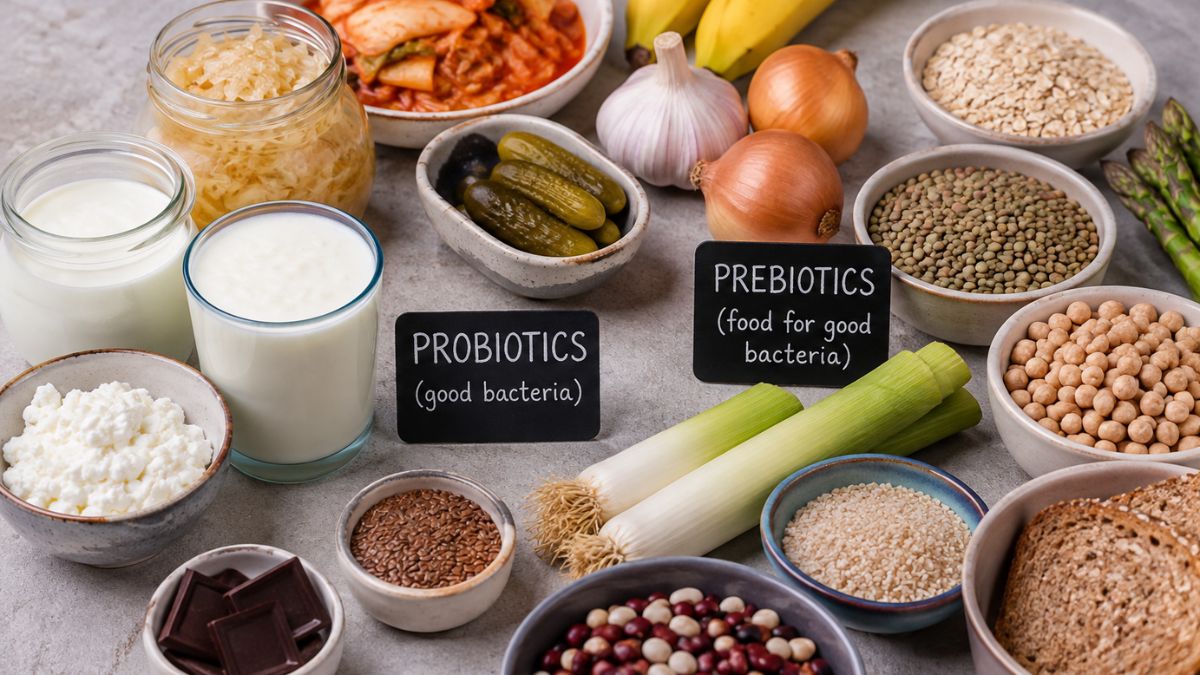
Probiotic foods are fermented foods that still carry live bacteria when you eat them. In an Indian kitchen, curd or dahi with live cultures, homemade buttermilk or chaas, and lassi are the most reliable, everyday sources — plain curd in particular is worth eating most days. Kanji, a traditional fermented carrot or beetroot drink popular in North India, especially around winter, is a genuine, less-talked-about probiotic food worth knowing about too. You may also recognise kimchi, sauerkraut, miso, tempeh or kefir from packaging or restaurant menus — these are real probiotic foods as well, just less central to most Indian kitchens day to day.
A word of caution on all of these: check the label or the process. Pasteurised curd or yoghurt processed after fermentation doesn’t count, and sauerkraut or pickles sitting unrefrigerated on a room-temperature shelf have almost certainly been pasteurised too, killing whatever cultures were present. “Live and active cultures” on a label, or finding your fermented food in the chilled section, are better signals to look for than the word “fermented” alone.
Prebiotic foods are less glamorous in conversation but arguably more important day to day, because most of us eat them, or should eat them, in far greater quantities. Garlic, onions, bananas (particularly the slightly underripe ones), oats, barley, dal, whole wheat, millets like bajra, jowar and ragi, and root vegetables like sweet potato are among the richest, most familiar sources. Essentially, a thali built around vegetables, dal, a cup of curd or a glass of lassi/chaas and whole grains is already a thali full of prebiotics, whether or not anything on the plate says so.
Rotis made with Aashirvaad Namma Chakki 100% Khapli Atta fit naturally into this picture too, providing about 11.4g of fibre per 100g, similar to whole wheat atta — fibre your gut bacteria can put to work. What this really means is that you don’t need to buy special prebiotic products to feed your gut bacteria well. You mostly just need to eat more plants, and most Indian thalis already have a head start.
Rarely, if your diet already includes vegetables and whole grains
Best evidence for
Specific strains for specific situations, like after antibiotics
General fibre intake supporting gut lining health
What the research actually says
The science here is genuinely interesting, and also genuinely complicated. There’s solid evidence that a diverse gut microbiome is associated with better digestive health, stronger immune function, and even mood — the gut-brain connection is an active area of research, and the early findings about how gut bacteria influence mental wellbeing are intriguing.
Here’s the catch, though. The evidence for specific probiotic strains doing specific things is considerably patchier than wellness culture implies. Certain strains have demonstrated real benefit for particular situations — Lactobacillus rhamnosus for diarrhoea prevention, for instance, or certain probiotic combinations for symptoms of irritable bowel syndrome. Prebiotics and probiotics have also been shown to improve immunity.
These are meaningful, studied outcomes. The broader claim that a daily probiotic supplement makes a healthy person significantly healthier is much harder to substantiate, and a 2024 expert review reached a similar conclusion for the general healthy population specifically.
Prebiotics have a more consistent evidence base in some respects, largely because the mechanism is well understood — the short-chain fatty acid pathway described above is well documented. Prebiotics are also involved in the absorption of fats and phospholipids in the lower intestine. This binding effect of prebiotics also leads to decreased levels of cholesterol. Prebiotics improve the absorption of vital minerals such as calcium and magnesium, which in turn has beneficial effects on bone mineralisation.
Do you need supplements, or is food enough?
This is the question most people are really asking, and the honest answer depends on your starting point. If you eat a varied, plant-forward diet with some fermented foods included — even a few spoonfuls of curd most days, dal and oats through the week, garlic and onion in your cooking — your gut is likely getting a reasonable amount of both. You’re not missing out on something a capsule would fix.
Probiotic supplements make more practical sense in specific situations: after a course of antibiotics, which disrupts the gut microbiome; for those managing particular digestive conditions where specific strains have been shown to help; or for people whose diet is genuinely limited and who can’t get fermented foods in regularly. Even then, it’s worth looking for supplements that specify the strain and the colony-forming units, and checking that the research backs that particular strain for that particular purpose, ideally with a doctor’s input.
Prebiotic supplements exist too, often as inulin or fructooligosaccharide powders stirred into drinks. They’re not harmful, but if your diet already includes plenty of fibre-rich vegetables, dal and whole grains, they’re largely redundant. The more useful investment, most of the time, is simply eating more of the foods that were always doing this work quietly in the background. It’s always better to avoid over-the-counter supplements and consult your dietitian or healthcare provider before consumption.
Ask Happy Tummy GPT
Try this prompt: “Here’s what I typically eat in a week, including curd or other fermented foods, vegetables, dal, whole grains and fruit. Can you help me identify whether my diet already covers both probiotics and prebiotics, or where the gaps are?”
A few things worth knowing before you start
Introducing large amounts of prebiotic fibre too quickly can cause bloating, gas and general digestive complaints. This isn’t a sign that something has gone wrong — it’s your gut bacteria doing exactly what they’re supposed to do, fermenting the fibre you’ve given them and producing gas as a byproduct. The solution is simply to increase fibre gradually and drink plenty of water alongside it. Your gut adjusts, usually within a week or two.
People with compromised immune systems, serious illness, or certain gut conditions should speak to a doctor before taking probiotic supplements, even though this is safe for the vast majority of healthy people.
Strip back the supplement marketing and the wellness jargon, and you’re left with something that resembles fairly old-fashioned dietary wisdom. Adapt the “My plate” concept recommended by ICMR, which includes all the food groups. Eat a wide variety of vegetables, fruits, dal and whole grains. Include a probiotic food or two most weeks — a bowl of good curd, a glass of buttermilk, kanji in season — and make sure your diet also includes plenty of fibre-rich foods to nourish your gut bacteria, instead of relying on the same narrow rotation of meals. Limit the intake of unnecessary antibiotics.
The gut microbiome is shaped over time by consistent dietary habits more than by any single supplement or superfood.
Curious what your plate is already giving your gut bacteria? Log a typical day and see where it lands.
FAQs
What’s the actual difference between probiotics and prebiotics?
Probiotics are live bacteria you add to your gut through food or supplements; prebiotics are fibre that feeds the bacteria already living there. You need both, but they’re not the same thing.
Do I need to take both probiotics and prebiotics?
Not as separate products, for most healthy people. A varied diet with some curd or fermented food, plus vegetables, dal and whole grains, usually covers both.
What are good probiotic foods to eat in an Indian diet?
Curd or dahi with live cultures, buttermilk, lassi, and kanji are reliable everyday options; just check that yoghurt hasn’t been pasteurised after fermentation.
What are good prebiotic foods?
Garlic, onion, banana, oats, dal, whole wheat, and millets like bajra, jowar and ragi are all rich, familiar prebiotic sources already common on an Indian plate.
Can eating too many prebiotic foods cause bloating?
Yes, especially if you increase fibre quickly and in a larger quantity. It’s your gut bacteria fermenting the new fibre, not a sign something’s wrong — increasing gradually with enough water usually resolves it within a week or two.
Disclaimer: This is general information, not medical advice. For children specifically, follow a doctor’s guidance before making changes. If you have a compromised immune system, a serious illness, or a diagnosed gut condition, speak to a doctor before taking probiotic supplements. Persistent or severe digestive symptoms should also be evaluated by a doctor rather than managed with supplements alone.
You are now being directed to an external website https://www.callr.live/aashirvaadexperts/premium-plan.
This link is provided for your information and convenience only and ITC Limited is not
responsible for the contents or services provided by Brand Touch India or any information that
you share with Brand Touch India.