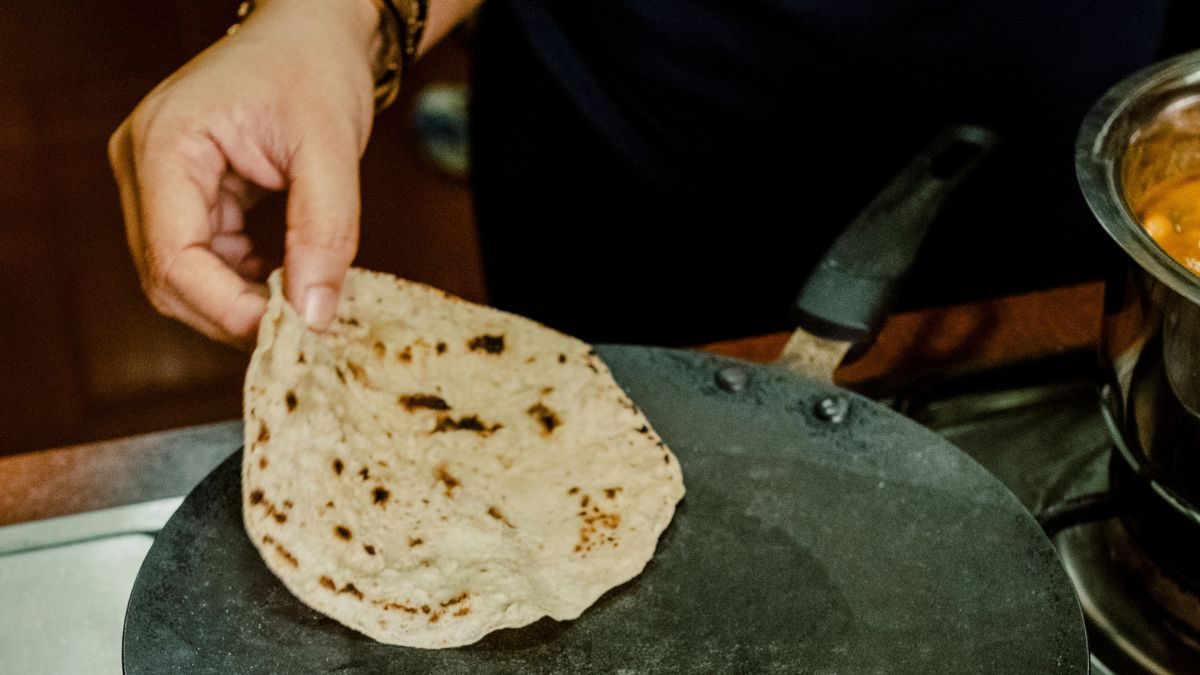
Does Cooking Change the Fibre in Your Roti?
The number on the atta packet and the fibre in your roti describe different quantities. Here is how to connect them.
Table of Contents
Cooking a roti does not make its fibre disappear. For everyday tracking, start with the type and amount of flour used. The result is an estimate: cooking, cooling and the method used to measure fibre can change the analysed value.
The Indian Food Composition Tables list whole-wheat atta at 11.36g dietary fibre per 100g of uncooked flour. A roti made with 30g of that atta therefore supplies an estimated 3.4g fibre from the flour. Two rotis using 60g provide about 6.8g; three using 90g provide about 10.2g. These are examples, not standard roti sizes or recommended portions.
Water explains the confusion between packet and plate. Flour takes up water during kneading, and some remains after cooking. A cooked roti can therefore weigh more than the flour used to make it. Its fibre per 100g can look lower without showing that the same proportion of fibre was destroyed.
For your own calculation, weigh the uncooked flour for a batch, multiply by its fibre value per 100g, divide by 100, then divide by the number of equal rotis. Include other ingredients separately if they contribute fibre.
Cooling can change resistant starch, which can count as dietary fibre. There is no reliable extra amount to add to your home calculation, and safe storage matters more than chasing a starch change.
Choose whole-grain flour you enjoy, pair rotis with dal and vegetables, increase fibre gradually and drink enough fluid. Follow individual dietary advice if you have been prescribed a low-fibre diet or fluid restriction.
Most of us have flipped over an atta packet and read the label with good intentions. Dietary fibre: about 11g per 100g. It sounds solid. Then a quiet question follows: is that what actually ends up on my plate?
The answer starts with the flour you use and the size of your roti. The packet gives you a concentration. Your plate gives you a portion.
An atta packet’s per-100g nutrition panel describes the uncooked flour as sold. It does not describe 100g of dough or cooked roti. “Uncooked flour” also does not mean a completely moisture-free laboratory sample: flour already contains some moisture.
The Indian Food Composition Tables 2017 list whole-wheat atta at 11.36g dietary fibre per 100g, compared with 2.76g for refined wheat flour, or maida. That is about four times as much fibre in the atta, comparing equal weights of uncooked flour.
Use your own pack’s figure when one is available. Database values are useful references; flours and products vary.
Here is the calculation using the IFCT whole-wheat atta value. Each roti is assumed to use 30g flour.
| Number of rotis | Uncooked atta used in total | Estimated fibre from that flour |
| 1 | 30g | 3.4g |
| 2 | 60g | 6.8g |
| 3 | 90g | 10.2g |
These are flour-based estimates, not laboratory measurements of the cooked rotis. Thirty grams is an example, not a universal roti size or a recommendation for how much to eat. Three smaller rotis might use less flour than two large ones.
For comparison, 30g maida supplies approximately 0.8g fibre using the IFCT value. The flour choice makes a clear difference before the dough reaches the tawa.
When you knead atta, you add water. Some evaporates during cooking and some remains. That retained water makes a soft roti heavier than the uncooked flour used to make it.
Water supplies no fibre. It changes how much fibre there is per gram of the finished food.
Consider an illustrative roti made with 30g atta that weighs 40g after cooking. Neither weight is a standard serving; this example shows the effect of water while keeping the flour-derived estimate fixed.
| What you are counting | Fibre estimate |
| Flour used for the roti | 3.4g in 30g atta |
| The whole cooked roti | Approximately 3.4g in the 40g roti |
| The equivalent per 100g cooked roti | Approximately 8.5g |
The lower per-100g figure is compatible with the same estimated fibre in that one roti. It does not, by itself, demonstrate fibre loss. The calculation illustrates concentration and portion size; actual measured fibre can also change during processing.
This is why you should not put an uncooked-flour label beside a cooked-roti database entry and interpret the difference as the amount destroyed by heat. Recipes, moisture and measurement methods may differ too.
Whole-wheat atta contains both soluble and insoluble fibre, predominantly insoluble fibre according to IFCT. These fibres contribute to normal bowel function in different ways.
Cooking can change measured fibre fractions. A 2023 study of Indian wheat foods found differences after cooking and storage, rather than a simple loss of chapati fibre. The samples were dried before analysis, so its per-100g results cannot be read as values for moist rotis on a plate.
For everyday tracking, use the flour calculation as an estimate. There is no validated universal percentage to deduct because a roti was cooked on a tawa.
Cooling can increase resistant starch, which escapes digestion in the small intestine. EFSA includes resistant starch within dietary fibre, including starch formed through retrogradation as cooked starch cools.
The 2023 study found increased resistant starch after refrigerating chapati for 24 hours; reheating reduced it relative to the refrigerated sample. It used one wheat variety and specific preparation conditions. It does not establish a fixed extra fibre allowance or a digestive-health benefit for your lunchbox roti.
Keep your home calculation consistent. Do not add an assumed resistant-starch bonus to a flour-derived estimate. The amount is unknown, and total-fibre measurements may already include some resistant starch, depending on the analytical method.
Food safety applies to the roti as well as its accompaniments. A closed tiffin does not automatically keep a meal at a safe temperature.
WHO’s Five Keys to Safer Food advises keeping cooked food hot above 60°C or chilled preferably below 5°C, and avoiding more than two hours at room temperature. FoodSafety.gov advises a shorter one-hour limit when temperatures exceed 32°C.
For a packed lunch, use suitable hot-holding equipment or keep chilled food cold with an insulated bag and at least two cold sources, such as frozen gel packs. Refrigerate on arrival where possible. USDA recommends this approach for perishable packed foods. An ordinary lunchbox cannot be assumed to maintain a safe temperature.
Cool leftovers promptly in small portions and refrigerate. The Food Standards Agency advises using general leftovers within 48 hours or freezing them for later. This is a general household-leftover rule, not a tested shelf life for every roti recipe. Reheat only the portion you need, once, until steaming hot throughout.
Do not leave roti out overnight to increase resistant starch. The study’s room-temperature storage experiment is not a safe home-storage recommendation. Smell and appearance alone cannot establish that food is safe.
The method stays the same: use the fibre value for the flour you actually buy.
For example, the manufacturer’s current page for Aashirvaad Meri Chakki Khapli Atta lists 10.7g fibre per 100g flour. On that basis, 90g flour contributes approximately 9.6g fibre, before allowing for any processing-related change. This product-specific figure is separate from IFCT’s generic atta entry.
Both Khapli and ordinary whole-wheat atta can contribute fibre. There is no reason here to present Khapli as a substantial fibre upgrade. Taste, availability and budget are sensible reasons to choose between them. Khapli is wheat and contains gluten.
Water absorption and dough softness do not establish a fibre advantage. They also do not tell you exactly how much a cooked roti will weigh.
For example, 240g atta × 11.36 ÷ 100 = approximately 27.3g fibre in the flour for the batch. If it makes eight equal rotis, that is approximately 3.4g each.
Weighing a dough ball does not give you its flour weight: the dough includes water. Cooked-roti weight alone cannot tell you how much flour went into it either.
Roti can make a useful contribution, but fibre comes from more than one place. Pair it with dal, beans, vegetables and fruit across the day. WHO recommends adults obtain at least 25g naturally occurring dietary fibre daily.
Increase fibre gradually, because a sudden jump can cause wind and bloating. Adequate fluid helps fibre support softer stools. If you have been prescribed a low-fibre diet or fluid restriction, follow your clinician’s or dietitian’s advice.
Speak to a healthcare professional if constipation or other digestive symptoms persist or keep returning. Blood in the stool, unexplained weight loss or continuing abdominal pain need medical review. Seek urgent care for sudden, severe abdominal pain.
This article provides general food and nutrition information, not personalised medical advice or a diagnosis. Fibre calculations are estimates based on uncooked ingredients, not laboratory measurements of a finished meal. Values vary by flour, product, recipe, cooking and storage. Follow current pack instructions and individual advice for coeliac disease, food allergies, a prescribed low-fibre diet or fluid restriction. Wheat, including Khapli, contains gluten.
Cooking does not simply eliminate it. Flour-based calculations are useful everyday estimates, although cooking and storage can change analysed fibre values. Do not apply an arbitrary “cooking loss” deduction.
A roti using 30g whole-wheat atta provides an estimated 3.4g fibre from the flour, based on IFCT's 11.36g per 100g value. Your roti may use a different amount or type of flour.
The atta label describes uncooked flour. Cooked roti contains added water, some of which remains after heating. Compare like with like: the same weight of cooked food and uncooked flour represents different amounts of flour.
Cooling is not a reason to subtract fibre from your estimate. It can change starch and measured fibre fractions. Safe cooling, refrigeration and reheating matter more than attempting to calculate a storage-related bonus.
Do not assume so. Compare the current flour labels and the amount used. Both can contribute fibre; Khapli is a variety choice, and its wheat still contains gluten.
Choose cookware for safe, practical cooking. The useful inputs for your fibre estimate are the flour, recipe and portion size. There is no established cast-iron-versus-non-stick correction to apply to that calculation.