The Everyday Wisdom of North India's Thalis
North Indian food is more than butter and ghee. The thalis tell us why.
Table of Contents
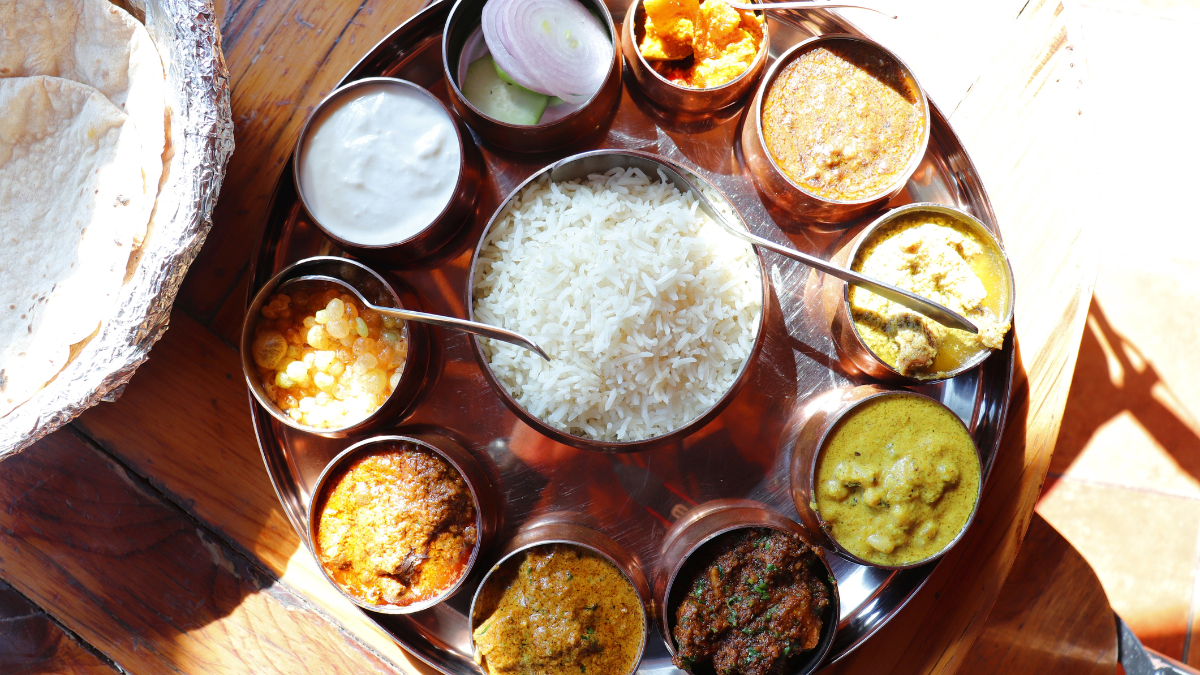
The everyday North Indian plate — whole-wheat roti or rice, dal, seasonal vegetables, and often curd or chaas — offers a good foundation for balanced eating. The region’s ceremonial thalis reveal what else is worth borrowing: Punjab’s winter greens and whole pulses, Rajasthan’s millets, dried desert vegetables and buttermilk, and the Himachali dham’s variety of pulse preparations and contrasting flavours.
These traditions can bring fibre, protein and dietary variety to the plate. Richer preparations such as restaurant-style dal makhani, dal-baati-churma and ghee-laden madra have their own place, particularly at celebrations. The lesson isn’t to choose one regional thali over another, but to recognise the everyday food wisdom behind each feast.
Ask what people across Delhi, Lucknow, Jaipur or Shimla ate for dinner last night, and many answers will sound familiar. Rotis made from whole-wheat atta, or perhaps rice. A dal. A seasonal sabzi. A bowl of curd or a glass of chaas, with some sliced onion and a wedge of lime on the side.
It’s a plate that can work well for the gut: whole-wheat roti brings fibre, the dal brings protein and more fibre, the sabzi adds variety, and fresh curd can contribute live cultures from fermentation. The balance depends on the portions and preparations, but the foundation is a good one.
The regional differences show up most vividly at celebrations. A Punjabi wedding spread, a Rajasthani thali at a heritage restaurant, a Himachali dham served on leaf plates at a village function: this is where each region lays out everything it cooks well. None of these is necessarily how people eat on a Tuesday, and it wouldn’t be fair to judge them as though they were. A feast is meant to be generous.
So this piece reads three of the North’s best-known ceremonial plates as maps. For each, it asks three questions: what the everyday foundation looks like, what’s worth borrowing for daily meals, and what belongs to the feast.
It doesn’t rank one region against another. Each has something to teach.
Home food in Punjab is often far simpler than the restaurant version most of India knows. Wheat rotis, sometimes with a little ghee. A dal made from whole or split pulses. A seasonal sabzi. And dairy is a familiar companion to meals: curd, lassi, chaas or paneer.
It’s food deeply connected to the region’s agricultural traditions, seasonal crops and long history of dairy farming.
Dal makhani, rich tomato-and-cream gravies, butter-laden naan and chole bhature are what many people picture when they think of Punjabi food. The richer restaurant versions often come with generous amounts of butter, cream, ghee or refined flour.
The restaurant dal makhani, in particular, can be a long way from the simpler whole-urad dal a Punjabi home might cook on a weekday. And while dishes like chole bhature are enjoyed well beyond weddings and festivals, they aren’t a complete picture of how Punjab actually eats.
Enjoy the elaborate versions when you want them. They just aren’t the only story Punjabi food has to tell.
Much of Rajasthan’s traditional cooking, particularly in its arid regions, grew up around scarcity: limited water, seasonal availability of fresh vegetables, and a need for food that would keep.
The everyday plate has long made room for millet, especially bajra, alongside or in place of wheat. A dal or kadhi, a dry vegetable preparation and buttermilk might complete the meal.
It’s a cuisine that knows how to make the most of what’s available.
Dal-baati-churma is Rajasthan’s signature plate: baked wheat dumplings, often broken open and served with generous amounts of ghee, alongside dal and a sweet crumble of churma, also prepared with ghee and sugar or jaggery.
It’s a magnificent dish and, depending on how it’s prepared, a rich one. Ghevar, the honeycomb-textured sweet associated particularly with the monsoon festival season, belongs to the same celebratory tradition.
These dishes are part of Rajasthan’s food heritage, not something to be measured against the requirements of an ordinary lunch. Portions, frequency and the rest of the day’s meals are what matter when thinking about nutritional balance.
Everyday food in the Himachali hills is often plain and sturdy: rotis or rice, a dal, a seasonal vegetable, sometimes a curd-based dish.
The dham is something else entirely.
Himachal’s ceremonial feast, served at weddings, festivals and community functions, is traditionally cooked by specialist hereditary cooks known as botis, often in large brass vessels. Guests sit in rows on the floor and eat from pattals, plates made from leaves. Dishes arrive one after another in a particular order, and the menu changes from district to district.
In Mandi, the meal traditionally opens with something sweet; in Kangra, the sweet generally comes at the end. Many traditional dham preparations also omit onion and garlic.
It isn’t just a collection of dishes. The cooking, serving and order of eating are all part of the occasion.
Madra, often made with chickpeas or kidney beans cooked slowly in a curd-based gravy and enriched with ghee, is one of the dham’s best-known preparations. Depending on the regional version, it can also be one of its richer dishes.
Sweet preparations are part of the abundance too: meetha bhaat, made with sweetened rice, may conclude a feast, while the boondi-based sweet associated with the Mandyali dham can open it.
Madra may begin with curd, but prolonged cooking generally inactivates its live cultures. Enjoy it for what it is: festive, filling and rich, rather than counting it as a probiotic food.
One practical note that applies to every large gathering: be careful with leftovers. Perishable cooked food that has sat at room temperature for more than two hours should be discarded, not brought home to refrigerate and reheat. Food kept safely hot or chilled can be stored appropriately, but reheating cannot reliably make improperly stored food safe again.
The North is far wider than three states, and the same pattern appears across it.
Everyday food in Uttar Pradesh often follows the familiar roti, dal, sabzi and chawal rhythm, while elaborate Awadhi biryanis and kormas are especially associated with more elaborate cooking and special occasions.
Kashmir has its own everyday rice-based traditions: a simple meal might pair rice with haak, a preparation of leafy greens, while the wazwan, a multi-course feast centred on meat preparations, holds a special place at weddings and other gatherings.
Haryana shares Rajasthan’s familiarity with bajra and Punjab’s long association with dairy. In Uttarakhand’s hill kitchens, millets like mandua and pulses like gahat still have a place in regional food traditions.
Everywhere, there’s an everyday meal shaped by local ingredients, and a feast that shows off.
And everywhere, the useful lesson is found by looking at both.
Northern food has a reputation for being rich, and its restaurant favourites have certainly helped build that reputation. The everyday plates behind the feasts tell a different story: whole-wheat and millet rotis, pulses, seasonal greens and buttermilk, which together can make a solid foundation for balanced eating and digestive health.
The feasts deserve celebrating too. They don’t need to be stripped of everything that makes them special.
If you borrow one thing from each plate here, let it be Punjab’s greens, Rajasthan’s millets and chaas, and the dham’s habit of putting several pulses, and something sour, on the same leaf.
Sometimes, the most useful thing a feast can teach us is what to bring back to an ordinary meal.
Disclaimer: This article is intended for general educational and informational purposes and does not constitute medical advice or a personalised diet plan. If you’re increasing your intake of whole pulses, millets or other fibre-rich foods, make changes gradually and drink adequate fluids, since a sudden increase in fibre can cause gas, bloating or abdominal discomfort. Individual tolerances and dietary requirements vary. If you have a diagnosed digestive condition, food allergies or a medically prescribed diet, follow the advice of your doctor or qualified dietitian. Seek medical attention for persistent or recurring digestive symptoms. Warning signs such as blood in the stool, unexplained weight loss, severe or persistent abdominal pain, or difficulty swallowing require prompt medical assessment.
A North Indian thali typically brings together a grain such as wheat roti or rice, dal or another pulse preparation, vegetables, and accompaniments like curd, chaas, pickle or salad. The dishes vary by region and occasion. Punjabi, Rajasthani and Himachali ceremonial meals have distinct ingredients and serving traditions.
Not inherently. The rich restaurant versions of Punjabi dishes often contain generous amounts of butter, cream, ghee or refined flour. Everyday Punjabi home food can include whole-wheat rotis, pulses, seasonal vegetables and curd, offering a good foundation for balanced eating. The difference lies in the ingredients, portions and cooking methods, not the cuisine itself.
Not reliably. Raab is prepared in different ways, sometimes using a fermented mixture of millet flour and buttermilk. However, the mixture is commonly cooked, and heating generally inactivates the live cultures. Fresh chaas made from curd containing live cultures is a more dependable source of those microorganisms, although live cultures alone do not establish a clinically proven probiotic benefit.
A Himachali dham is a traditional ceremonial feast served at weddings, festivals and community occasions in Himachal Pradesh. It is traditionally prepared by specialist cooks called botis and served in courses to guests seated on the floor, often on leaf plates. Dishes may include rice, pulse preparations, madra, khatta and sweets, with menus and serving sequences varying by district.
Neither grain is automatically better. Bajra and whole wheat both contribute dietary fibre and other nutrients, though their nutritional profiles differ. Including a variety of whole grains can be useful, while the rest of the plate — vegetables, pulses and fruit — also matters. If you're increasing your fibre intake, introduce changes gradually according to your tolerance.
Dal-baati-churma contains grains and pulses, but traditional preparations can also be rich in ghee and, in the churma, sugar or jaggery. Its nutritional profile depends on the recipe and portion size. It can be enjoyed as part of a varied diet without needing to turn a celebratory dish into an everyday meal.