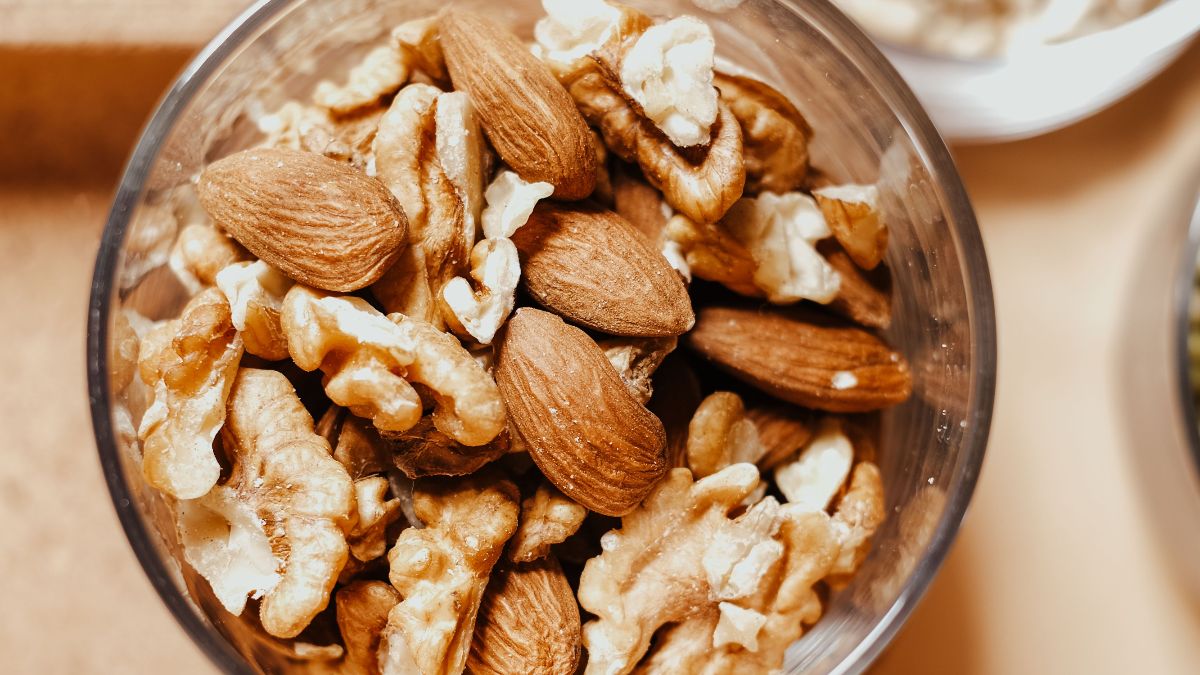
Almonds, walnuts, pistachios, cashews and peanuts all bring different nutrients to the table. Here’s what research actually says about nuts, the gut microbiome, soaked almonds and sensible portions.
Nuts were part of Indian kitchens long before they became wellness staples. There were overnight-soaked badam before school, walnuts cracked open during winter, peanuts tossed through poha and pistachios scattered over kheer. Cashews thickened gravies, while roasted groundnuts made an inexpensive, filling snack.
Today, nuts are often described as compact packets of protein, fibre and “healthy fats”. All of that is useful, but their relationship with the digestive system is more interesting than a nutrient list.
Some of the fibre and plant compounds in nuts escape digestion in the upper gastrointestinal tract and travel into the colon, where they become part of the environment in which gut microorganisms live. Researchers are studying whether regular nut consumption can influence particular microbes or the compounds they produce.
The findings so far are promising in places, inconsistent in others and much less dramatic than the phrase “gut-friendly superfood” suggests. Nuts can contribute to a varied diet. They cannot independently repair the microbiome, cure constipation or guarantee smoother digestion.
What Do Nuts Actually Do In The Gut?
Nuts bring together dietary fibre, predominantly unsaturated fats, plant protein, minerals and polyphenols. Their fibre contributes to overall fibre intake, while some of their carbohydrates and plant compounds may be metabolised by microorganisms in the colon.
During microbial fermentation, bacteria produce substances called short-chain fatty acids. These include acetate, propionate and butyrate, and researchers are interested in their roles within the intestinal environment. Finding that a food affects one of these compounds, however, is not the same as proving that it will improve every measure of gut health.
A 2025 systematic review and meta-analysis examined 28 intervention trials involving almonds, walnuts, peanuts, pistachios, Brazil nuts and mixed nuts. Most studies found no significant change in the gut microbiome’s overall diversity or community structure. Some reported changes in particular bacterial groups, and the pooled analysis found an increase in propionate. The results for other microbial compounds and measures of gut function were mixed.
The fairest conclusion is that nuts may have modest and selective effects on the gut microbiome, but responses differ according to the nut, amount, study population and research method. Their established nutritional value does not depend on promising to cultivate one supposedly perfect group of bacteria.
Almonds: The Familiar Indian Favourite
Almonds need little introduction in India. They appear in badam milk, halwa, kheer, chutneys and festive sweets, as well as in the familiar morning ritual of eating a few soaked nuts.
Almonds provide fibre, protein, predominantly unsaturated fats and minerals such as magnesium. They are also the most frequently studied nut in the recent gut-health literature.
One systematic review of randomised trials found that almond-based diets may encourage some bacteria associated with short-chain-fatty-acid production. That review, however, concerned people with type 2 diabetes, included a relatively small number of studies and did not find improvement across every outcome measured. Its findings should not be treated as proof that almonds remodel the microbiome in everyone.
The everyday case for almonds is simpler. They add texture and nutrients to a meal or snack. Try a modest handful with fruit instead of biscuits, or add chopped almonds to plain dahi with apple, guava or another seasonal fruit.
Must Almonds Be Soaked Overnight?
Soaked badam may be softer, easier to peel and tied to a comforting family ritual. What soaking does not appear to do is unlock a hidden store of nutrients.
In an eight-week crossover trial, 76 people ate soaked or unsoaked almonds in different forms. Soaking did not improve gastrointestinal tolerance. A separate laboratory study found only small changes in phytate after soaking and no improvement in the ratios used to estimate mineral availability.
Eat almonds soaked if you prefer their texture or flavour. Eat them unsoaked if that is more convenient. Neither version earns automatic superiority. Chewing them properly and choosing a portion that suits you matter more than following an elaborate “activation” ritual.
Walnuts: A Different Nutritional Package
Walnuts differ from almonds in both taste and nutritional composition. They are particularly notable for alpha-linolenic acid, or ALA, a plant-derived omega-3 fatty acid. Their gut story, however, also involves their fibre and polyphenols.
In one controlled, randomised crossover study, 18 healthy adults ate diets containing either no walnuts or 42 g of walnuts a day for two three-week periods. Walnut consumption changed the relative abundance of several bacterial groups and altered some microbially produced bile acids.
This was a small, short study conducted under controlled conditions. It shows that walnuts can interact with the intestinal environment; it does not prove that they create a universally “better” microbiome or that everyone needs to eat 42 g daily. Nor does it establish that walnuts are superior to almonds.
In an Indian kitchen, walnuts can be crushed into chutney, folded into vegetable pulao, added to oats or sprinkled over a bowl of dahi, cucumber, coriander, pomegranate and roasted cumin. Their slightly bitter richness works with savoury food just as well as it does with cake.
Pistachios, Cashews And Peanuts Count Too
Pistachios contribute fibre, protein and unsaturated fats, but they do not need to remain trapped in mithai. Unsalted pistachios can add crunch to poha, salads, dahi or roasted vegetables.
Cashews are sometimes dismissed because they contain less fibre than almonds or pistachios and are energy-dense. That does not make them nutritionally empty. They provide protein, unsaturated fats and minerals, and can be part of a varied diet in sensible quantities.
Peanuts are botanically legumes rather than tree nuts, although nutrition research and everyday food habits often group them with nuts. They are affordable, widely available and easy to use in poha, chutneys, chaat or a simple roasted snack. An unsalted handful of groundnuts can be every bit as practical as a far more expensive imported nut.
There is no need to construct a gut-health league table. Almonds, walnuts, pistachios, cashews and peanuts offer different combinations of nutrients. Rotate according to taste, budget, availability and tolerance.
Nuts And A Sensitive Gut
The label “gut-friendly” needs context. Some people tolerate nuts comfortably, while others experience bloating, heaviness or discomfort after a large portion. The amount eaten, the form of the nut and the rest of the meal can all matter.
If nuts are not usually part of your diet, begin with a small portion rather than suddenly eating several handfuls because a wellness reel told you to. Nut butter can be a convenient alternative, but check the label for added sugar, excess salt or hydrogenated fat. Choose a product made mainly from the nut itself.
Persistent symptoms should not automatically be blamed on fibre or treated through dietary guesswork. If several foods regularly cause pain, bloating, diarrhoea or other significant symptoms, seek advice from a qualified healthcare professional.
Food allergy is a separate and more serious issue. Peanuts and tree nuts are both recognised as major allergens, although peanuts are not tree nuts. Someone with a diagnosed allergy should avoid the relevant food and follow their allergist’s advice, including guidance on labels and cross-contact. Even small amounts can cause a reaction; this is not a food to “test” at home. US Food and Drug Administration
How Many Nuts Should You Eat?
The ICMR-National Institute of Nutrition’s Dietary Guidelines for Indians 2024 include 35 g of nuts and seeds in the illustrative “My Plate for the Day” pattern for a 2,000-kcal diet.
That figure combines nuts and seeds and belongs to a complete dietary pattern. It is not a mandatory daily dose for every person. Individual needs vary with age, appetite, activity, medical conditions and the rest of the diet.
For everyday use, a modest handful is a more practical cue than eating directly from a large packet. Portions matter because nuts are energy-dense, but that is not a reason to avoid them. It is simply a reason to let them replace a less nourishing snack rather than adding several handfuls on top of everything else.
The Indian Way To Eat More Nuts
Nuts do not require a separate “gut-health menu”. They can become part of food you already enjoy:
- Add crushed walnuts to cucumber-and-cumin raita.
- Scatter almonds over oats, poha or fruit with dahi.
- Sprinkle pistachios over a salad or savoury grain bowl.
- Add a few cashews to vegetable pulao.
- Use roasted peanuts in poha, chutney or homemade chaat.
- Make a small trail mix with roasted chana, makhana, nuts and seeds.
The World Health Organization recommends a varied diet containing fruits, vegetables, whole grains, legumes, nuts and seeds. That broader pattern matters far more than identifying one miraculous nut.
The best nut for your gut is not automatically the one with the loudest health claim. It is one you can afford, tolerate and enjoy as part of a varied diet—without expecting a handful to do the work of the entire plate.
FAQs
Which nuts are best for gut health?
There is no single best nut. Almonds, walnuts, pistachios, cashews and peanuts provide different combinations of fibre, plant protein, unsaturated fats and plant compounds, so variety is more useful than trying to rank them.
Are almonds good for the gut?
Almonds contribute fibre, protein, unsaturated fats and magnesium, and some research suggests they may influence particular gut bacteria. Evidence does not show that almonds universally remodel or “fix” the microbiome.
Are walnuts good for gut health?
Walnuts contain fibre, polyphenols and the plant omega-3 fat ALA. Small human studies have found changes in some intestinal bacterial groups after walnut consumption, but that does not prove walnuts create a universally healthier microbiome.
Are soaked almonds better than unsoaked almonds?
Not necessarily. Soaking makes almonds softer and may make them easier to peel, but research has not shown clear improvements in gastrointestinal tolerance or mineral availability simply from soaking them. Choose whichever form you prefer.
How many nuts should you eat per day?
There is no universal number that suits everybody. ICMR-NIN’s illustrative 2,000-kcal plate includes 35g of nuts and seeds combined, but this is part of an overall dietary pattern rather than a mandatory prescription for every adult.
Can nuts cause bloating?
Yes, some people may feel bloated or heavy after eating a large quantity of nuts. If you are not used to them, start with a modest portion and see how your digestive system responds.
This article provides general food and nutrition information and is not a substitute for personalised medical or dietary advice.