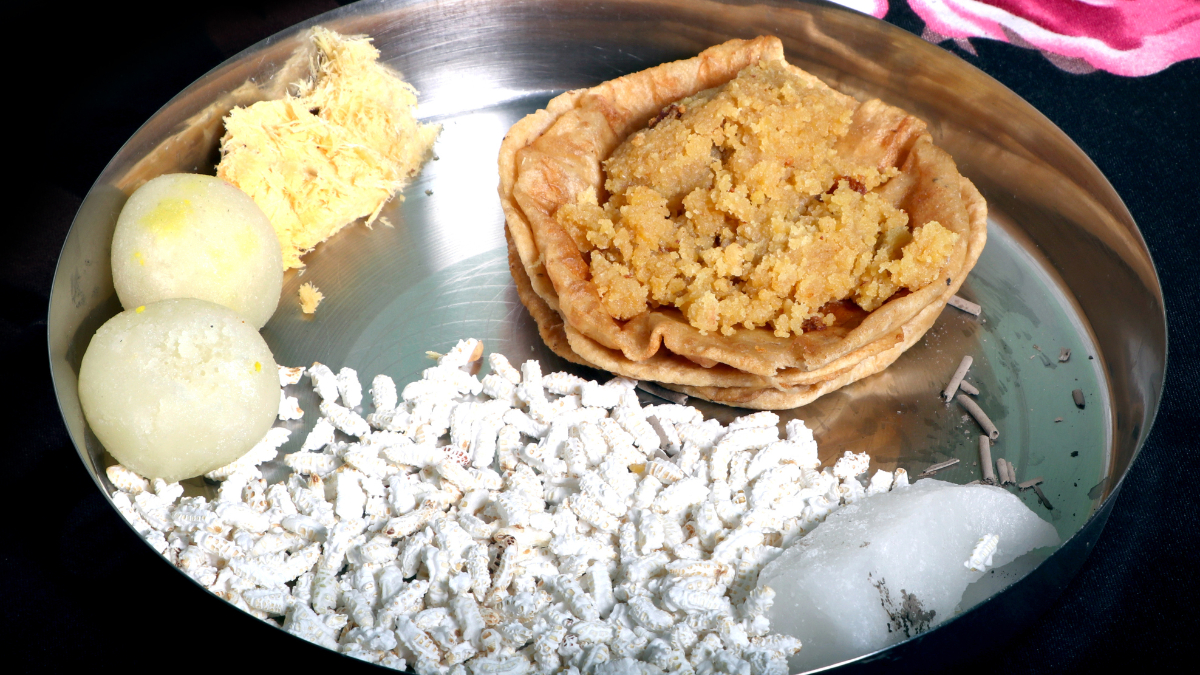
Ashtami Prasad: Enjoying Halwa, Puri and Kala Chana
Food, family and faith meet on the Kanya Pujan plate. A few thoughtful choices can keep halwa, puri and kala chana a meal to savour.
Table of Contents
Ashtami prasad commonly includes suji halwa, puri and kala chana, especially in families observing Kanya Pujan. Puri provides the grain-based part, halwa brings sweetness and richness, and chana adds protein and fibre. Enjoy them together in portions that suit your appetite and any dietary advice you follow. Soak and cook the chana until tender, eat at an unhurried pace, and let children stop when they are full. The whole plate matters: chana does not cancel out the oil or sugar in the other dishes.
There are some festive meals that need no introduction, and a plate of halwa, puris and kala chana arriving after the Ashtami puja is one of them. The sight alone (dark, glossy chana, soft and puffy puris still warm from the kadhai, and a generous spoonful or two of fragrant halwa) is enough to make any morning feel like a proper celebration. For many Indian households, particularly those observing Kanya Pujan, this is not simply a meal but part of a traditional ritual that brings food, family and faith together.
Many families perform Kanya Pujan on Ashtami or Navami, depending on family practice and the local panchang. For 2026, Drik Panchang lists Durga Ashtami on Monday, 19 October for Delhi. Check the calendar your household follows for its observances, especially Navami, rather than assuming one schedule applies everywhere.
That is also why the usual conversation around festive food, aka too much oil, too much sugar, too many puris, can miss the point. Ashtami prasad is meant to be enjoyed, not approached with dietary suspicion. At the same time, enjoying it comfortably does not mean turning a traditional plate into a supposedly ‘healthy’ but, in reality, overloaded imitation of itself. The more sensible approach is to understand what each preparation brings to the plate, and let the combination work as a meal rather than treating each item in isolation.
The classic combination has an appealing nutritional logic as well. Puri provides the grain-based, starchy element; halwa brings sweetness and richness; while kala chana supplies a pulse-based component. In other words, the plate has more variety than its deceptively simple appearance suggests. The Indian Council of Medical Research and National Institute of Nutrition (ICMR-NIN) dietary guidelines also emphasise variety across all food groups rather than building meals around any one isolated nutrient.
Their 2024 guidelines also encourage fresh and minimally processed foods, including whole grains and legumes, and caution against diets in which excessive added fat, sugar or salt dominate. That makes kala chana especially interesting here: it is a pulse, and pulses are an important source of plant protein, fibre and other nutrients in Indian diets. So, nutritionally as well, the three foods are not doing the same job. Rather, they are executing a three-part culinary operation.
Ashtami halwa is usually a suji halwa, although household versions do vary. Some are loose and spoonable, many are almost sliceable, and the flavour can shift considerably depending on the amount of ghee, sugar, cardamom, nuts and dried fruit used. So, the first mistake would be to treat halwa as though it needs to be transformed into a low-sugar dessert to earn its rightful place on the Kanya Pujan plate. It does not. It is a celebratory preparation, and its sweetness is part of what makes the ritual food memorable and recognisable.
The more useful distinction to keep in mind is between a portion of halwa as prasad and returning to the halwa for helping after helping simply because it is available. The two are not the same way of eating. Halwa made with bountiful quantities of sugar and ghee is energy-dense, so helping after helping adds up. The key is moderation, not elimination.
So, there is no nutritional prize for eliminating the halwa from your Ashtami plate. A serving that suits your appetite and any personal dietary advice, alongside the other foods, makes more sense than picking up a large bowl of halwa on its own and then grazing on it throughout the afternoon. There is another reason to eat it as part of the plate, too: the chana and puri provide texture and a savoury contrast that a sweet dish by itself cannot. As a result, the meal can feel complete rather than like an extended dessert session.
Puri has acquired an unfortunate reputation in modern nutrition conversations because it is deep-fried. As a result, its mere presence is often treated as a catalyst for dietary disaster. Of course, the ICMR-NIN guidelines do identify puri and other deep-fried foods as high-fat foods, especially when prepared with substantial quantities of oil or fat, and that is worth knowing. But it is equally important not to stretch the point into the idea that an occasional, festive serving of puri is inherently harmful.
The practical difference lies in how the puri is made and how much of it becomes the meal.
Puris are best eaten fresh rather than kept around for repeated snacking. If the household is making them specifically for Kanya Pujan, there is little reason to make an enormous batch simply because the food is traditional. A smaller number of properly puffed puris can be far more satisfying than a mountain of them that gradually disappears, or turns cold and soggy, simply because it is there. A few small kitchen habits help as well: fry in properly heated oil, avoid overcrowding the kadhai, and let the puris drain on a sieve or kitchen paper for a moment before serving.
Also, there is no need to replace puris with an entirely different bread merely to make the meal appear virtuous. If puri is the food traditionally or nostalgically associated with the puja in your home, then puri is the food. A better, more balanced adjustment can happen around it: in the quantity of halwa, a generous presence of chana, and what else is eaten across the rest of your day.
If halwa is the indulgent note and puri is the celebratory one, then kala chana is the component that gives your plate some substance. Black chickpeas contain protein and dietary fibre, adding a pulse-based component alongside the grain-based dishes. The Indian Food Composition Tables 2017 list whole Bengal gram at about 19 g of protein and 25 g of fibre per 100 g of uncooked, dried beans. These are ingredient values, not the amounts in 100 g of cooked chana or one cooked katori: chickpeas absorb water during cooking. Research on dietary fibre supports its role in gastrointestinal health, while recognising that the source, type and amount of fibre matter.
Of course, that does not mean kala chana magically ‘cancels out’ puri and halwa. Food does not work like a mathematical equation in which one ingredient can neutralise another.
It simply shows that the traditional combination has nutritional diversity built into it. A serving of well-cooked kala chana adds a pulse component to a meal that would otherwise lean much more heavily towards cereals, added sugar and cooking fat. Preparation matters here as well.
Soak kala chana overnight in the fridge, drain and rinse it, then cook it in fresh water until tender. Seasoned with cumin, ginger, asafoetida or other familiar spices, it can be pretty different from a very oily or heavily salted version. Soaking and discarding the water may reduce some of the carbohydrates that contribute to gas, but it does not guarantee a comfortable stomach. And for someone who is not accustomed to eating legumes, suddenly eating a very large bowl of chickpeas can be a recipe for discomfort rather than digestive enlightenment. This is one place where ‘healthy festival food’ advice can become unnecessarily dramatic. More fibre is not automatically better in a single sitting. Individual tolerance, the type of fibre and the wider diet all matter a lot.
For a closer look at how whole and split pulses differ, see which dals and pulses have the most fibre.
None of this needs a rulebook, but a few small habits can help you enjoy the morning:
There is also a cultural dimension to this meal that a purely nutritional analysis often misses. For many families, Kanya Pujan food carries memories of little girls arriving after the puja, being welcomed into homes and served a meal that has been prepared specially for the occasion. The halwa is fragrant, the puris arrive hot, the chana is generously ladled out, and someone is inevitably insisting that the children should have ‘at least one more’ to fill up properly, while the kids are too stuffed to eat a bite more. If you’re the one serving this year, it’s perfectly fine to let the little ones stop when they’re full.
For very young children, mash the chana and leave whole nuts or hard dried-fruit pieces out of their halwa. Serve them seated and supervised, with food textures they can manage.
That emotional context matters. Food eaten as part of a ritual does not need to be stripped of its identity in the name of wellness. Practise balance and portion control instead. And once the satisfying, celebratory meal is finished, let it be finished. That is a far more realistic way to think about festive nourishment: not as perfection, punishment or nutritional accounting, but as a meal with a special, cherished place in the calendar, a powerful religious and cultural meaning and, quite frankly, some very good food.
ICMR-National Institute of Nutrition. Dietary Guidelines for Indians 2024
Longvah T, Ananthan R, Bhaskarachary K, Venkaiah K. Indian Food Composition Tables 2017
Gill SK, Rossi M, Bajka B, Whelan K. Dietary fibre in gastrointestinal health and disease — Nature Reviews Gastroenterology & Hepatology. 2021;18:101–116. DOI: 10.1038/s41575-020-00375-4.
Colorado State University Extension. Cooking Dry Beans
North Dakota State University Extension. Prairie Fare: I’m Spillin’ the Beans
CDC. Choking Hazards
Drik Panchang. Durga Ashtami 2026 for Delhi
Drik Panchang. Kumari Puja and Kanya Puja
Disclaimer: This article offers general food and nutrition information, not individual medical advice. Follow any prescribed dietary guidance. If you have a health condition or take regular medicines, ask your clinician for advice before fasting.
A common Kanya Pujan plate includes suji halwa, freshly fried puris and cooked kala chana, often without gravy. Family and regional traditions can vary.
Puris are deep-fried, and halwa usually contains ghee and sugar. Recipe, portion and frequency matter; an occasional festive plate can fit many eating patterns, subject to personal dietary advice.
There is no universal amount. Choose a portion that suits your appetite and any dietary advice you follow; enjoy it alongside the other foods rather than automatically taking repeated helpings.
Kala chana is a traditional part of prasad in many households. Nutritionally, it adds plant protein and fibre, but it does not cancel out the sugar or frying fat.
Yes. Some carbohydrates in chana are fermented by gut microbes and can produce gas. Soak and cook it well, choose comfortable portions, and seek advice for persistent or severe discomfort.