

Table of Contents
Every Indian kitchen runs its own quality control. Khapli wheat is finding out what that actually means.
In India, no health food gets a free pass. It doesn’t matter how impressive the nutritional profile is, how many milligrams of protein it contains, or how many wellness accounts are posting about it. Before anything earns a permanent place in an Indian kitchen, it has to survive something far more demanding than a laboratory test.
It has to survive the family.
The roti test is not an official thing. Nobody announces it. But every home cook in this country knows exactly what it is: the moment a new ingredient or flour has to prove itself at the dinner table, under the rolling pin, in the tiffin box, and in the mouths of people who did not ask for a health upgrade and are perfectly happy with the way things were. Pass all of those, and the ingredient earns its place. Fail any one of them, and it goes back in the cupboard, quietly forgotten.
Khapli atta — made from Emmer wheat, one of the oldest cultivated grains in the world — has been going through exactly this test in kitchens across urban India. And what is interesting is not just that it is passing. It is how it is passing, and what that tells us about what Indian home cooks actually need from a health food.
The Nutritional Case: What Khapli Actually Brings
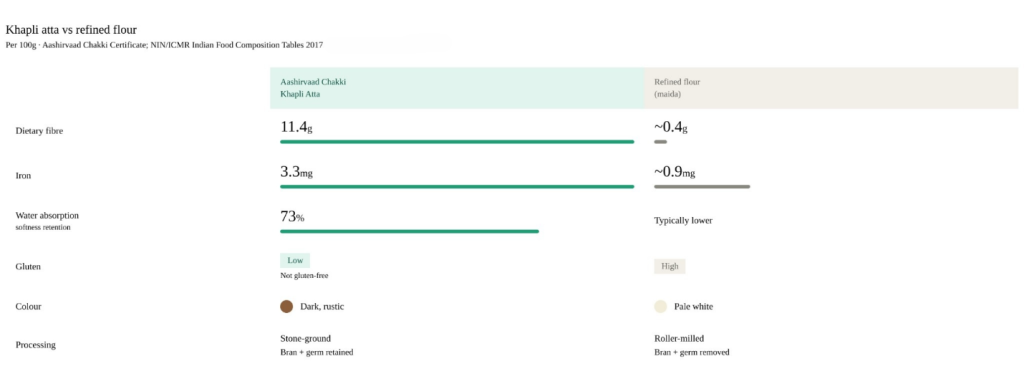
The nutritional case for Khapli is straightforward. It is higher in protein and dietary fibre than modern wheat varieties, lower in gluten, and richer in micronutrients including iron, calcium, and B vitamins. Three rotis made with Aashirvaad Chakki Khapli Atta provide approximately 34% of the daily fibre requirement and around 23% of the daily protein requirement — meaningful numbers for a food that most families eat at every single meal.
The reason the numbers are what they are comes down to how the grain is processed. When wheat is refined into the fine, pale flour that fills most grocery shelves, the process strips away the bran and germ — the two parts of the grain where most of the fibre, protein, iron, and fat-soluble vitamins actually live. What remains is primarily the starchy endosperm: caloric, consistent in texture, and useful for making soft, uniform rotis that stay pale and familiar.
Khapli wheat, stone-ground using the traditional Chakki Jaisi Pisai method, keeps all three parts of the grain intact. The colour of the roti is the most visible consequence: darker, with a rustic appearance that immediately signals less processing. But the more important consequence is in the gut. Grain that retains its bran and germ digests more slowly. The fibre slows the rate at which carbohydrates are absorbed, which means blood glucose rises more gradually, and the meal sits with you longer. For anyone who has noticed they feel genuinely satisfied after certain meals and oddly hollow after others, this difference in grain processing is often part of the explanation.
It is also worth being precise about one thing the marketing sometimes obscures: Khapli is low-gluten, not gluten-free. It contains less gluten than modern high-yield wheat varieties, which many people find sits more comfortably on the stomach. But it is not safe for those with coeliac disease and should not be treated as a substitute for clinically gluten-free flour where that is a medical requirement.
Is Aashirvaad Chakki Khapli Atta good for digestion?
Aashirvaad Chakki Khapli Atta is stone-ground from Emmer wheat, retaining the grain’s bran and germ. Its higher fibre content (approximately 11.4g per 100g) may support digestive regularity and more sustained satiety compared to refined flour. It is a low-gluten grain, not gluten-free, and is not suitable for people with coeliac disease.
Test One: The Visual Barrier
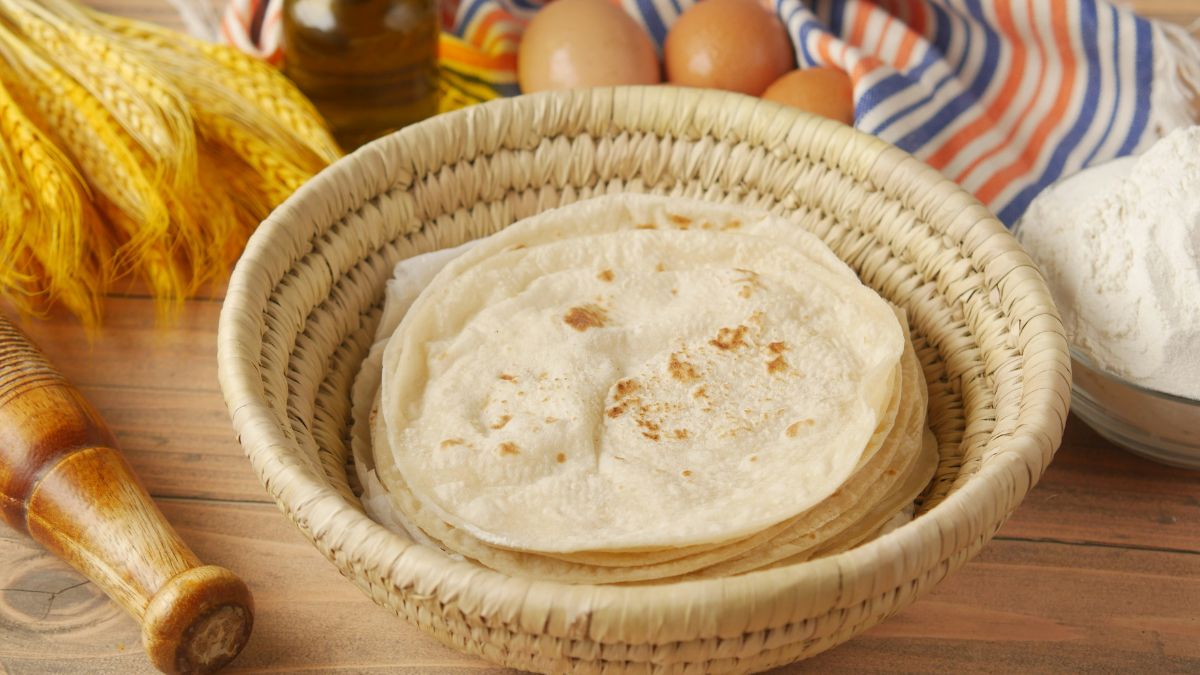
The first challenge Khapli faces is the visual one, and it is not a small one. Khapli rotis are darker than the rotis most Indian families grew up eating. Less glossy. Browner, with none of the bright, familiar finish of a Sharbati roti. In a country where the appearance of food carries enormous cultural weight — where a soft, pale, perfectly puffed phulka is the benchmark against which all rotis are measured — this is a real barrier.
The people who pushed past it did so, almost universally, by reframing what they were looking at. The darker colour is not a sign of inferior processing. It is a sign of less processing. When a grain keeps its bran intact through the milling, the flour is naturally darker — it is carrying more of the original grain’s character, not less. A pale flour has had that character refined away. Once this is understood, the appearance of the roti changes from a drawback into a signal.
A touch of ghee on the finished roti helps with the visual as well as the flavour. The fat brings out the nuttiness of the grain and gives the roti a sheen that makes it look as good as it tastes. It is a small trick, but it is one that comes up consistently among home cooks who have successfully made the switch.
Test Two: The Tiffin Box
The second challenge is the tiffin test, and this is where many health foods quietly fail. An ingredient can be as nutritious as it likes at 7 in the morning when it is freshly cooked. What matters in an Indian household is whether it is still edible at 1 in the afternoon, packed in a box, carried on a commute, and eaten at a desk or a school bench. The roti that turns hard, dry, and unpleasant by lunchtime is not a health food anyone will keep buying.
This is where the quality of the flour itself becomes decisive. Aashirvaad Chakki Khapli Atta has a confirmed Water Absorption Percentage of 73% — measurably higher than most wheat flours, and directly linked to how soft the rotis stay over time. Stone-ground using the Chakki Jaisi Pisai method, with 40+ quality checks from grain to grinding, the flour produces a dough that holds moisture well through the cooking process and for several hours after.
Tip: A small addition of milk while kneading the dough extends that softness further — a tip that circulates among home cooks who have worked out how to get the best from Khapli. Wrapping finished rotis in muslin cloth rather than foil also helps: muslin breathes, so the rotis stay soft rather than going clammy.
One home cook described eating a tiffin roti at 9 in the evening that had been made at 1:30 in the afternoon: still soft enough to tear without effort. That is a roti that has passed the tiffin test.
Test Three: The Family
The third challenge is the one that decides everything: the family. Health food that only one person in a household will eat is not really a household food. It is a personal project, and personal projects have a short shelf life when they require a separate meal to be made every night.
The home cooks who have successfully brought Khapli into their kitchens are the ones who managed to bring their families along — gradually, honestly, without pretending the roti was something it was not. The approach that works, again and again, is not disguise. It is negotiation.
What this looks like in practice is a division of purpose rather than a complete replacement. Khapli takes over the everyday rotis — the weeknight phulkas, the lunch parathas, the tiffin. Regular atta is kept for puris, sweets, and the larger occasions when thirty people are sitting down and practicality has to win. This is not a nutritional compromise. It is a sensible allocation of the right grain to the right preparation. Heritage grains like Khapli perform best in daily staple use, where their fibre and sustained-release properties accumulate over time. Other flours have their own strengths in their own contexts, and keeping them around for specific purposes is nutritionally sound — not a failure to commit.
The households that took this approach — giving the new flour a fair trial for a month, in the everyday preparations, without treating it as a total kitchen overhaul — are, in most cases, still using it a year later. The transition worked because it asked for less. Families adapt to gradual change far more reliably than to wholesale replacement, particularly where food is involved.
“When you know the benefits, you adjust.”
What Passing the Roti Test Actually Means
There is a line that one Khapli convert used that has stayed with us. Asked about the trade-offs — the darker colour, the slightly more demanding dough, the higher price — she said: “When you know the health benefits, you compromise.”
It sounds like a concession. It is not. It is what informed choice actually looks like in a real kitchen, made by a real person who has weighed what she is giving up against what she is getting and decided the exchange is worth it. Not because a wellness account told her so. Because her family is eating better, waking up lighter, and — crucially — still eating rotis.
That is what it looks like when health food passes the roti test. Not a perfect replacement for what came before. A better answer to what the family actually needs.
Aashirvaad Chakki Khapli Atta is sourced from farmers of Karnataka and Maharashtra, stone-ground using the Chakki Jaisi Pisai method, and put through 40+ rigorous quality checks per batch. Each pack carries a unique quality certificate traceable to the grain source and the specific milling batch.