


Table of Contents
You eat fairly healthily. But are you eating the same healthy things every single day? Your gut would like a word.
There is a particular kind of healthy eating that is more limited than it appears. You have figured out what works for you — a set of meals that are nutritious, manageable, not too time-consuming — and you rotate through them. Monday is dal-rice. Tuesday is roti-sabzi. Wednesday is probably also roti-sabzi. The vegetables might vary slightly but the roster is fairly fixed. It is not bad food. It is dependable food.
Your gut, however, has a different perspective on the word “dependable.”
The microbiome — the community of bacteria, fungi, and other microbes living in your gut — thrives on variety in a way that goes beyond the usual nutritional framing. Different bacterial species ferment different types of plant fibre. Different vegetables, legumes, and grains contain different combinations of prebiotic compounds that feed different populations. A diet built on a narrow rotation of even nutritious foods feeds some bacterial strains well and starves others. Over time, the strains that are not being fed reduce in number. Microbiome diversity quietly decreases.
And microbiome diversity, it turns out, is one of the most consistent predictors of gut health that researchers have found. More diverse = more resilient, better digestion, stronger gut lining, more robust immune response. Less diverse = the opposite.
The 30 plants a week idea
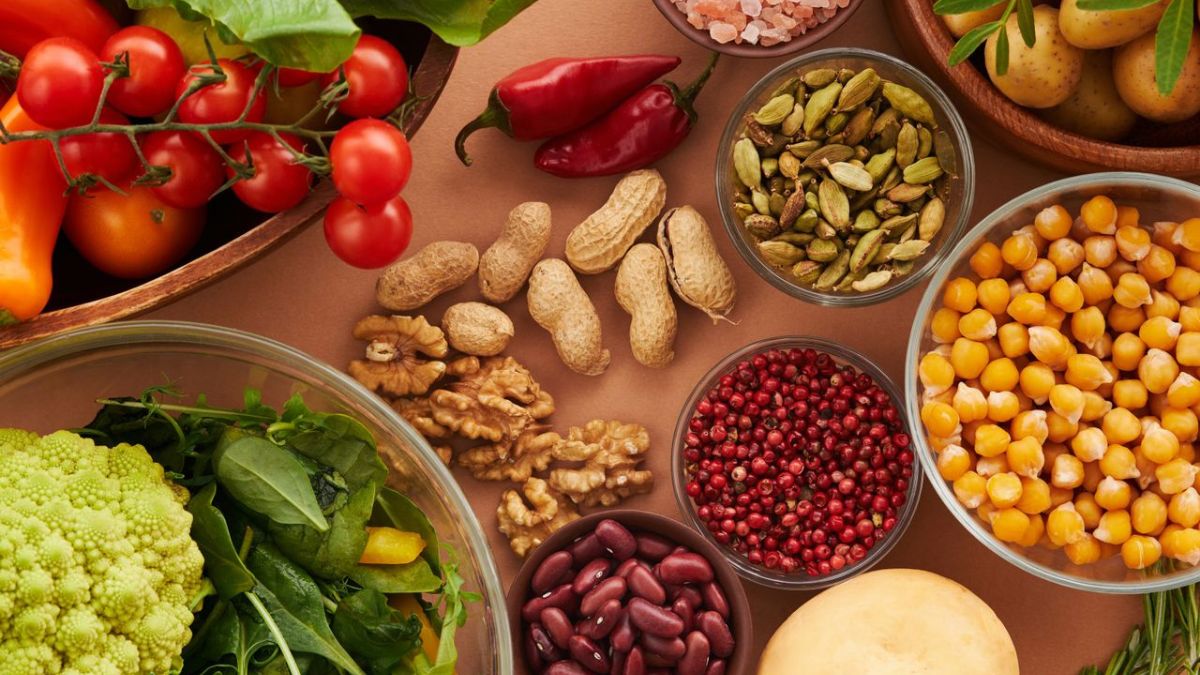
There is a target that has come out of microbiome research that is worth knowing about: eating 30 or more different plant foods per week is associated with significantly higher microbiome diversity than eating fewer. This includes vegetables, fruits, legumes, whole grains, nuts, seeds, herbs, and spices. Each different plant brings a slightly different set of fibres and compounds that feeds a slightly different set of gut bacteria.
Thirty sounds like a lot until you start counting. The dal (1), the two vegetables in the sabzi (2 and 3), the roti’s grain (4), the coriander garnish (5), the cumin in the tadka (6), the ginger-garlic paste (7 and 8), the onion (9), the tomato (10). You can get to ten before you have finished describing a single ordinary Indian meal. The Indian kitchen, when it is drawing from the full range of its ingredients rather than a contracted version of them, is already built for diversity.
The issue is contraction. When the meal repertoire narrows — same vegetables, same dal, same grain, same spices — the plant diversity drops, and the microbiome notices.
Where the grain fits in
The grain you eat every day is one of the most consistent inputs your microbiome receives. Refined flour provides very little that the microbiome can work with — the processing that produces white flour removes the prebiotic fibre that the bran contains, and what remains is primarily starch that is digested in the small intestine before it reaches the large intestine where the microbiome lives.
A stone-ground whole grain flour — one where the bran and germ are intact — delivers prebiotic fibre to the large intestine, where it feeds a range of beneficial bacterial populations. Aashirvaad Chakki Khapli Atta, made from ancient Emmer wheat using traditional stone-grinding that preserves the grain’s structure, is doing this work with every roti. It is not the only source of variety the microbiome needs, but it is a meaningful and consistent contribution to it.
A diverse gut microbiome is built on a diverse diet. The Indian kitchen, at its fullest, is already designed for this. The question is whether you are using the whole kitchen.
Small ways to add variety without adding complexity
The goal is not to make every meal an adventure or to source unusual ingredients. It is to use a slightly wider range of what is already available in the average Indian kitchen.
Rotating the dal is one of the easiest. Masoor one day, moong the next, rajma later in the week, chana on the weekend. Each has a different fibre profile and feeds different microbial populations. Rotating the vegetable in the sabzi — not always the same two, but moving through the seasonal options available at the market. Adding a different seed or nut to breakfast a few times a week: til in the chutney, flaxseed in the roti dough, a small handful of groundnuts as a snack.
Fermented foods are worth their own special mention. Curd, chaas, kanji, idli-dosa batter, pickles made by lacto-fermentation — these add live microbial cultures to the gut rather than just feeding the ones already there. Even a small daily portion of homemade curd is doing something that no amount of dietary fibre, on its own, can replicate.
Your gut is not asking for a completely new diet. It is asking for a bit more range within the diet you already have. Which, given the breadth of the Indian food tradition, is not a difficult request to honour.
This article is part of the Your Gut Doesn’t Read Labels series on Happy Tummy. It is for general informational purposes and does not constitute medical or dietary advice.