The Science of Satiety: Why Khapli Rotis Keep You Full Longer
Why do some meals keep you satisfied for hours while others leave you reaching for a snack by 3:30 pm? Fibre, protein and a slower glycaemic response may hold the answer — and Khapli rotis bring all three to the plate.
Why do some meals keep you satisfied for hours while others leave you reaching for a snack by 3:30 pm? Fibre, protein and a slower glycaemic response may hold the answer — and Khapli rotis bring all three to the plate.
There are two kinds of hunger. The first is real hunger — the kind that happens slowly, a few hours after a meal, when your body genuinely needs to refuel. The second is stranger. You finish lunch at 1pm. By 3:30pm, you are standing near the office pantry staring at a packet of biscuits you were not thinking about twenty minutes ago. Or you are at home, opening and closing the fridge as if new food might appear.
We have all experienced it. And while it is tempting to blame willpower or discipline, nutrition science increasingly suggests that satiety — the feeling of fullness after eating — has far more to do with what you are eating than how strong your self-control is.
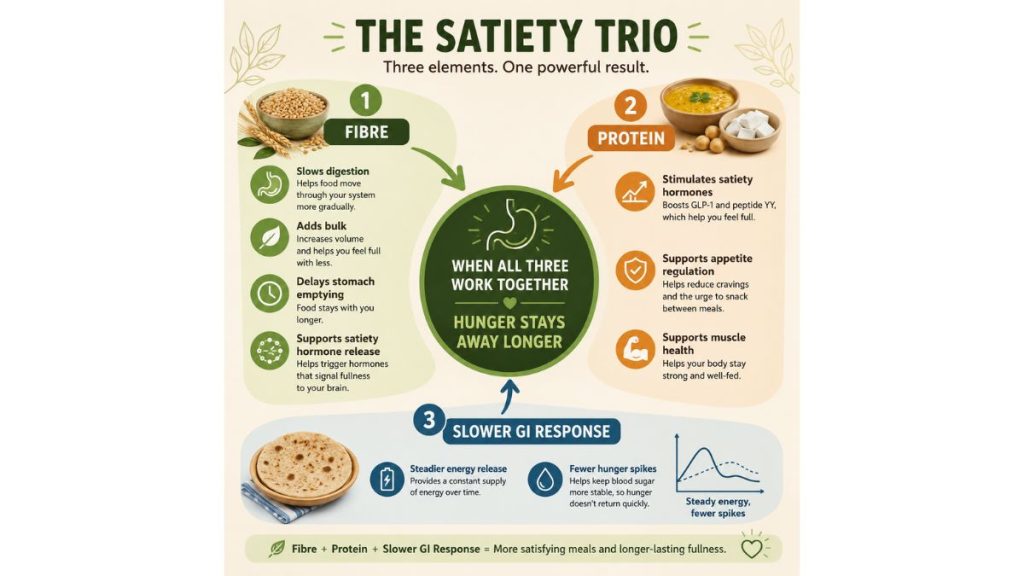
Some foods simply keep you full longer. Others seem to disappear from your system almost as quickly as they arrived. The difference comes down to three powerful factors: fibre, protein, and glycaemic response. Together, they determine how satisfying a meal actually is.
Why do I feel hungry again so quickly after eating?
Hunger returns quickly when a meal is built primarily on rapidly-digesting carbohydrates — refined flour, white rice, processed foods — with limited fibre and protein. These meals digest fast, blood sugar rises and falls sharply, and the hunger signal returns sooner than the volume of food would suggest. Meals with more fibre, adequate protein, and a slower glycaemic response tend to hold hunger back considerably longer.
What is satiety?
Satiety is the feeling that tells your brain: I am good for now. Not stuffed, not uncomfortable — just satisfied. A meal with high satiety typically keeps hunger away longer, reduces cravings, improves meal satisfaction, and supports more stable energy through the day. A meal with poor satiety often leads to frequent snacking, afternoon cravings, and energy fluctuations. The goal is not eating less. It is staying satisfied longer.
Why calories alone do not explain fullness
Two meals can contain the same number of calories and create completely different hunger responses. 300 calories of biscuits and 300 calories of roti, dal, and sabzi. Most people instinctively know which one will keep them fuller. Satiety is not determined by calories alone. It depends on fibre, protein, food structure, digestion speed, and even how much chewing is involved. This is where whole grains begin to change the picture.
The three factors that determine how full you stay
Steadier blood sugar release, fewer hunger spikes, more even energy
High
Fibre: the unsung hero of fullness
If protein is the lead actor of nutrition, fibre is the hardworking supporting actor that nobody talks about enough. Fibre helps satiety because it slows digestion, adds bulk to meals, increases chewing effort, and delays stomach emptying. In simple terms, food stays with you longer, which means hunger takes longer to return.
Dietary fibre comes in two broad types, and both contribute to satiety in different ways. Soluble fibre — found in oats, barley, legumes, and certain fruits — dissolves in water to form a gel-like consistency in the gut, slowing digestion and moderating the rate at which nutrients are absorbed. Insoluble fibre — found in whole grain bran, vegetables, and seeds — adds bulk to the meal and supports regularity. Together, they also influence the release of satiety hormones including GLP-1 and peptide YY, which signal to the brain that the meal is complete. These hormonal signals are part of why a high-fibre meal produces more lasting fullness than a low-fibre one of equivalent calories.
People eating highly refined foods frequently report feeling hungry quickly, constant snacking, and cravings between meals. The food digests fast and leaves the system fast. The absence of fibre is often the missing variable.
Protein: the fullness star
Protein is one of the most satiating nutrients available. It stimulates satiety hormones, supports appetite regulation, and slows the digestion of the overall meal. This is why a breakfast of eggs, paneer, or dal chilla often feels very different from the same calories worth of biscuits or toast.
Protein does not work alone. Its satiety effect becomes significantly stronger when paired with fibre. Roti, dal, and sabzi together is an example of this combination working as it should: the grain provides fibre and carbohydrate, the dal provides protein, and the sabzi adds more fibre and micronutrients. The combination creates a meal that holds you considerably longer than any of the components individually.
The glycaemic response: why the 3:30pm crash happens
When carbohydrates digest rapidly, blood sugar rises sharply. The body responds by bringing it down, and the resulting dip produces hunger, low energy, and the specific difficulty concentrating that characterises the post-lunch slump. Most people have experienced the office version of this: a lunch built around white rice, maida roti, or refined bread, followed by inexplicable tiredness at 3:30pm and an impulse toward snacks.
This is the glycaemic curve in action. A meal built on rapidly digesting carbohydrates raises blood sugar fast, the body lowers it fast, and the dip produces hunger before the meal should be over. The meal that digests more gradually — from a whole grain with a slower glycaemic response — produces a steadier curve. Energy stays more even, hunger returns more slowly, and the 3:30pm moment simply does not arrive at the same intensity.
A note on GI figures: specific glycaemic index numbers for Khapli wheat have not been confirmed by the brand. This article uses directional language throughout — ‘slower glycaemic response,’ ‘more gradual digestion’ — and does not cite specific GI scores.
Where Khapli wheat fits in
Compared to heavily refined grain products, Khapli naturally offers higher fibre, a denser grain structure, moderate protein, and slower digestion characteristics — meaning it performs well across all three satiety factors when used as part of a balanced meal.
People who regularly use Khapli atta often find that meals feel more satisfying and that the mid-afternoon hunger that follows a refined-flour lunch arrives later or less intensely. This is consistent with the mechanisms described above: more fibre, slower digestion, a more gradual energy release. The grain helps; the full meal completes the picture.
The practical difference shows up most clearly in the tiffin box. A Khapli roti packed in the morning with dal and a sabzi will still be satisfying at lunchtime — both because the whole grain holds together better (Khapli’s higher water absorption means the roti stays soft for longer) and because the meal is built around fibre and protein rather than just starch. Compared to a lunch of maida paratha with a thin filling, the Khapli tiffin produces a more sustained afternoon. The difference is particularly noticeable on long meeting days or when the next meal opportunity is uncertain.
Satiety is about the whole meal
Khapli is not a magic ingredient. A Khapli roti eaten alongside vegetables, dal, curd, and a protein source will generally create much better satiety than a Khapli roti eaten alone. The grain helps. The meal completes the picture.
Satiety and weight management
Most restrictive diets fail not because of a lack of discipline but because they fight the body’s hunger signals rather than working with them. Sustained calorie restriction tends to increase appetite over time, making the pattern progressively harder to maintain. A different approach — building meals that are genuinely satisfying, so that the impulse to overeat or snack is reduced naturally — tends to produce better long-term outcomes with considerably less effort.
Satiety-focused eating is not about eating less. It is about choosing foods that give the body a better reason to stay satisfied. Whole grains, adequate protein, vegetables, and fermented foods together create meals that the gut handles comfortably and the brain registers as complete. Traditional Indian thalis, at their best, are already structured this way. The shift from whole grain to refined flour is often what breaks the architecture.
Small satiety upgrades that actually work
Add more fibre: whole grains, vegetables, legumes
Include protein at each meal: dal, paneer, eggs, curd
Slow down refined carbohydrates where possible
Replace heavily refined grain products with whole grain options where practical
Stay hydrated — fibre works better with adequate water
Build meals, not snacks: a structured meal outperforms repeated small snacks for sustained satiety
Aashirvaad Chakki Khapli Atta
One reason many households are exploring Aashirvaad Chakki Khapli Atta is that it improves a staple food they already eat regularly. Made from authentic Khapli wheat, it offers naturally higher fibre, whole grain integrity, moderate protein, and slower-digesting carbohydrate structure. Paired with a balanced meal, it supports more satisfying daily eating without requiring any change to how you cook or what your family will accept on the plate.
The most successful eating habits are usually not built around eating less. They are built around staying satisfied. And sometimes the smartest nutrition move is simply choosing a food that gives your body a better reason to say: bas, abhi ke liye itna hi kaafi hai.
This article is for general informational and educational purposes. It is not a substitute for medical or dietary advice.
You are now being directed to an external website https://www.callr.live/aashirvaadexperts/premium-plan.
This link is provided for your information and convenience only and ITC Limited is not
responsible for the contents or services provided by Brand Touch India or any information that
you share with Brand Touch India.