

Table of Contents
Ragi is a naturally gluten-free millet with fibre comparable to whole-wheat atta and substantially more calcium than most other grains. Here is where it fits into an everyday diet (and where the superfood claims go too far).
IS RAGI GOOD FOR YOU? Yes: Ragi is a nutritious whole grain with fibre comparable to whole-wheat atta and other commonly eaten millets. Its most distinctive nutritional feature is its calcium content: the Indian Food Composition Tables 2017 list ragi at approximately 364mg calcium per 100g, considerably more than most other cereals.
That does not make ragi the best grain for everyone, nor does it turn every ragi dish into a health food. What it offers is grain variety, useful fibre, naturally gluten-free status and several familiar ways of bringing it into everyday Indian cooking. Its value lies in those specific qualities… not in treating it as a superfood that should replace everything else.
What Is Ragi?
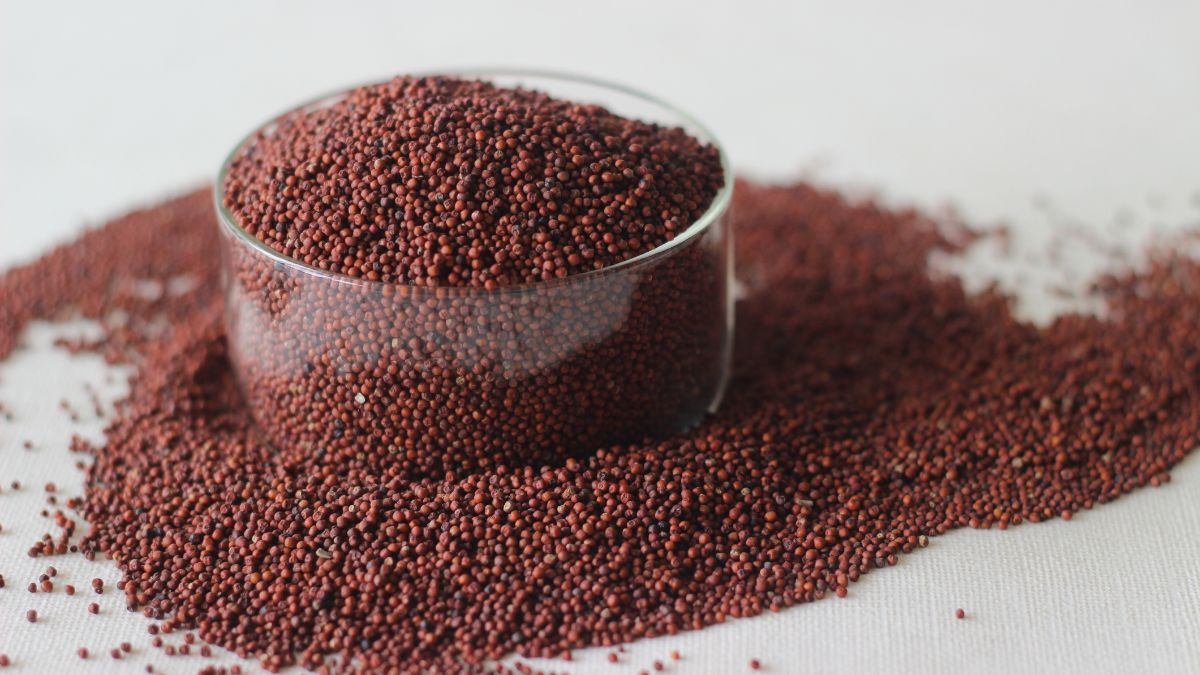
Ragi is finger millet, or Eleusine coracana — a small, reddish-brown grain that has been cultivated across the Deccan plateau, parts of South India and East Africa for thousands of years. It gets its ‘finger millet’ name from the shape of its seed head. In South Indian cooking it appears most commonly as ragi mudde (steamed balls eaten with sambar or chutney), ragi dosa, ragi roti, and as a porridge or kanji. (These preparations do not all have identical nutritional effects: the amount of flour used, how finely it is ground, fermentation, cooking method and what accompanies it all shape the final meal.)
How Much Fibre Does Ragi Contain, And Is It Gluten-Free?
IFCT 2017 lists ragi at approximately 11.18g of total dietary fibre per 100g. That is broadly comparable to bajra at about 11.49g, jowar at about 10.22g and whole-wheat atta at about 11.36g.
The useful comparison, therefore, is not “ragi versus every other whole grain”, but whole grains versus more heavily refined flour. Maida contains considerably less fibre at approximately 2.76g per 100g. Ragi is also naturally gluten-free, although people following a strict gluten-free diet must check the specific product for cross-contact and keep its preparation separate from wheat.
| ⓘ Ragi at a Glance Fibre: ~11.18g per 100g (IFCT 2017) — comparable to bajra, jowar and whole wheat Gluten-free: Naturally gluten-free, but packaged flour may require cross-contact checks Calcium: Approximately 364mg per 100g — substantially higher than most other cereals Taste: Mildly earthy, with a denser texture than wheat-based preparations Best understood as: One useful grain in a varied diet, not a replacement for every other grain |
How Much Calcium Does Ragi Contain?
Ragi’s calcium reputation has a firm nutritional basis. IFCT 2017 lists it at approximately 364mg calcium per 100g, much higher than the figures recorded for grains such as bajra, jowar and whole-wheat atta.
That does not mean the body absorbs every milligram listed, or that eating ragi by itself guarantees healthy bones. Calcium absorption and bone health are affected by the wider diet and other factors, while the amount consumed depends on the quantity of ragi in the actual recipe. Processing methods may also influence how accessible its minerals are.
The accurate claim is therefore straightforward: ragi is an unusually calcium-rich cereal. It can contribute to calcium intake, but should not be presented as a treatment for calcium deficiency, osteoporosis or any other medical condition.
Does Ragi Have a Low Glycaemic Index?
There is no single glycaemic-index number that applies to every ragi dish. A coarse, fermented ragi preparation is not nutritionally identical to a finely milled porridge, sweetened drink, biscuit or instant mix.
Processing, particle size, cooking and the other ingredients in the meal can all change the blood-glucose response. This is why ragi should not automatically be labelled “low-GI” or recommended as a treatment for diabetes. Anyone managing blood sugar should consider the complete dish, portion and personal medical advice—not the grain’s name alone.
How to Use Ragi Flour
Ragi flour can be used for roti, dosa, idli, porridge and several regional dishes. Because ragi contains no gluten, a pure ragi dough behaves differently from wheat dough: some rotis are shaped by hand or prepared using hot water, while other recipes blend ragi with wheat to make rolling easier.
For households new to the grain, ragi flour—such as Aashirvaad Ragi Flour—can be introduced through a familiar recipe rather than as a total substitution. Add a modest quantity to an atta or dosa batter, or try a traditional ragi preparation whose texture is designed around the grain.
Ragi porridge can be made sweet or savoury, but the nutrition of the finished bowl also depends on what is added to it. A heavily sweetened ragi preparation does not inherit a special health exemption simply because its base is millet.
Is Ragi Better Than Wheat or Other Millets?
Ragi isn’t a superfood that replaces everything else on the plate. Like every whole grain in this series, its value comes from variety — a week’s eating that includes ragi alongside other grains, pulses, vegetables and fruit is more nutritionally rounded than a diet built around ragi alone. It’s also worth noting that ragi’s denser texture and earthier flavour are genuinely different from a wheat roti, and some households need a few tries to find the preparation style that works for them. Starting with a blend of ragi and regular wheat, rather than a full substitution, is a reasonable, low-pressure approach.
Why Ragi Is Worth Adding to a Varied Diet
Ragi earns a place in a varied, grain-diverse diet not because it beats everything else, but because it contributes something specific: solid fibre, a calcium reputation among millets, natural gluten-free status, and centuries of culinary tradition behind multiple preparation styles. For households looking to bring more grain variety into everyday cooking without an elaborate overhaul, ragi flour is one of the easiest places to start.
How Ragi Fits Into a Varied Week of Eating
Ragi doesn’t need to replace wheat or any other grain to be useful — it’s most valuable as one grain in a varied rotation. A household that has ragi dosa or ragi roti two or three times a week alongside regular wheat rotis on other days has achieved the variety benefit without a full transition. That rotation model — no permanent winner, just a diversity of grains across the week — is consistently the framing this series applies, and it’s the reason pieces like this one exist alongside the millet overview and the three-grain guide rather than as a standalone recommendation.
A Note on Ragi for Infants
Ragi has a long history as a complementary food in parts of southern India, commonly prepared as a smooth porridge. Tradition alone, however, does not determine whether a particular preparation is suitable for an individual child.
Complementary foods are generally introduced at around six months, alongside continued breastfeeding, and should gradually become more varied in texture and ingredients. Ragi may form one part of that varied diet, but should not be treated as a complete meal plan or the sole source of an infant’s nutrition.
Parents and caregivers should seek guidance from a paediatrician or qualified dietitian on the appropriate timing, texture, quantity and ingredients for their child.
Is Ragi the Right Fit for Your Week?
Think about how the grain would actually enter your meals:
- Are you adding ragi for variety, or expecting it to solve a health problem by itself?
- Is there a form you genuinely enjoy—dosa, mudde, roti or porridge?
- Does the finished meal also contain protein, vegetables or fruit?
- If you need a strict gluten-free diet, is the flour labelled appropriately and prepared away from wheat?
- Is a ragi porridge staying relatively simple, or acquiring enough sugar to become dessert?
- Are you replacing every grain at once, or trying one or two ragi meals within a varied week?
There is no score. The useful question is whether ragi adds something practical and sustainable to the way your household already eats.
FAQs
Is ragi good for you?
Yes. Ragi is a whole grain containing approximately 11.18g fibre and 364mg calcium per 100g according to IFCT 2017. It is useful as part of a varied diet, but is not categorically better than every other whole grain.
Does ragi have more fibre than wheat?
No — the two are broadly comparable. Ragi carries about 11.18g of fibre per 100g; whole wheat atta about 11.36g. Both carry several times more fibre than maida.
Is ragi high in calcium?
Ragi is unusually high in calcium for a cereal, with approximately 364mg per 100g in IFCT 2017. The amount in a serving depends on how much ragi the recipe contains.
Is ragi gluten-free?
Ragi is naturally gluten-free. People with coeliac disease or another medical need for strict gluten avoidance should choose appropriately labelled flour and prevent cross-contact during storage and cooking.
Is ragi good for diabetes?
Ragi should not be presented as a diabetes treatment or assumed to have one fixed glycaemic index. The response depends on processing, recipe, portion and the rest of the meal.
What is ragi flour used for?
Ragi roti or paratha, dosa, idli, porridge (kanji), and as a partial flour blend in standard wheat roti. It’s versatile across South Indian cooking traditions.
Is ragi good for infants?
Ragi may be used as one complementary food from around six months, but infant feeding should be varied, age-appropriate and discussed with a paediatrician or dietitian.
Can I blend ragi with regular wheat atta?
Yes, provided you do not need the finished food to be gluten-free. Begin with a relatively small quantity and adjust it according to the dough, flavour and texture your household prefers.
Next Steps
- Do: Scan your plate — did a millet show up in your day?
- Ask Happy Tummy GPT: “What’s the easiest way to add ragi to my everyday cooking?”
- Reflect: “Tried ragi recently? How did it work in your kitchen?”
Disclaimer: This article is intended for general educational purposes and is not a substitute for personalised medical or dietary advice. Nutritional needs and responses vary. Consult a qualified healthcare professional for guidance concerning coeliac disease, diabetes, calcium deficiency, infant feeding or any other specific health condition.
Sources:
Indian Food Composition Tables 2017 — ICMR-National Institute of Nutrition
WHO Guideline for Complementary Feeding of Infants and Young Children 6–23 Months
FDA: Gluten-Free Food Labelling
Checked by the Happy Tummy editorial team using the sources listed above. This article has not undergone medical review.