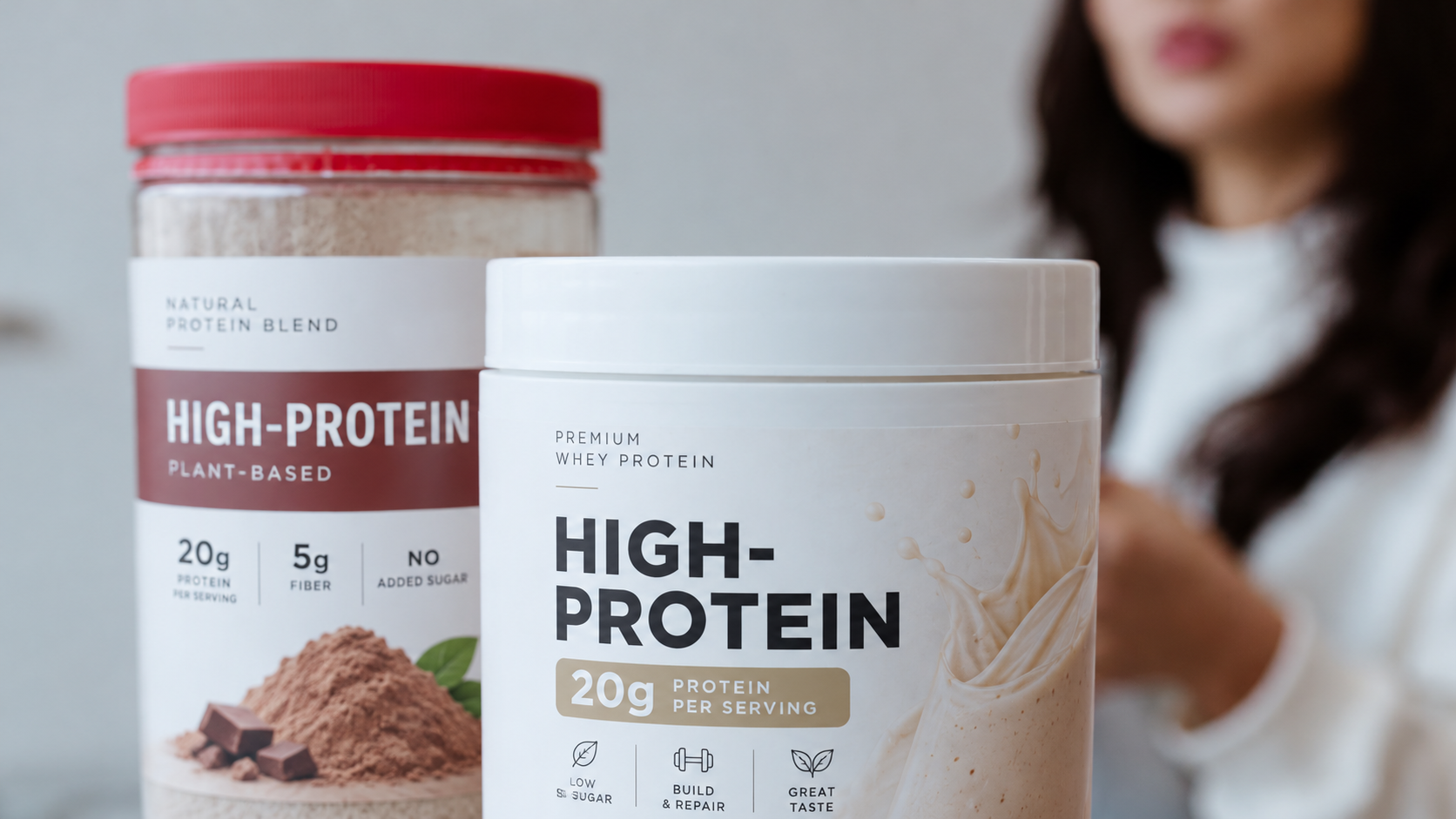
Why 'High-Protein' on a Label Deserves a Second Look
It is a regulated claim with real arithmetic behind it — but it doesn't necessarily tell you how much protein you'll eat. And ordinary dals deserve a place in the comparison.
Table of Contents
In India, “high protein” is a regulated nutrition claim under the Food Safety and Standards Authority of India’s (FSSAI) Advertising and Claims Regulations, 2018, as amended.
For a solid food, the “high” or “rich” protein threshold is 20% of the applicable Recommended Dietary Allowance (RDA) per 100g, or 10% of the RDA per 100 kilocalories. A liquid may qualify at 10% of the RDA per 100ml, with the alternative energy-based criterion also available.
But that tells you whether a food meets a defined threshold. It doesn’t necessarily tell you how much protein is in the portion you’ll actually eat, whether the protein meets your nutritional needs, or whether the product is worth its price.
Read this if: you have been buying products because the front of the pack says high-protein; you are trying to work out whether they are worth the price; or you would like to know what the phrase is legally required to mean in India.
A note on fairness: this is not an argument that protein products are bad or that nobody needs them. Some people have genuine gaps and some products are useful. It is an argument for reading the back of the pack, which is where the information is.
Let me start somewhere unexpected.
Ordinary dals and pulses are substantial sources of protein. Many dried pulses contain enough protein per 100g to meet the numerical threshold used for a high-protein claim.
Nobody prints that on the storage dabba, and nobody charges a premium for saying it.
There is a distinction, though. A katori of cooked dal contains water, and the amount of protein in it depends on how much dry dal went into the preparation. You cannot automatically award every cooked dal the same claim.
Understanding that difference tells you most of what you need to know about the phrase on the packet.
In India, nutrition claims are governed by the Food Safety and Standards (Advertising and Claims) Regulations, 2018, as amended.
Under Schedule I, protein claims have defined thresholds. “Source of protein” has one set of conditions; “high” or “rich” in protein requires a higher level.
| Basis of measurement | Source of protein | High / Rich in protein |
|---|---|---|
| Per 100g of solid food | At least 10% of RDA | At least 20% of RDA |
| Per 100ml of liquid food | At least 5% of RDA | At least 10% of RDA |
| Per 100 kilocalories | At least 5% of RDA | At least 10% of RDA |
These are alternative measurement bases specified in Schedule I, not requirements that all have to be met simultaneously. Products must also comply with other applicable FSSAI labelling and claims requirements.
This is important because it corrects a common misunderstanding: India does not assess these claims exclusively by asking what proportion of a food’s calories comes from protein.
The regulations allow protein content to be assessed against the applicable RDA using defined quantities of food or energy.
Other countries use different systems.
In the European Union, for instance, at least 12% of a food’s energy must come from protein for a “source of protein” claim, and at least 20% for “high protein”.
The United States uses a daily-value-based approach, with protein quality taken into account when calculating the relevant protein contribution for claims.
The precise rules differ. The underlying lesson is the same: a regulated phrase has a defined meaning, but that meaning is not necessarily the one a shopper assumes.
Sources: FSSAI Advertising and Claims Regulations, Schedule I; European Commission, Regulation (EC) No 1924/2006; US FDA, 21 CFR 101.9 and 101.54.
Here is the consequence, and it is not obvious from the front of a pack.
The Indian thresholds are expressed against a standard quantity of food or energy — not necessarily the portion you’re about to eat.
A food may legitimately qualify for a high-protein claim per 100g, but if you eat only a small serving, your actual protein intake may be modest.
Take a purely illustrative example.
Suppose a packaged food contains 12g protein per 100g. If you eat a 30g serving, you get 3.6g protein.
The amount in the smaller portion is simply:
12 × 30 ÷ 100 = 3.6g protein
That is the figure relevant to what you actually ate.
The example doesn’t establish whether any particular product qualifies for an FSSAI claim. It shows why a prominent number per 100g and a smaller serving size tell you different things.
The energy-based route introduces another consideration: a product’s protein contribution can be compared with its energy content. But in India, this is one alternative route under the regulations, not the entire definition of high protein.
So the claim answers a regulatory question about the product’s composition.
It doesn’t automatically answer the personal question:
How much protein will I actually get from this serving?
And that is the one you care about.
| What the claim establishes | What it does not automatically tell you |
|---|---|
| The product meets an applicable regulatory protein threshold | How much protein is in the portion you eat |
| A defined protein-content criterion is satisfied | The full amino-acid profile or how well the protein meets your needs |
| The protein claim must be substantiated under applicable rules | What else is in the pack: sugar, salt, saturated fat or other ingredients |
| A property of the food | Whether you personally needed more protein at all |
The quality point is worth dwelling on.
Protein is not just a number of grams. Its nutritional quality also depends on essential amino-acid composition and digestibility.
Some regulatory systems factor this into the calculation used for protein claims. In the United States, for example, the FDA uses a protein digestibility-corrected amino acid score, or PDCAAS, when calculating the protein contribution relevant to the percentage of Daily Value.
DIAAS, the Digestible Indispensable Amino Acid Score, is another method studied in protein-quality research, but it is not interchangeable with the PDCAAS method specified in current US labelling rules.
For a shopper, the distinction is simpler.
Two foods can declare similar amounts of protein yet differ in the sources and nutritional quality of that protein.
A food’s ingredients, the rest of the diet and the person’s needs all matter. The high-protein phrase alone cannot settle those questions.
And the last row of the table is the one that gets skipped entirely.
A claim tells you about a food. It tells you nothing about whether you had a shortfall to correct.
Dried pulses contain meaningful amounts of protein. Chana dal, for example, provides approximately 21.55g protein per 100g in the Indian Food Composition Tables 2017.
That is why ordinary pulses deserve to be part of any comparison with specially marketed protein foods.
But the form in which you eat them matters.
A 100g portion of dry chana dal is not the same as 100g of cooked dal. Cooking adds water, and a household katori can be thick or thin, substantial or mostly liquid.
The more useful question is how much dry dal or other pulse went into the serving.
And this is why comparing a protein bar with “a katori of dal” requires a little more care than simply placing the two names side by side.
There is a related point I have written about separately.
The old idea that vegetarians must carefully combine incomplete plant proteins at every single meal was abandoned decades ago. Grains and pulses still complement one another nutritionally, but their essential amino acids don’t have to arrive in precisely the same mouthful.
Indian cooking has been making familiar combinations — roti and dal, rice and sambar, khichdi — for generations.
None of which means that every vegetarian automatically gets enough protein. Total intake, variety, protein quality and individual needs still matter.
But it does mean that you should not assume a purchased protein product is necessary merely because your usual food is vegetarian.
For a closer look at what everyday grains contribute, read What Two Rotis Actually Contribute to Your Day.
None of this means packaged protein is useless.
For someone with a genuinely increased requirement, poor appetite, difficulty eating enough food or a practical problem meeting their needs through meals, a convenient product can be a sensible solution.
An athlete’s requirements may differ from those of a sedentary adult. Someone recovering from illness may have needs that aren’t met by their usual diet. Older adults may also need particular attention to protein intake.
And some people simply find particular ready-to-eat or easy-to-prepare products convenient.
I would not sneer at any of that.
The question is whether the product serves a real need, whether the amount and quality of protein suit that need, and whether the price makes sense.
That is a more useful conversation than treating either ordinary food or packaged products as automatically superior.
There is no need to treat the nutrition panel as a test you must pass in the supermarket.
Just use it for what it was designed to provide: information about the food.
Everything above generalises.
Front-of-pack language is a claim. The nutrition panel is a quantitative declaration, subject to labelling rules and substantiation requirements.
That distinction holds for high in fibre, added protein, enriched, fortified and every persuasive new phrase yet to be invented.
It applies to whole-grain flour too.
Aashirvaad Chakki 100% Khapli Atta has a reported dietary fibre content of 11.4g per 100g according to the brand’s product-specific testing. The reason I can refer to that number is that it has a stated measurement behind it, not merely because the product is described as an ancient grain or a wholesome flour.
And that number must be attributed to the product’s own documentation, not to a general food-composition table for regular wheat.
Ask the same of everything else in the trolley, including the things I write about.
A declared number is more useful than a flattering adjective. It can still need checking against the current product label, but at least it tells you what is being claimed.
The purpose of reading the back of the packet isn’t to become suspicious of everything you buy. It’s to know what you’re paying for.
This article is intended for general educational and informational purposes and is not a substitute for personalised medical, nutritional or regulatory compliance advice.
Protein requirements vary with age, body weight, activity, dietary pattern and health status. If you have been advised to increase, restrict or otherwise manage your protein intake for a medical reason, follow your doctor’s or qualified dietitian’s guidance.
Nutrition claims on food products must be assessed under the currently applicable FSSAI regulations and the specific product’s formulation, labelling and documentation. General examples in this article do not establish whether an individual product legally qualifies for a claim.
Poulomi Mukherjee, M.Sc. Food and Nutrition
Poulomi Mukherjee holds a Master’s degree in Food and Nutrition. She works in nutrition education and writes for Happy Tummy on gut health, fibre and the evidence behind everyday food choices.
Under FSSAI's Advertising and Claims Regulations, a high-protein claim must meet a specified threshold. For solid foods, this is at least 20% of the applicable RDA per 100g, or 10% of the RDA per 100kcal. For liquids, the regulation also provides a threshold of 10% of RDA per 100ml. These are alternative criteria, subject to other applicable rules.
Not necessarily. A product may qualify based on its protein content per 100g or another permitted measurement basis, while the portion you actually eat is much smaller. Check the grams of protein in your serving rather than relying only on the front-of-pack claim.
Dried dals and whole pulses are substantial protein sources. Many provide enough protein per 100g to satisfy the numerical high-protein threshold for solids. However, a cooked dal preparation contains added water, and its protein content depends on the recipe. You cannot automatically assume that every cooked katori qualifies for a regulated claim.
FSSAI sets a lower threshold for "source of protein" and a higher threshold for "high" or "rich" in protein. For solid foods measured per 100g, the respective thresholds are 10% and 20% of the applicable RDA. The regulations also specify alternatives based on volume or energy.
A high-protein label in India tells you that the food meets an applicable protein-content criterion. It does not, by itself, give you the food's full amino-acid profile or tell you how well its protein meets your particular needs. Some other regulatory systems use protein-quality-adjusted calculations when determining protein claims.
Not by default. A varied vegetarian diet can provide adequate protein through pulses, soy foods, dairy where consumed, grains, nuts and seeds. Supplements may be useful when requirements are increased or food intake is inadequate. The decision should be based on the whole diet and individual needs, not merely the assumption that plant protein is incomplete.
If the pack lists protein per 100g, multiply that amount by the weight of your serving in grams and divide by 100. For example, a food listing 12g protein per 100g would provide 3.6g protein in a 30g serving. Check whether the label describes the food as sold or as prepared, especially for products mixed with water or milk.
Not automatically. Protein is one important nutrient, but the overall nutritional profile includes energy, fibre, fats, sugar, sodium and other ingredients. A high-protein claim is not an assessment of the food's entire nutritional value or its suitability for every person.
Read the nutrition panel, particularly protein per serving, serving size, total energy, sugar, sodium and saturated fat. Check the ingredient list and compare the product with ordinary foods you already eat. Ask whether it provides something your current diet actually needs.