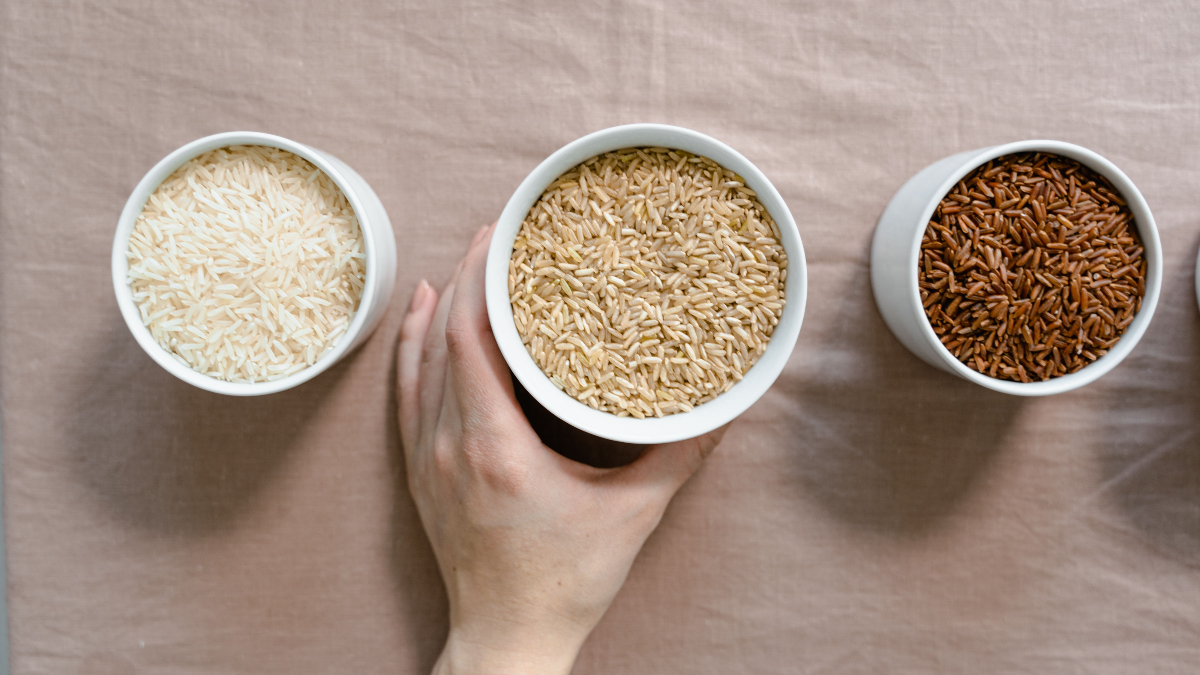
Beyond Brown vs White: Parboiled, Matta, Red, Black and Hand-Pounded Rice, Compared
India’s rice choices go well beyond two colours. Here’s what bran, parboiling, cooking water and portion size change—and why white rice still has a place at the table.
Brown versus white is too narrow a question for a country with this much rice. Less-polished brown, red, black and hand-pounded rice retain more bran and generally more fibre than fully polished white rice. Parboiling can help retain B vitamins even after milling and can change how starch is digested. There’s one complication: brown rice generally contains more inorganic arsenic than comparable white rice because arsenic concentrates in the bran. Eat a variety of grains, pay attention to portions and cooking water, and choose rice that works for the dish and your needs.
A Country, Not a Choice
The brown-versus-white debate is too narrow for the way we eat rice in India. Rice is a staple eaten two or three times a day in many regions, and it comes in far more forms than two. There’s Kerala’s matta, Tamil Nadu’s puzhungal arisi and pacharisi, Bengal’s siddho chal and atop chal, Manipur’s black chak-hao, hand-pounded kaikuthal rice, and the familiar grains of basmati and Sona Masoori. Comparing only brown and white misses most of what’s actually on Indian plates.
These names don’t all describe the same thing. Some refer to a variety, some to colour, and others to processing. Red rice can also be parboiled; parboiled rice can be polished. That overlap matters when you’re choosing a packet.
Why the Bran Matters
Every grain of rice has three main parts under its husk: the bran, the outer layers carrying much of the fibre, B vitamins and minerals; the germ; and the starchy endosperm. Polishing rice white removes the bran and germ, leaving mostly the endosperm. That’s why fully polished white rice contains less fibre than brown rice.
The gut-health case for less-polished rice is real, though fibre does more than one job. It can help bowel regularity, and some of it is used by gut bacteria. Changing the rice is one option among several ways to bring more fibre into everyday Indian meals.
Rice Nutrition Compared
The following ICMR–NIN figures are for 100 g of dry, uncooked edible rice, not a bowl of cooked rice. Cooking adds water, so values per 100 g of cooked rice will be different. “Available carbohydrate” excludes fibre. These are composition-table averages, not figures for every variety or brand.
Parboiled Milled Rice per 100 g
Nutrient
Amount
Energy
1,471 kJ (about 352 kcal)
Protein
7.81 g
Fat
0.55 g
Available carbohydrate
77.16 g
Total dietary fibre
3.74 g
Water
10.09 g
Source: Indian Food Composition Tables 2017, entry A014. “Parboiled” describes processing before milling; these grains still need cooking.
White Milled Rice per 100 g
Nutrient
Amount
Energy
1,491 kJ (about 356 kcal)
Protein
7.94 g
Fat
0.52 g
Available carbohydrate
78.24 g
Total dietary fibre
2.81 g
Water
9.93 g
Source: Indian Food Composition Tables 2017, entry A015, “Rice, raw, milled”. Here, “raw” means not parboiled.
Brown Rice per 100 g
Nutrient
Amount
Energy
1,480 kJ (about 354 kcal)
Protein
9.16 g
Fat
1.24 g
Available carbohydrate
74.80 g
Total dietary fibre
4.43 g
Water
9.33 g
Source: Indian Food Composition Tables 2017, entry A013, “Rice, raw, brown”. The energy values across these three entries are similar; the nutritional differences go beyond calories.
The Rice Spectrum
White rice is fully polished: mostly starch, with less fibre than less-polished rice. Basmati and Sona Masoori are commonly eaten this way, though less-polished versions are also available. Soft white rice may be comfortable to eat when your stomach feels unsettled.
Brown rice has only the husk removed, so it keeps its bran and germ. More fibre and several naturally occurring nutrients, a chewier texture and usually a longer cooking time.
Hand-pounded rice, or kaikuthal arisi in Tamil, is traditionally pounded rather than fully machine-polished. It can retain part of its bran; how much depends on how heavily it has been pounded or milled.
Red rice, including Kerala’s matta, gets its colour from pigments in the outer layers. Less-polished red rice retains those layers. It’s eaten in Kerala and other parts of the South and North East.
Black rice, like Manipur’s chak-hao, gets its deep colour from pigments in its outer layers too. It’s traditionally used for kheer and festive dishes. Colour alone doesn’t tell you the fibre content; the degree of polishing still matters.
Parboiled rice—puzhungal arisi in Tamil Nadu, siddho chal in Bengal, sella in the North—is soaked, heated with steam or hot water, and dried in its husk before milling. Kerala’s matta is usually parboiled as well. Pacharisi and atop chal refer to non-parboiled rice; neither term means it is eaten uncooked.
Parboiling: Tradition Got There First
Parboiling is the most interesting entry on this list, because it helped solve a problem long before the chemistry was understood. During soaking and heating, some water-soluble vitamins, especially thiamine, move from the outer layers into the endosperm. So even after milling, parboiled rice can retain more of these vitamins than ordinary, non-enriched polished rice. WHO describes this nutrient migration in its rice-fortification guidance.
That mattered enormously. Beriberi is a serious disease caused by thiamine deficiency. NIN’s early studies helped explain why it occurred in communities on the Andhra coast that relied heavily on milled rice, while it was absent in the Madras communities studied, where parboiled rice was more commonly eaten. Households that parboiled rice for generations were retaining something valuable before they knew its name.
Parboiling also changes starch structure. As heated starch cools, some can reorganise into resistant starch: starch that escapes digestion in the small intestine and can be fermented by bacteria in the large intestine. How much forms depends on the rice and the processing conditions. Parboiled rice often cooks up firmer and less sticky, which is why it has an everyday place in the regions that eat it.
This doesn’t give every parboiled rice the same glycaemic index, or GI. Variety, polishing, cooking and the amount you eat all affect the blood-sugar response to a meal.
The Arsenic Question, Honestly
Rice absorbs arsenic from soil and water more readily than many other crops. Some is inorganic arsenic, the form of greater health concern. Arsenic can concentrate in the outer layers, so brown rice generally has more than comparable white rice. The amount varies with where and how the rice was grown and processed; colour alone cannot tell you what is in a particular packet.
This isn’t a reason to give up rice. It is a reason to consider dietary variety, especially for young children and people who eat rice very frequently. Contaminated groundwater adds another concern in affected areas, including parts of West Bengal, Bihar and Uttar Pradesh. Rice can travel far from where it was grown, so the issue isn’t confined to people living in those areas.
Cooking method can help. The FDA reports that cooking in excess water and draining it—using roughly six to ten parts water to one part rice—can reduce inorganic arsenic by about 40–60%, depending on the rice. Rinsing alone has much less effect. Draining can also remove nutrients, so follow the cooking instructions on enriched or fortified rice rather than assuming one method is best for every packet.
A University of Sheffield-led study tested a two-stage method: boil rice in plenty of already-boiling water for five minutes, drain and discard that water, then finish cooking on a lower heat with fresh water until it is absorbed. It removed about 54% of inorganic arsenic from the brown rice and 73% from the white rice tested, while retaining some important minerals. The study used three samples of each type; the percentages are findings from those samples, not a guarantee for every rice.
This home method is different from commercially parboiling paddy before milling. For either excess-water method, the water must be arsenic-safe. WHO stresses safe water for drinking and food preparation. Where contamination is known or suspected, follow local water-safety advice; changing the rice colour or cooking method cannot compensate for contaminated water.
Cooking Less-Polished Rice So It Actually Gets Eaten
The usual reason families give up on brown or red rice is texture, not taste. A few adjustments help a great deal.
Soak it. Soaking before cooking can soften the grain and help it cook more evenly. Brown, red and black rice may benefit from a longer soak than white rice; follow the pack or a recipe for that variety. If soaking for several hours, keep it refrigerated, especially in warm weather.
Use more water and more time than for white rice, or a pressure cooker, which handles less-polished rice well. Start with the pack’s directions and adjust for the texture you like.
Start with a mix. Half white and half red or brown is often easier to introduce than a full switch. If their cooking times differ, give the firmer rice a head start or cook them separately and combine.
Use it where texture matters less. Less-polished rice works well in pulao, khichdi and pongal, where other ingredients carry the dish. Choose a variety and cooking time that suit the result you want.
Parboiled rice has a quieter place in many kitchens already. Much of the rice sold for idli and dosa batter in the South is parboiled, though household recipes vary and some use a mix.
So Which Rice? Here’s What I Do
As a South Indian, rice is a staple in my diet and is included in at least one meal of the day. Social media trends and myths have cast rice as a villain, but that’s not true. Rice can be eaten every day; the type, method of cooking and portion size matter.
At home, I use a variety of rice for different dishes. Sona Masoori and brown rice are for everyday meals; jeera samba and basmati are occasional choices for special dishes such as pulao and biryani. I don’t stop my clients from eating rice. I counsel them about controlling their portion size and quantity.
I also suggest soaking rice for 15–20 minutes, then cooking it with excess water, draining that water and steaming to finish—a method often called “destarching”. It drains away some starch that has leached into the water, but the cooked rice still contains substantial carbohydrate. Soaking and draining alone should not be treated as a reliable way to increase resistant starch or prevent blood-sugar spikes.
Eat less-polished rice some of the time. Red, brown, hand-pounded or black rice, even a few times a week or mixed with white, can bring back some of the fibre polishing removes. Increase fibre gradually if your usual intake is low.
Don’t overlook parboiled rice. It’s widely available and can retain more thiamine and other B vitamins than ordinary polished rice. The label describes processing, not a promise of a particular fibre content or GI.
Refrigerate leftover rice promptly. Divide it into smaller, shallow portions and chill it as quickly as possible, ideally within one hour. Eat it within 24 hours; if reheating, do so only once, until steaming hot throughout. Don’t leave it on the counter to build resistant starch. These rice-specific FSA precautions matter because cooking can leave bacterial spores behind. There’s more on storing and reheating Indian leftovers safely.
Where arsenic is a concern, prioritise safe water. Excess-water cooking and draining can help reduce exposure. Include other grains in the week too; rotating only between rice colours doesn’t ensure lower arsenic intake.
Keep white rice where it belongs. A bowl of plain white rice with dal and vegetables can be a good meal. On an unsettled day, the gentleness of soft white rice may be exactly the point. Follow a prescribed diet if you’ve been advised to limit fibre.
The Honest Takeaway
Brown rice isn’t a simple upgrade, and white rice isn’t a villain. India’s rice spectrum offers more useful choices than either label alone, and one of the most interesting is also one of the oldest: parboiled rice, which helps retain thiamine before the rice reaches your kitchen. Eat a variety, lean towards less-polished rice some of the time, refrigerate your leftovers promptly, and where arsenic is a concern, pay attention to the water as well as the grain.
Sources
ICMR–National Institute of Nutrition. Indian Food Composition Tables 2017. Entries A013, A014 and A015, printed page 3. Values per 100 g uncooked edible portion.
Disclaimer: This article provides general information and is not a substitute for personalised medical advice, diagnosis or treatment. If you have diabetes, a digestive condition or a prescribed diet, follow your doctor’s or registered dietitian’s advice on rice type, portions and preparation. Seek individual guidance for a child or for specific nutritional needs during pregnancy or older age. Cooking methods do not replace diabetes treatment or safe drinking and cooking water. If digestive symptoms continue, are severe, or keep coming back, speak to a doctor.
FAQs
Is brown rice healthier than white rice?
Brown rice retains its bran and germ, so it generally provides more fibre and several naturally occurring nutrients than polished white rice. It can also contain more inorganic arsenic than comparable white rice. Both can fit a varied diet. Soaking brown rice before cooking can help soften its texture; it does not reliably remove arsenic or guarantee a lower blood-sugar response.
What is parboiled rice, and is it healthy?
Parboiled rice is soaked, heated and dried in its husk before milling. This helps move vitamins such as thiamine into the endosperm, so more can remain after polishing. It can be a useful everyday choice, but its fibre content and blood-sugar effect depend on the variety, milling, preparation and portion.
Should I worry about arsenic in rice?
Rice can remain part of a balanced diet. Vary your grains, use arsenic-safe cooking water and take local contamination advice seriously. Cooking in excess water and draining can reduce inorganic arsenic; rinsing alone has limited effect. Young children should have a variety of age-appropriate grains rather than relying only on rice.
Is red or black rice better than brown rice?
All can retain bran and provide more fibre than fully polished rice, depending on how much they have been milled. Their pigments differ, but colour alone does not establish that one is the healthiest. Choose for variety, taste, the dish and any dietary needs.
Is white rice bad for gut health?
No. It contains less fibre than less-polished rice, but it can be part of a varied diet, especially alongside dal and vegetables. Soft white rice can also suit some people when digestion feels unsettled or a clinician has recommended a lower-fibre diet.
You are now being directed to an external website https://www.callr.live/aashirvaadexperts/premium-plan.
This link is provided for your information and convenience only and ITC Limited is not
responsible for the contents or services provided by Brand Touch India or any information that
you share with Brand Touch India.