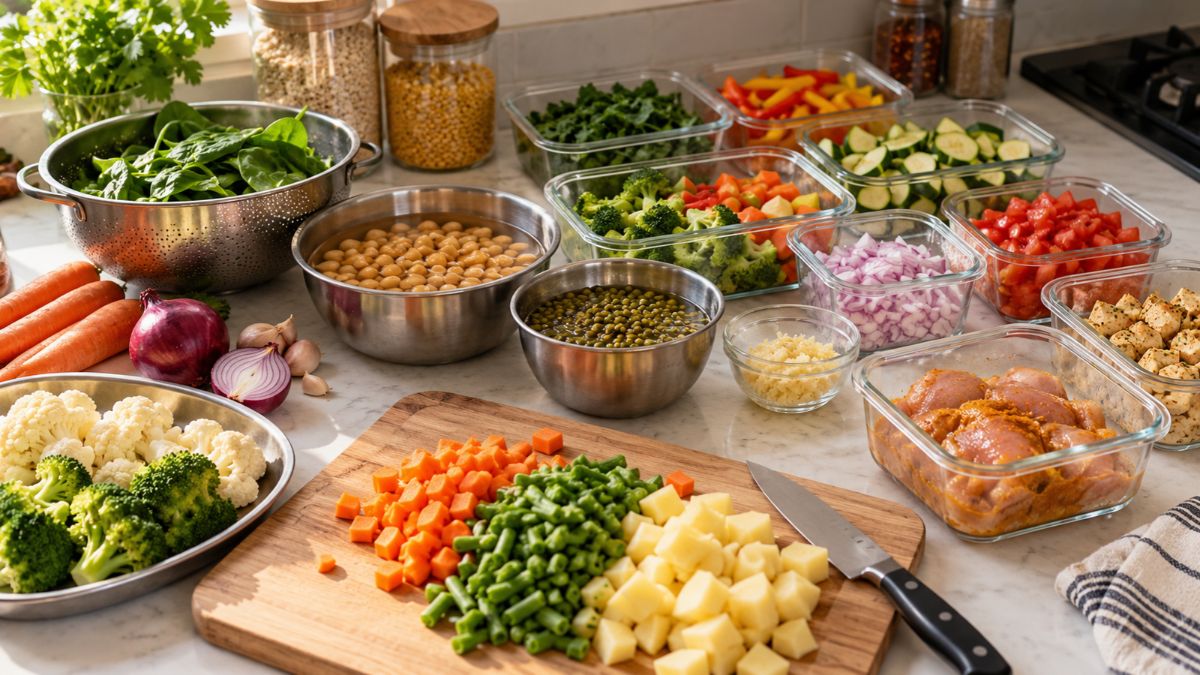
The Sunday Hour: What to Prep for Easier Weeknight Meals
A cooked pulse, a tomato base, vegetables ready to use: a little preparation can make weekday dinner less of a decision.
Table of Contents
For easier weekday meals, prep a few components: one fully cooked pulse, a tomato-onion base, vegetables for the next couple of days and something for chai time. Add cooked moong dal if you will use it. You do not need five finished dinners or every item on the list.
Decide what belongs in the fridge and what must be frozen. Keep only the portions you will eat within two to three days refrigerated; freeze later-week portions on the day you cook them. Sunday’s cooked dal for Thursday should go in the freezer, not stay in the fridge all week. Thaw in the fridge and use within twenty-four hours of fully defrosting.
Rice needs a shorter window. Cool cooked rice quickly, ideally within one hour, refrigerate and eat within twenty-four hours. Reheat it only once, until steaming hot throughout. Cooling can increase resistant starch, but that is no reason to leave rice on the counter overnight or extend its storage time.
For other cooked components, refrigerate within two hours, or one hour above 32°C. Divide batches into shallow containers, label dates and keep the fridge at 4°C or below. Smell and appearance cannot reliably tell you whether leftovers are safe.
Treat the Sunday hour as preparation time rather than a promise that soaking, cooking and cooling will all be finished. With only twenty minutes, choose ready-cooked pulses and a little vegetable prep. A varied diet matters; meal prep makes it easier to organise, without promising a particular gut-health result for everyone.
You are standing in front of an open fridge, tired, with no decision made and no obvious ingredient ready. At that moment, ordering something is the path of least resistance.
Move some of the decisions and tedious work to a calmer part of the week. An hour on Sunday is a starting point, not a promise that soaking, cooking and cooling will all fit within sixty minutes. Choose two or three useful tasks.
Different plants provide different fibres and nutrients, and gut microbes differ in the compounds they use. The American Gut study associated plant-food variety with microbial diversity. That supports variety as a useful habit, without establishing a single best approach for everyone.
The practical aim is to make rotating vegetables, pulses and grains easier when you are tired.
Some dishes freeze and reheat well. Others, especially sabzis whose appeal is their texture, are more enjoyable freshly cooked.
A cooked pulse, a tomato-onion base and vegetables ready to use reduce the work from scratch. Dinner may still need simmering, rice cooking or rotis made fresh.
There is an older version of this idea in many Indian households: grinding masala on a quieter morning, soaking tomorrow’s beans, or preparing a base while another dish cooks. The Sunday hour is that habit written down.
Start with the components you will actually use. Make space in the fridge and freezer, and have clean, shallow containers ready before cooking a batch.
Rajma, chana or lobia can become a curry, a cooked chaat or part of a bowl. Cook it fully, keep early-week portions chilled and freeze later-week portions on the day of cooking.
Dried beans need soaking and thorough cooking. Rajma contains lectins that can cause illness if it is undercooked. For an open-pan method, the FDA advises soaking for at least five hours, discarding the water and boiling in fresh water for at least thirty minutes; continue until fully tender. Pressure cooking needs a method approved for your appliance. Do not shorten cooking to fit the session.
Ready-cooked canned pulses help when you have not soaked anything. Drain and rinse, and follow the pack’s storage instructions after opening.
A batch of moong helps with dal or palak moong later. A Sunday portion intended for Thursday belongs in the freezer.
You do not need both a whole pulse and moong every time.
Divide a batch into meal-sized portions: refrigerate for early-week use and freeze the rest promptly after cooling. Simple seasoning lets the final dishes taste different.
Wash, dry and prepare what you need for Monday and Tuesday. Use clean containers and refrigerate promptly. Storage life varies by vegetable, so do not treat all chopped produce as interchangeable.
Plan a small fresh top-up or use frozen vegetables later in the week, cooking as the pack directs.
Follow storage instructions for bought paste; freeze extra homemade paste in small portions.
For chai time, try ready-roasted chana. Cool home-seasoned chana completely before storing in a dry, airtight jar somewhere cool. Make small batches: oil, moisture and kitchen conditions affect storage life, so do not assume it keeps for weeks.
Dhokla needs prompt refrigeration and the same short window as other cooked leftovers.
Cook sprouted moong thoroughly. Raw or undercooked sprouts are particularly unsuitable for people who are pregnant, young children, older adults and people with weakened immunity.
Adapt this to your household. Refrigerate Sunday’s cooked components for Monday and Tuesday; cool and freeze later-week portions the same day.
| Day | Dinner idea | What makes the prep work |
| Monday | Rajma with rice and a vegetable side | Use chilled Sunday rajma and base; cook rice for the meal. |
| Tuesday | A dry sabzi with dal and roti | Use the early-week vegetables and chilled dal within its storage window. Make rotis fresh if you prefer. |
| Wednesday | Tehri or vegetable dalia khichdi | Use fresh or frozen vegetables. Allow the full cooking and pressure-release time required by your recipe. |
| Thursday | Palak moong dal with rice | Thaw Sunday’s frozen dal in the fridge ahead of the meal. Add fresh spinach and heat thoroughly. Cook rice fresh. |
| Friday | Mixed vegetable sabzi, roti and curd or another suitable protein | Use a midweek vegetable top-up or properly stored frozen vegetables. |
Thaw in the fridge, covered, and use within 24 hours of fully defrosting. After microwave defrosting, reheat and eat immediately. Heat only the portion you need.
Divide batches into shallow containers so they cool quickly. Refrigerate within two hours of cooking, or one hour when the temperature is above 32°C. Do not leave a large pot on the counter until it is completely cold.
Keep the fridge at 4°C or below. Loosely cover food while it chills, then close containers once cold. Label the cooking date and keep raw foods separate from ready-to-eat components.
Use refrigerated cooked components within 2–3 days, with three days as this plan’s outer limit; freeze later portions early. This follows Health Canada’s guidance and the Centre for Food Safety’s three-day limit.
Reheat until steaming hot throughout, stirring gravies and dense foods for even heating. A food thermometer should read at least 74°C at the centre. Reheat only once, and discard uneaten reheated portions.
Smell, taste and appearance are not reliable safety tests. Discard food that is spoiled or whose storage history is uncertain.
Cool cooked rice quickly, ideally within one hour, then refrigerate and eat within 24 hours. Reheat only once, until steaming hot throughout. Do not leave it cooling in the cooker overnight.
Bacillus cereus spores can survive cooking; warm storage can allow growth and toxin formation. Reheating does not reliably rescue unsafe rice. Follow the Food Standards Agency’s rice guidance.
Keep the freezer around −18°C, label contents and dates, and use small portions that thaw evenly. Thaw in the fridge and use within 24 hours of fully defrosting.
Storage windows assume the food has stayed properly chilled.
Cooling can change cooked starch’s structure, increasing resistant starch. A small white-rice study found an increase after refrigeration and reheating. The amount varies; storage limits still apply.
Refrigerate promptly. Do not leave rice on the counter overnight to chase this effect or treat cooled rice as a gut-health treatment.
If digestive symptoms are severe, persist or keep returning, seek medical advice. Sudden severe abdominal pain, repeated vomiting, dehydration or blood in the stool needs prompt assessment rather than waiting for a particular dinner to help.
Pick one part of the routine and see whether it makes your week easier. Add another when the first no longer needs much thought.
Use the shorter session for tasks that fit:
Dried rajma or chana, soaking time, cooking and safe cooling included, is not a reliable twenty-minute task. Save that batch for a session with enough time.
This article provides general meal-planning, nutrition and food-safety information, not personalised medical advice. Storage guidance assumes food was properly cooked, cooled and kept at safe temperatures. Follow pack instructions and any stricter advice given for your health needs. Increase fibre gradually with adequate fluid, and follow any prescribed dietary or fluid restriction. Seek professional care for persistent, severe or recurring digestive symptoms. Children, pregnant people, older adults and people with weakened immunity may need individual guidance.
For this plan, use properly cooled and refrigerated cooked pulses within 2–3 days. Freeze portions intended for later on the day of cooking. Keep the fridge at 4°C or below, label dates and do not rely on smell to decide whether an old batch is safe.
Yes, if you freeze that portion promptly on Sunday and thaw it safely before Thursday’s meal. It should not remain in the fridge from Sunday to Thursday. Use within 24 hours of fully defrosting and reheat thoroughly once.
Yes, when its storage has been safe. Cool quickly, ideally within an hour, refrigerate and eat within 24 hours. Reheat only once until steaming hot throughout. Rice left out overnight should be discarded.
No. Refrigeration can increase resistant starch while keeping the cooling process within food-safety guidance. The size of the change varies, and it does not justify leaving rice out overnight or storing it for longer.
It can be. Small components and individual freezer portions let you make different meals without repeatedly cooking a large batch or eating the same dinner all week. Scale the plan to what you will use.
Choose another quieter part of the week. Two smaller sessions may suit you better than one long session. Count storage time from when each food was cooked, not from the day printed on the plan.