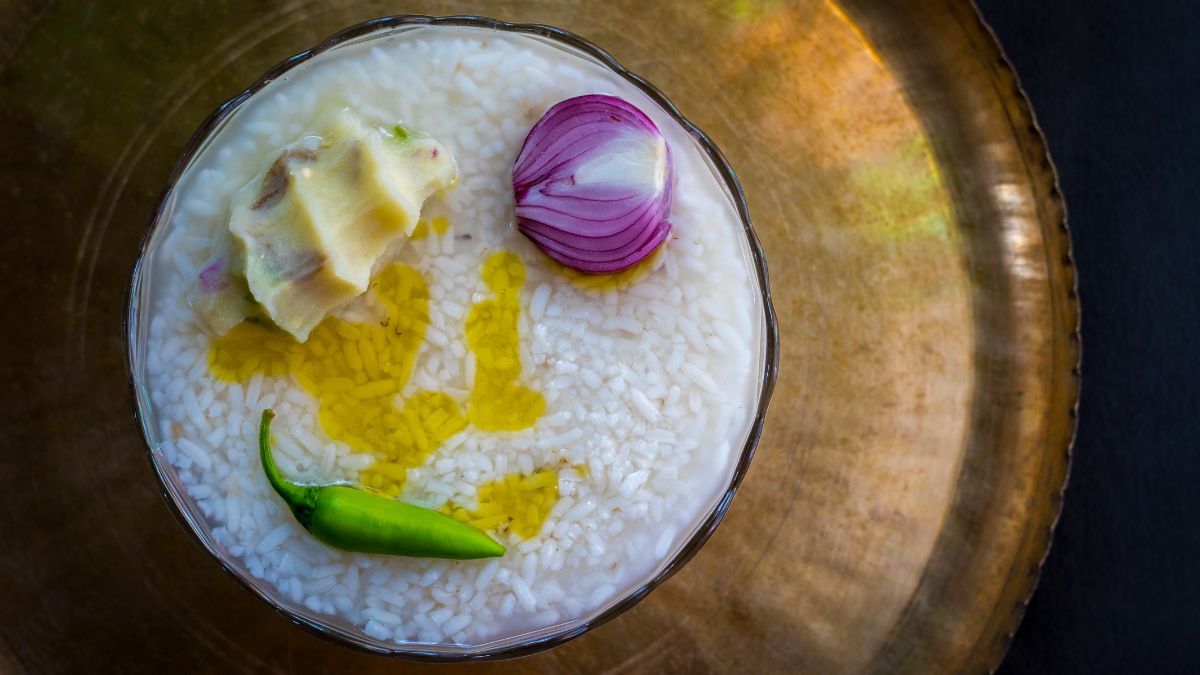
Across Bengal, Odisha and Assam, cooked rice left to soak overnight becomes something more than leftovers. Here’s what fermentation changes, what the gut-health evidence actually shows, and where the claims need restraint.
Panta bhat, pakhala and poita bhat are regional versions of the same broad food tradition: cooked rice soaked in water and left overnight, then eaten without another cooking step. In Bengal, Odisha and Assam respectively, the details and accompaniments differ, but mild fermentation is central to the traditional preparation.
That last detail matters nutritionally. Because the rice is not ordinarily cooked again after fermentation, the finished food can contain living microorganisms. Cooling the cooked rice can also increase resistant starch, while research on Assamese poita bhat has found substantial reductions in phytic acid during fermentation, alongside changes that may improve mineral availability. That is an interesting nutritional case.
It still does not make panta bhat a miracle probiotic.
And because cooked rice also has specific food-safety risks when held at room temperature, the traditional preparation deserves more careful handling than a casual “leave your leftovers out overnight” instruction.
A Famine Food That Became a Festival Food
There’s a version of this idea, or something close to it, in ancient Indian medical writing. The Charaka Samhita, compiled over a long period in antiquity, describes peya, a thin rice gruel valued for being gentle on the stomach. It is a related idea rather than evidence that today’s panta bhat is precisely the same preparation.
What is clearer is its much more recent practical history.
For generations, rural households across eastern India have soaked cooked rice in water overnight, making use of rice left from the previous meal rather than wasting it. The resulting meal suited hot, humid climates and households in which a heavy freshly cooked breakfast was neither necessary nor always practical.
It also carries more difficult associations.
Panta bhat is remembered in parts of Bengal in connection with scarcity and lean years. A food born partly from thrift can easily acquire the stigma of hardship, particularly as incomes rise and older subsistence foods are pushed away from aspirational tables.
Yet that is only half the story.
In Odisha, pakhala is not a reluctant fallback. It is woven into regional identity strongly enough to have its own Pakhala Dibasa on 20 March, and exists in numerous familiar forms, including basi pakhala and dahi pakhala.
Both histories can be true.
A food can carry memories of scarcity and still be culturally cherished. It can emerge from the need to waste nothing and nevertheless turn out to have interesting nutritional properties.
Flattening panta bhat into either “poverty food” or a newly discovered “superfood” misses the much better story sitting between those two extremes.
What Are Panta Bhat, Pakhala and Poita Bhat?
The core technique is similar across the three traditions: Cooked rice is cooled, covered with water and traditionally left to soak overnight. Over time it develops a mildly sour character as natural fermentation occurs, producing the characteristic cloudy liquid that accompanies the softened rice. The names and the plates around it change by region.
Panta Bhat: Bengal
Bengali panta bhat may be eaten with fried fish or vegetables, aloo makha or aloo bhorta, raw onion, green chilli, salt, lemon and mustard oil. Its simplicity is part of its identity: yesterday’s rice becomes today’s breakfast, accompanied by sharp, salty, smoky and fresh flavours. (Check out a recipe here.)
Pakhala: Odisha
Odisha’s pakhala belongs to a broad family rather than one fixed recipe. Fermented basi pakhala is perhaps closest to the overnight-rice preparation being discussed here. Other forms can be freshly prepared rather than fermented, and dahi pakhala incorporates curd. Common accompaniments include fried vegetables, greens, badi, fish and other regional preparations. Odisha Tourism identifies the rice water as torani.
Poita Bhat: Assam
Assamese poita bhat follows the same broad principle of soaked or fermented leftover rice and is traditionally eaten as a simple breakfast, often with accompaniments such as onion, chilli, curd, potato preparations or fish depending on the household.
So these are not three perfectly interchangeable dishes. They are regional expressions of the same older food technique.
What Are the Accompaniments Doing?
The things served beside overnight rice deserve some attention too, although there is no need to retroactively turn every traditional pairing into intentional nutrition science.
Raw onion, for example, contributes fibre and fructans, while vegetables broaden the plant diversity of the meal. Fish may add protein, and curd changes both the texture and nutritional composition of versions that include it.
Mustard oil supplies the characteristic sharpness of many eastern Indian plates and contributes dietary fat, which changes the overall meal considerably compared with eating fermented rice alone. What matters is the combination.
The rice itself may be the headline, but panta bhat, pakhala and poita bhat are meals rather than laboratory samples.
What Happens to Overnight Rice? Four Things Worth Knowing
1. Cooling Cooked Rice Can Increase Resistant Starch
Cooked rice that is cooled undergoes changes in its starch structure. Some starch becomes less readily digestible in the small intestine and behaves as resistant starch, reaching the large intestine where it can be fermented by gut microorganisms.
That doesn’t turn cooled rice into a high-fibre vegetable, and the amount of resistant starch varies according to the rice, cooking and cooling conditions. But the underlying phenomenon is well established.
2. Fermentation Means Living Microorganisms Can Still Be Present
This is one of the more interesting things about panta bhat. Many familiar Indian fermented grain foods are cooked after fermentation. Idli and dosa batter ferments, for example, but the finished food goes onto a hot steamer or tawa. Traditional overnight rice is different.
It undergoes mild fermentation and is then eaten without a subsequent kill step. Research published in 2024 examining traditional overnight-soaked cooked rice found an increase in microbial communities during soaking, including organisms considered potentially beneficial.
There is still an important terminology distinction here: “Contains live bacteria” does not automatically mean “probiotic.” For a microorganism to be called probiotic in the clinical sense, particular strains and adequate amounts need to be demonstrated to confer a health benefit. So it is reasonable to describe panta bhat as a live fermented food.
It is less defensible to promise that every household batch provides a clinically established probiotic dose.
3. Fermentation Can Reduce Phytic Acid
Here the evidence is unusually specific.
A 2016 study from Assam Agricultural University examined poita bhat across 12 hours of fermentation. Phytic acid in the cooked rice declined substantially over that period, while phytate-to-mineral ratios fell and measured availability of minerals including iron, magnesium, calcium and zinc increased. Why does that matter?
Phytic acid naturally occurs in grains and can bind certain minerals, reducing how available they are for absorption. Fermentation can activate microbial and endogenous phytases that break some of that phytate down.
This doesn’t mean one bowl of poita bhat fixes iron deficiency. It means fermentation changed the food in a direction that could make some minerals more available for absorption — a narrower and much more defensible claim.
4. There Is Real Institutional Research on Fermented Rice Water
The interest in torani, Odisha’s fermented rice water, isn’t simply a newspaper trend.
AIIMS Bhubaneswar has formally documented a research project titled Nutrient and microbiota characterization of traditional fermented rice water and its impact on maternal nutrition and gut microbiome in Odisha, India, with Dr Balamurugan Ramadass named as the institute principal investigator. The institute lists the project as beginning in 2021 with a five-year duration.
Related institutional work has also examined fermented rice water in adolescent girls and other populations.
That makes the research interest real and worth following. It does not justify jumping directly from “scientists are studying torani” to claims that panta bhat has been clinically proven to “boost immunity” or treat disease. Those are different statements.
For now, the interesting territory is its nutrient composition, microbial profile and possible effects on the gut microbiome — not miracle-food language.
Is Panta Bhat Actually Good for Gut Health?
There isn’t one clean clinical answer yet. What we can say is that several mechanisms make the dish nutritionally interesting:
What changes?
What the evidence supports
Cooked rice is cooled
Resistant starch can increase
Rice undergoes mild fermentation
Living microbial communities can develop
It isn’t cooked again
Some living microorganisms can remain in the food when eaten
Fermentation reduces phytate
Mineral availability may improve
Rice remains a carbohydrate food
Fermentation does not turn it into medicine
Microbes are present
This does not automatically establish a probiotic effect
That is already a fairly interesting story. It doesn’t require embellishment.
The Food-Safety Question Matters
There is one important complication with overnight rice that should not be buried under the excitement about fermentation: Cooked rice is a recognised food-safety risk when held improperly at room temperature.
Spores of Bacillus cereus can survive cooking. If cooked rice then spends prolonged periods at temperatures that permit those spores to germinate and multiply, the bacteria may produce toxins associated with food poisoning. Rapid cooling and cold storage are the standard food-safety recommendations for ordinary cooked rice that is going to be eaten later.
Traditional panta bhat and poita bhat deliberately depart from that ordinary leftover-rice model because fermentation itself is part of the preparation. During successful fermentation, acidity increases. In the 2016 poita bhat experiment, for example, the pH fell substantially over 12 hours.
But spontaneous household fermentation is not a laboratory-controlled process. That means the cultural fact that generations of families have prepared overnight rice should not be translated into a blanket instruction that any pot of cooked rice can safely be left at room temperature for 12 or 24 hours.
If You Already Make It Traditionally
Use the established method followed in your household or community rather than improvising fermentation times from a social-media recipe.
Start with freshly cooked rice and clean water and equipment, keep the vessel protected from environmental contamination and pay attention to the characteristic appearance, aroma and sourness of a normal batch. Discard anything showing mould or an abnormal smell or appearance. And don’t assume that reheating a questionable batch later will necessarily make it safe.
If You’ve Never Made It Before
This is one traditional food for which learning the method from somebody who actually prepares it — or using a properly tested recipe — is more sensible than simply leaving ordinary leftovers on the counter overnight.
Climate matters too. Fermentation proceeds differently according to temperature, and an air-conditioned kitchen in one part of India is not microbiologically identical to a warm kitchen in coastal Odisha or Bengal.
The calendar may say “12 hours”. Microbes don’t own clocks.
Is Panta Bhat a Probiotic Food?
The careful answer is: It is a fermented food that can contain living microorganisms, including potentially beneficial bacteria. Calling every bowl “probiotic” goes a step beyond the evidence.
That distinction matters because probiotic is not simply another word for fermented. A probiotic effect refers to specific live microorganisms demonstrated to provide a health benefit when consumed in adequate amounts.
Research on fermented rice has isolated organisms with potentially probiotic properties, and recent microbiome work on overnight-soaked rice supports the presence of diverse living bacterial communities.
What we don’t yet have is a reason to promise that every household panta bhat contains the same strains, in the same quantities, producing the same clinical effect.
So:
Live fermented food? Yes.
Interesting for gut-health research? Definitely.
Clinically standardised probiotic? Not yet.
The Honest Takeaway
Panta bhat, pakhala and poita bhat are interesting not because any one claim about them is dramatic, but because several smaller things are true at once.
Cooling cooked rice can increase resistant starch. Overnight soaking produces mild fermentation and living microbial communities. A direct study of Assamese poita bhat found substantial phytic-acid reduction and greater mineral availability during fermentation. And serious institutional research is examining the nutrient and microbiome characteristics of fermented rice water. That is already a strong case for taking the food seriously.
It has spent a long time being pulled towards one of two stories: a leftover associated with poverty and hardship, or an ancient “superfood” that modern science has supposedly just discovered. Neither does it justice.
The better story is that communities developed an economical, climate-specific way of dealing with cooked rice, generations continued eating it because it made cultural and culinary sense, and modern food science is now helping us understand some of the changes that take place in the bowl. No miracle required.
In Part 2: Kerala’s pazham kanji, Tamil Nadu’s pazhaya sadam, and Andhra Pradesh and Telangana’s chaddannam or ganji annam — and the broader southern Indian tradition of soaking yesterday’s rice for the next morning.Read it here.
Frequently Asked Questions
What is panta bhat?
Panta bhat is a traditional preparation associated particularly with Bengal and Bangladesh in which cooked rice is soaked in water, usually overnight, before being eaten with accompaniments such as onion, chilli, mustard oil, potato preparations, vegetables or fish.
What is pakhala?
Pakhala is Odisha’s family of water-soaked rice preparations. Some versions are fermented overnight, while others are prepared fresh. Fermented basi pakhala is the version closest to panta bhat, while dahi pakhala incorporates curd.
What is poita bhat?
Poita bhat is the Assamese version of the overnight soaked or fermented cooked-rice tradition, commonly eaten as a simple breakfast with regional accompaniments.
Are panta bhat, pakhala and poita bhat the same?
They share the core practice of soaking cooked rice in water, but they are not perfectly interchangeable names. Each belongs to a distinct regional food culture and has its own versions, accompaniments and terminology.
Does panta bhat contain probiotics?
Panta bhat can contain living microorganisms because it is fermented and generally not cooked again before eating. Some of these may have potentially beneficial properties, but that does not establish every bowl as a clinically proven probiotic food.
Is panta bhat good for gut health?
It has several properties of interest to gut-health researchers, including resistant starch and live fermentation. However, direct clinical evidence showing specific gut-health benefits from eating panta bhat is still developing.
Does overnight fermented rice have more resistant starch?
Cooling cooked rice can increase resistant starch through starch retrogradation. The exact amount depends on the rice variety and preparation conditions.
Does fermenting rice reduce phytic acid?
Research on Assamese poita bhat found a substantial reduction in phytic acid during 12 hours of fermentation, alongside changes suggesting greater mineral availability.
What is torani?
Torani is the cloudy rice water associated particularly with Odia pakhala. It is consumed alongside the rice and is also the subject of institutional research into fermented rice water, nutrition and the gut microbiome.
Does panta bhat boost immunity?
There is not enough clinical evidence to make that claim. Researchers are investigating fermented rice water and its microbial and nutritional properties, but “boosts immunity” goes beyond what the evidence currently establishes.
Is overnight fermented rice safe?
Traditional preparation exists across several regions, but cooked rice also carries a known Bacillus cereus risk when improperly held at room temperature. If you don’t already know the traditional fermentation method, use a tested recipe or learn it from an experienced practitioner rather than simply leaving ordinary cooked rice out overnight.
Why is Pakhala Dibasa celebrated on 20 March?
Pakhala is strongly associated with Odia food culture, and 20 March is celebrated as Pakhala Dibasa or Pakhala Day, marking the dish and its many regional accompaniments.
You are now being directed to an external website https://www.callr.live/aashirvaadexperts/premium-plan.
This link is provided for your information and convenience only and ITC Limited is not
responsible for the contents or services provided by Brand Touch India or any information that
you share with Brand Touch India.