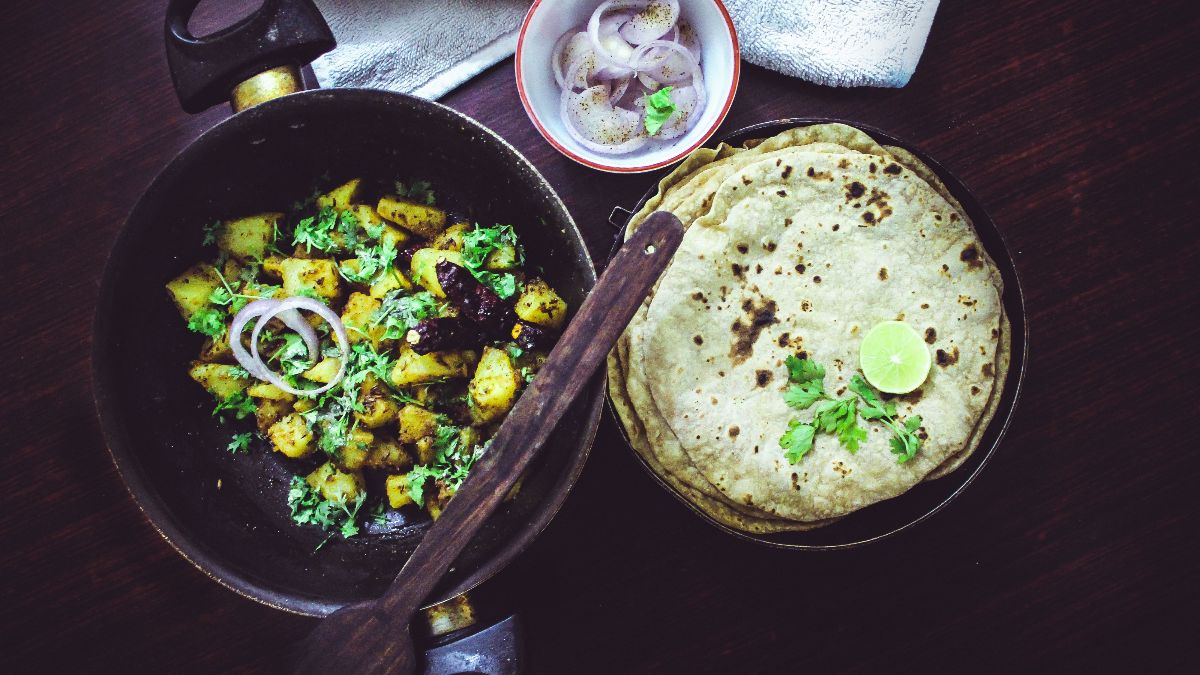
Roti and potatoes both bring carbohydrates to the plate, but that doesn’t automatically make aloo sabzi with roti an unbalanced meal. Portion, preparation and what else you eat alongside them matter too.
For generations, the combination of soft, homemade rotis and comforting aloo sabzi has been a staple on Indian dining tables. While the dish sounds simple, it is a nostalgic reminder of simpler times. Whether packed into lunchboxes, served as a weekday dinner, or enjoyed as a safe meal option during travel, this pairing has endured time and modernisation because roti and aloo sabzi remain affordable, satisfying and deeply rooted in regional food traditions.
Yet, in recent years, this familiar meal has come under a lot of scrutiny. With growing awareness around carbohydrates and blood sugar, many people assume that pairing rotis with potatoes creates a “double dose” of carbs, something that should apparently be avoided during mealtime. The belief has become so widespread that some households have started replacing potatoes altogether, fearing they are automatically making an unhealthy choice.
But nutrition is rarely that simple or that rigid towards natural foods.
The nutritional quality of a meal depends on far more than the simple presence of two carbohydrate-rich foods on the same plate. The type of carbohydrate, portion size, cooking method, fibre content and overall composition of your meal all matter. Studies of mixed meals make the same point: the glycaemic response to a potato-containing meal can change considerably when protein, fat and vegetables are eaten alongside it, which is one reason the GI of an isolated food does not tell you exactly what an entire meal will do.
So yes, a Khapli roti and aloo sabzi meal contains two carbohydrate-rich foods. That fact alone does not tell you whether the meal is balanced.
Understanding Carbohydrates: Why “Double-Carb” Doesn’t Tell the Whole Story
Carbohydrates remain one of the most consistently misunderstood parts of everyday nutrition, partly because they are often discussed as though every carbohydrate-rich food behaves identically in the body. In reality, whole grains, vegetables, pulses, fruits and refined sugars may all provide carbohydrates, but they differ greatly in fibre, micronutrients, food structure and how they are usually eaten.
Potatoes, despite their reputation, are not simply “empty carbs”. They provide potassium and vitamin B6 and can contribute vitamin C, although the amount of vitamin C can change with storage and cooking.
Likewise, Aashirvaad Namma Chakki 100% Khapli Atta is a whole-grain emmer wheat flour. Current Aashirvaad material gives a product-specific dietary fibre figure of 11.4g per 100g in its quality-certificate data, although another comparison table on the same current site lists 10.7g per 100g; I would use whichever figure your approved product specification confirms before publication.
Rather than viewing carbohydrates as something to eliminate, it is more useful to look at the overall nutritional quality of the meal. Khapli wheat, also known as emmer wheat (Triticum dicoccum), is one of the older cultivated wheat species and has a long history in Indian food traditions. Aashirvaad Namma Chakki 100% Khapli Atta gives households another whole-wheat option with its own slightly nutty flavour and texture.
One claim we should avoid, though, is describing Khapli roti as automatically “GI-friendly” simply from the flour name. Glycaemic responses vary substantially across breads and cereal products according to processing, preparation and the complete meal, and the scientific literature does not support assigning one universal response to every Khapli roti.
Khapli Roti With Aloo Sabzi: Can It Be a Balanced Meal?
Yes — it can be.
Potatoes may frequently be labelled unhealthy or “carb-heavy”, but the ingredient itself is a nutrient-containing vegetable. The more useful questions are how much is being eaten, how it has been cooked and what else accompanies it.
A deep-fried potato preparation, a highly processed potato snack and a simple homemade aloo sabzi are plainly not the same food experience. Frying also adds considerably more fat and energy to the dish, while cooking method can alter the potato’s nutritional composition and starch digestibility.
A simple aloo sabzi made with boiled potatoes, a modest amount of oil and everyday spices therefore deserves to be judged as exactly that — a home-cooked potato dish — rather than being treated as nutritionally equivalent to every fried or packaged potato food.
And the roti matters, but so does everything sitting beside it. Add curd, dal, salad or a green vegetable and you have changed the composition of the meal again.
That is the real weakness of the phrase “double-carb”: it stops counting at two ingredients.
A Simple Aloo Sabzi for Two
Ingredients
- 4 medium potatoes, boiled, peeled and cubed
- 2 teaspoons groundnut or sunflower oil
- 1 teaspoon cumin seeds
- A pinch of asafoetida, optional
- 1–2 green chillies, finely chopped
- 8–10 fresh curry leaves, optional
- ½ teaspoon turmeric powder
- 1 teaspoon coriander powder
- ½ teaspoon roasted cumin powder
- Salt, to taste
- 2 tablespoons water, if needed
- 2 tablespoons chopped fresh coriander
- 1 teaspoon freshly squeezed lemon juice
Method
- Heat the oil in a heavy-bottomed kadhai or frying pan over a medium flame. Add the cumin seeds and allow them to crackle. If using, stir in the asafoetida and curry leaves for a few seconds until fragrant.
- Add the chopped green chillies and sauté briefly without allowing them to brown.
- Sprinkle in the turmeric and coriander powder, followed immediately by two tablespoons of water. This helps prevent the spices from scorching while they release their aroma.
- Add the boiled potato cubes and season with salt. Toss gently until every piece is evenly coated with the spices.
- Cover and cook over a low flame for 4–5 minutes, stirring occasionally, so the potatoes take on the flavours without breaking apart.
- Finish with roasted cumin powder, chopped fresh coriander and a squeeze of lemon juice. Toss lightly and serve hot.
How to Make Soft Khapli Rotis
For the rotis, keep the method simple. Khapli dough can behave a little differently from the atta your household normally uses, so the first batch is more about finding the hydration that works for your flour than following a rigid water ratio.
- Add water gradually to Aashirvaad Namma Chakki 100% Khapli Atta while bringing the dough together.
- Knead until the dough feels soft and pliable without becoming excessively sticky.
- Cover and allow it to rest for around 20 minutes so the flour hydrates evenly.
- Knead it briefly once again before dividing and rolling.
- Roll each roti evenly without putting excessive pressure on the edges.
- Cook on a well-heated tawa, flipping once the first side begins to develop bubbles and dry spots, then finish according to your normal roti method.
Proper hydration, resting, even rolling and avoiding unnecessary overcooking will generally matter more to the final texture than chasing one “correct” Khapli technique.
How to Balance a Roti-and-Aloo Meal
Instead of worrying about whether the plate contains “double carbs”, look at what the two carbohydrates are sharing the plate with.
A bowl of curd is one very easy addition. So is a serving of dal if the meal needs more protein and pulse-based fibre. Salad, sautéed greens or another seasonal vegetable bring more plant variety to a meal that would otherwise be dominated by roti and potato.
For example:
Khapli roti + aloo sabzi is a simple grain-and-potato meal.
Khapli roti + aloo sabzi + curd + salad brings in dairy/protein and additional vegetables.
Khapli roti + aloo sabzi + dal + greens changes the plate again, adding a pulse and another vegetable source.
The potato does not need to disappear for the rest of the meal to improve.
ⓘ A 30-Second “Double-Carb” Check
Before deciding that two carbohydrate-rich foods make a meal unbalanced, ask:
- Are both foods minimally processed or is one heavily refined?
- What are the portions?
- Is there a protein-rich food on the plate?
- Are there vegetables beyond the potato?
- How much oil or ghee has gone into the preparation?
- Is this an everyday meal or an occasional indulgence?
The label “double-carb” answers none of those questions. The plate does.
A Few Practical Meal-Balancing Tips
It is perfectly fine to enjoy richer preparations occasionally, but for everyday meals, simple home-style cooking makes it much easier to build the rest of the plate around the food you already like. Khapli rotis can rotate alongside different dals, seasonal vegetable curries, curd, salads and homemade pickles without every meal needing to become a nutrition project.
If you enjoy ghee on your roti, a small amount can absolutely remain part of the meal. Fat also helps the body absorb fat-soluble vitamins from food, but that does not make extra ghee necessary for a meal to be “balanced”, nor does it make portion size irrelevant.
And if you want softer Khapli rotis for children or a lunchbox, concentrate first on dough hydration, resting and cooking time. Some home cooks also use a little milk in the dough, but it is an optional kitchen technique rather than a nutritional requirement.
Above all, remember what started this conversation: carbohydrates are not automatically the enemy, and eating a roti alongside potatoes does not make the meal nutritionally doomed. The overall pattern matters much more than whether somebody can point to two ingredients and say, “Aha — carbs.”
FAQs
Is roti with aloo sabzi too high in carbohydrates?
Both roti and potatoes provide carbohydrates, so the combination is carbohydrate-rich. That does not automatically make the meal unbalanced. Portions, preparation and the other foods on the plate matter too.
Can potatoes be part of a balanced diet?
Yes. Potatoes provide nutrients including potassium, vitamin B6 and vitamin C. Cooking method and portion size influence the final meal, and frying or highly processed potato foods should not be treated as equivalent to a simple boiled or home-cooked potato preparation.
Is Khapli roti lower in carbohydrates than regular roti?
Not dramatically. Aashirvaad’s current comparison lists 72.4g carbohydrate per 100g for its Khapli atta and 76.8g for the regular atta in its comparison. The difference should not be turned into a claim that Khapli roti is a low-carbohydrate food.
Does eating roti and potato together cause a blood-sugar spike?
You cannot reliably predict the glycaemic response to a mixed meal from the presence of roti and potatoes alone. Studies show that protein, fat, vegetables and other components of a potato-containing meal can substantially change its post-meal glucose response.
What can I add to aloo sabzi and roti to make the meal more varied?
Curd, dal, salad, sautéed greens or another seasonal vegetable are all simple additions. You do not need all of them at once; one or two additions may be enough to broaden the meal.
Is Khapli atta good for people with diabetes?
Khapli is a wheat flour and contains carbohydrates. People managing diabetes should consider portions, the complete meal and their individual medical guidance rather than treating any atta as a treatment or universally low-GI food.
The Bottom Line
Roti and aloo sabzi have survived for generations because the combination is practical, inexpensive, comforting and very good at tasting like home. Calling it a “double-carb meal” does not suddenly erase any of that, nor does the label tell you very much about its nutritional quality.
Yes, both foods contain carbohydrates. What matters next is how much you eat, how the potatoes are prepared and what else is sharing the plate. Keep the sabzi simple, let the roti be the roti, and bring in curd, dal, salad or another vegetable when the meal needs more variety.
The answer was never to fear the potato. It was to look at the whole plate.
Disclaimer: This article provides general dietary information and is not a substitute for personalised medical advice. People managing diabetes, insulin resistance or another health condition affecting carbohydrate intake should follow guidance from their doctor or registered dietitian.
Sources
- Hätönen et al., British Journal of Nutrition: Protein and fat modify glycaemic and insulinaemic responses to a mashed-potato-based mixed meal.
- Dodd et al., American Journal of Clinical Nutrition: Directly measured meal GI can differ substantially from predictions based on individual food GI values.
- NIH Office of Dietary Supplements: Potassium, Vitamin B6 and Vitamin C