What Are Digestive Enzymes? Your Questions, Answered
Everything you’ve wondered about how your body breaks down food, and never knew whom to ask.
Table of Contents
Digestive enzymes are proteins your body makes to break food down into pieces small enough to absorb. Different enzymes handle different nutrients: amylase breaks down starches, proteases break down proteins, lipase breaks down fats, and lactase breaks down the sugar in milk. They’re made in your mouth, stomach, pancreas and small intestine, and for most healthy people, the body makes all it needs. Feeling bloated doesn’t usually mean you’re short of enzymes. Enzyme supplements have a clear role only for specific, diagnosed conditions.
You’ve probably seen the advertisements. “Take digestive enzymes before every meal.” “Stop bloating instantly.” “Digest your food better.” It’s easy to assume that if your stomach doesn’t feel right, you must be “low on enzymes”. But what are these enzymes, really, and what do they do all day?
Here are the questions most people have about digestive enzymes, answered simply, with a source for every answer.
| Digestive enzymes, in one line Digestive enzymes are proteins your body makes to break down food and aid digestion, cutting carbohydrates, proteins and fats into pieces small enough for your body to absorb and use. |
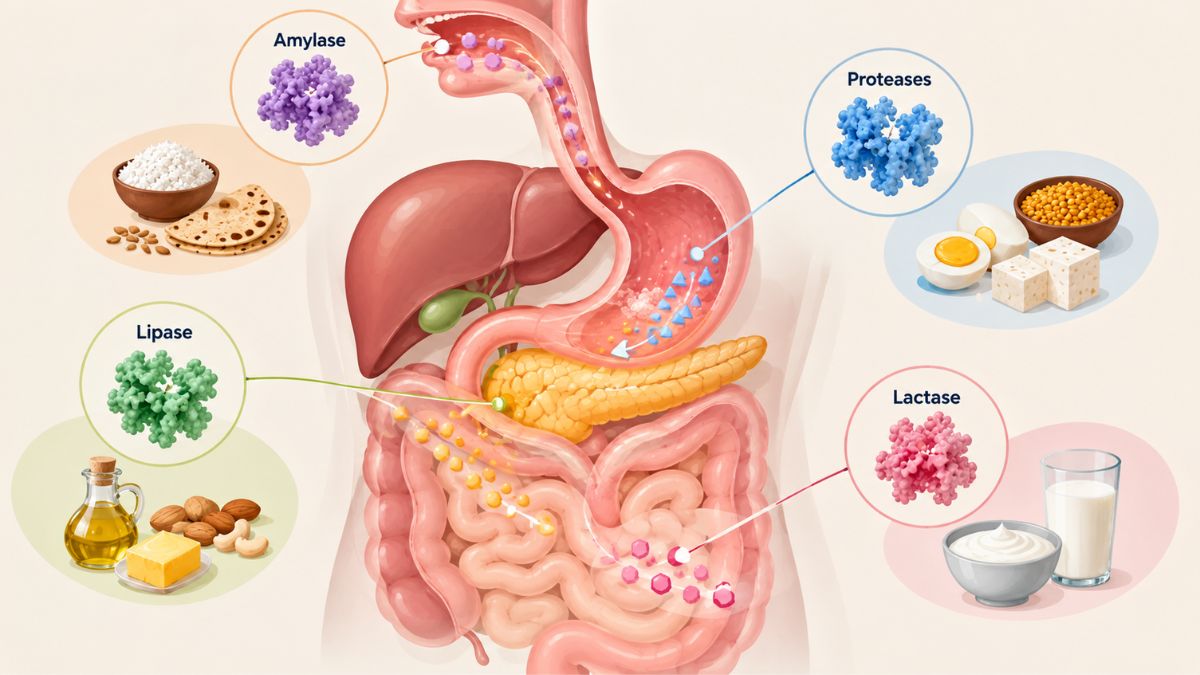
In several places along the way. Digestion is a relay, and each stage adds its own digestive juices:
The pancreas does most of the heavy lifting; Johns Hopkins Medicine calls it the “powerhouse” of enzyme production.
There isn’t one single digestive enzyme. Think of them as a team, each with its own job. You don’t need to memorise the names, but here’s how they map onto an everyday Indian plate:
| Enzyme | Made mainly in | Breaks down | On your plate |
| Amylase | Salivary glands, pancreas | Starches (complex carbohydrates) | Roti, rice, poha |
| Proteases | Stomach, pancreas | Proteins | Dal, paneer, eggs |
| Lipase | Pancreas | Fats | Ghee, cooking oil, nuts |
| Lactase | Small intestine | Lactose, the natural sugar in milk | Milk, chai, kheer |
Sources: Johns Hopkins Medicine; Cleveland Clinic.
Yes. Chewing breaks food into smaller pieces, and saliva adds an enzyme that begins breaking down starches before you’ve even swallowed. It’s one reason the old advice to chew your food properly still holds, and why eating slowly and mindfully tends to feel better than wolfing down lunch in five minutes.
| Try it in your kitchen Take a small bite of plain roti and chew it slowly for 30 seconds or so before swallowing. You may notice it starts to taste faintly sweet. That’s amylase in your saliva beginning to turn starch into sugar: an enzyme at work, in real time. |
A lot more than most people realise. Your pancreas sits behind your stomach and releases a digestive juice containing enzymes for carbohydrates, fats and proteins into your small intestine. That’s where most digestion actually happens.
When the pancreas can’t make enough enzymes, a condition called exocrine pancreatic insufficiency, people may notice bloating, loose, greasy, bad-smelling stools and weight loss. It’s usually linked to conditions such as chronic pancreatitis or cystic fibrosis, it’s diagnosed by a doctor, and it’s treated with prescribed enzymes. It’s very different from feeling a bit heavy after a big dinner.
It often comes down to one enzyme: lactase. Lactase breaks down lactose, the natural sugar in milk. When your small intestine makes less lactase, undigested lactose travels on to the large intestine, where it can cause bloating, gas and diarrhoea.
Lower lactase levels are very common: in Asia, most people have some degree of lactose malabsorption. Many can still manage some lactose without symptoms, and how much varies from person to person. Some people choose lactose-free milk; others, after talking to a doctor, use lactase products with dairy. It’s a good example of an enzyme supplement with a specific, targeted purpose, rather than a general “digestive tonic”.
Not at all. It’s the point. Humans don’t make the enzymes needed to break down most fibre, so fibre passes through your small intestine largely undigested. That’s what lets it add bulk and help keep things moving.
When fibre reaches your large intestine, the bacteria living there ferment some of it, which feeds those helpful bacteria. So the enzymes you lack are, in a way, what makes fibre useful. For everyday ways to eat more of it, see our practical guide to increasing fibre in an Indian diet.
Beans and dals contain certain carbohydrates that your stomach and small intestine can’t fully digest, because we lack the enzymes to break them down completely. Those carbohydrates travel on to the large intestine, where gut bacteria ferment them and produce gas along the way.
That’s normal, and it isn’t a reason to stop eating dal. Pulses are among the most nourishing foods on an Indian plate. If a big bowl of rajma leaves you uncomfortable, a smaller portion is usually the easiest fix.
Usually not. This is where most of the confusion starts. Feeling bloated after a meal doesn’t automatically mean your body is short of enzymes. Cleveland Clinic’s gastroenterologists put it plainly: in most cases, you don’t need to worry about your body making enough.
Bloating has many possible explanations, including:
That’s why buying a supplement without understanding the cause may not solve anything. If you’re unsure whether a tight waistband is bloating at all, here’s how to tell bloating from weight gain.
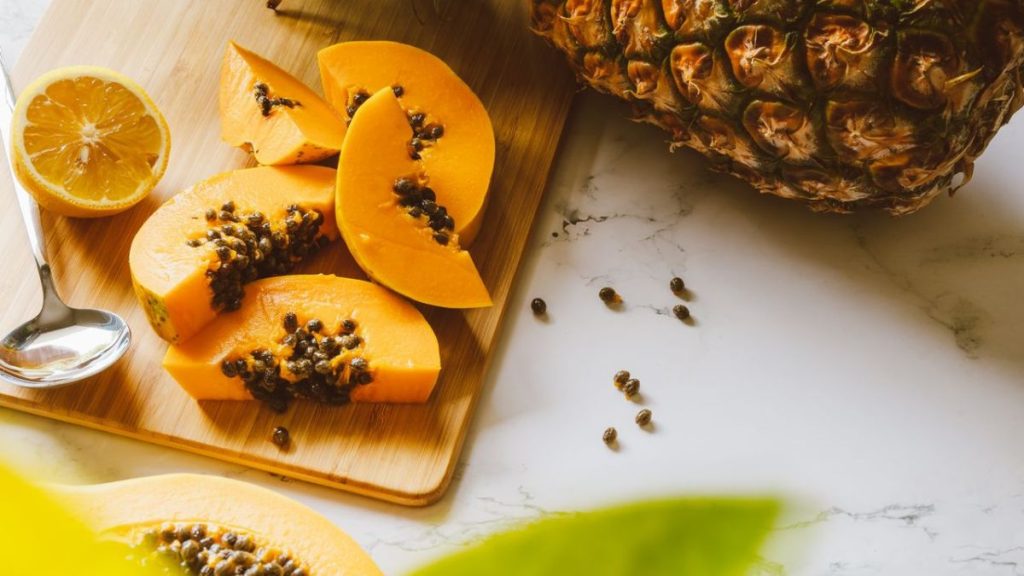
They do contain enzymes: papaya has papain and pineapple has bromelain, both of which break down protein. But Johns Hopkins Medicine notes that there’s no real evidence that eating enzyme-rich fruits improves digestion for healthy people. Your own enzymes already handle the job.
That doesn’t make them any less worth eating. Papaya and pineapple are good fruits in their own right: they bring fibre, vitamins and variety. Just enjoy them as fruit rather than as a digestive treatment.
For most healthy adults, no. Johns Hopkins and Cleveland Clinic both make the same point: a healthy body makes the enzymes it needs, and over-the-counter supplements aren’t closely regulated, so what’s in the bottle can vary. If your body already makes enough enzymes, taking more doesn’t make digestion work better. Think of it like wearing two raincoats on a sunny day.
Enzymes do have an important place for specific, diagnosed conditions, such as exocrine pancreatic insufficiency or lactose intolerance, where a doctor can advise on the right product. If you’re considering a supplement for regular bloating, talk to a doctor first; they can help work out what’s actually going on.
Test what you’ve picked up:
| Statement | Myth or fact? | Why |
| “If I’m bloated, I must be low on enzymes.” | Myth | Bloating has many causes; most healthy people make plenty of enzymes. |
| “Digestion starts in your mouth.” | Fact | Saliva contains an enzyme that starts breaking down starches. |
| “Everyone should take an enzyme tablet after a heavy meal.” | Myth | Healthy people don’t need them; supplements are for specific, diagnosed conditions. |
| “Your body can’t digest most fibre, and that’s a good thing.” | Fact | Undigested fibre adds bulk and feeds your gut bacteria. |
| “Eating raw papaya or pineapple helps digest your meal.” | Myth | They contain enzymes, but there’s no real evidence they improve digestion. |
| “Lower lactase levels are common in Asia.” | Fact | Most people in Asia have some degree of lactose malabsorption. |
Digestive comfort is usually built through everyday habits rather than supplements. Before assuming you need enzyme tablets, take two minutes with these questions about the past week:
If most of your answers point to an irregular routine, improving those habits is likely to be a more useful first step than buying a supplement. To see how your meals add up on fibre, try My Meal Plan.
Happy Tummy GPT can help you look for everyday patterns behind post-meal discomfort. It can’t diagnose an enzyme deficiency; only a doctor can. Try this prompt: “I’ve been experiencing bloating after meals. Here’s my typical daily diet, meal timings, hydration, activity levels and symptoms. Can you help me identify possible lifestyle patterns that may be contributing to my digestive discomfort? Please focus on balanced eating habits, and tell me whether digestive enzyme supplements are something I should discuss with my doctor.”
Occasional bloating or indigestion is common. Persistent symptoms deserve a proper check-up rather than a self-prescribed supplement.
If symptoms continue, are severe, or keep coming back, it’s worth speaking to a doctor. Sudden weight loss, blood in stool, severe or persistent pain, or difficulty swallowing need prompt medical attention.
See a doctor, too, if you notice persistent diarrhoea, ongoing constipation, persistent vomiting, or loose, greasy, bad-smelling stools.
Digestive enzymes are essential, and your body makes them every day, from the first chew of roti to the last stretch of your small intestine. For most healthy people, occasional discomfort doesn’t mean an enzyme shortage, and supplements aren’t a routine fix. Balanced meals, slow eating, water, movement and a steady routine do more of the everyday work.
Enzyme supplements matter for specific, diagnosed conditions, where a doctor can guide their use. For everyone else, your body’s own team of enzymes has it covered.
This article is for general information only and is not a substitute for professional medical advice, diagnosis or treatment. Always consult a doctor or a qualified healthcare professional about any health concerns, or before making changes to your diet, especially if you are pregnant, managing a medical condition, or making changes for a child or an older adult.