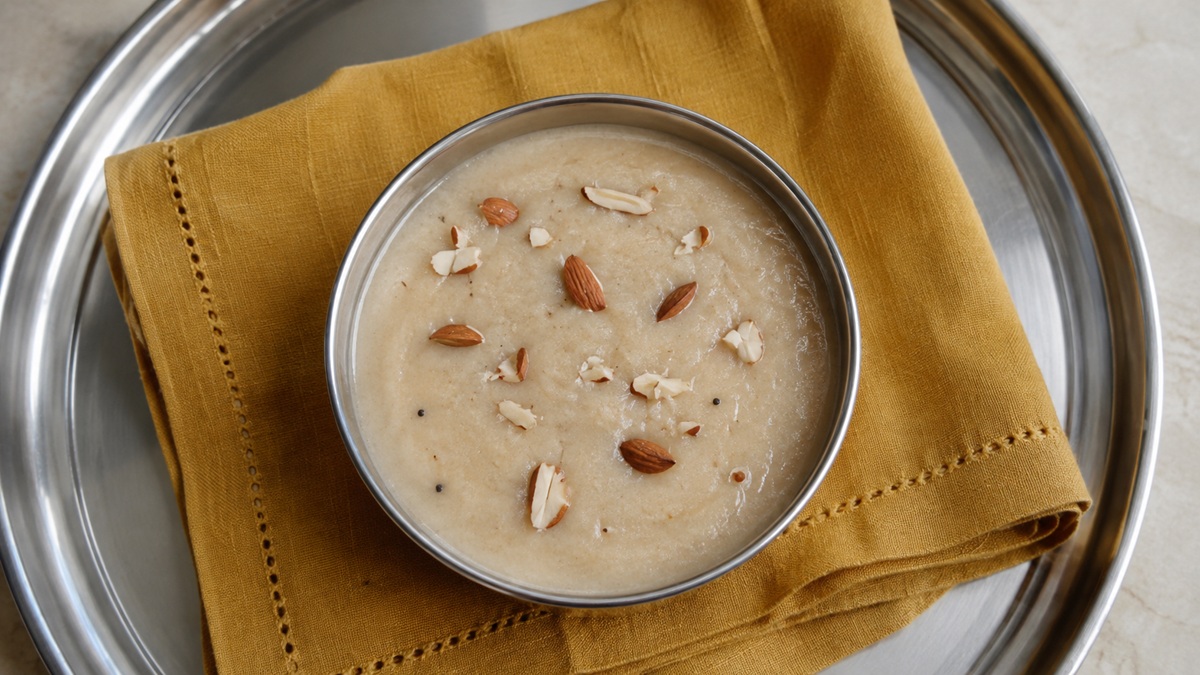
Odisha’s mandia pej, ragi ambali and the Sindhi juar jo bhutt start with familiar millets but take very different routes to the bowl — from fermentation to straightforward cooking.
Odisha’s mandia pej and ragi ambali both use finger millet and can involve genuine fermentation, although neither exists as one rigid recipe across every household. Traditional mandia pej methods include fermenting ragi in water before cooking it with rice, while other versions make use of fermented rice water; ambali likewise exists in deliberately fermented forms as well as simpler cooked versions. Juar jo bhutt, made in Sindhi households with jowar, breaks from this pattern altogether: it is associated with winter and is cooked and eaten warm rather than relying on fermentation.
What connects the three is therefore not one processing method but a much older instinct — taking the grain a region has, processing it in a way that suits the local kitchen and climate, and turning it into something filling without making it elaborate.
Closing Out the Map
Part 1 of this series covered sattu and its roasted-grain relatives alongside Tamil Nadu’s ragi koozh and Karnataka’s ragi huri hittu, regional answers to a similar practical problem: making a grain or pulse into something quick to prepare, filling and easy to carry into an ordinary working day. This piece finishes that map by heading east to Odisha, west towards Maharashtra and then into Sindhi kitchens, where a jowar preparation complicates the pattern once again.
The east-west group resists the tidy categories of Part 1 in a useful way. Mandia pej genuinely changes from one community and household to another, ambali has both fermented and quicker contemporary preparations, and juar jo bhutt breaks the seasonal pattern altogether by appearing as a warm winter porridge rather than a cooling drink.
There is a different social context worth naming here too. Foods such as sattu and ragi koozh have both acquired a newer layer of urban wellness attention, while mandia pej remains first and foremost strongly connected with Odisha’s Adivasi food traditions, particularly in the southern districts. Writing about it only as another regional “health drink” misses the fact that it has long existed as an ordinary staple food within communities that did not need a wellness category to validate it.
The East: Mandia Pej
Mandia pej is a ragi-and-rice preparation rooted particularly strongly among Adivasi communities in southern Odisha, including Koraput and the surrounding tribal belt. Academic documentation among the Gadaba community describes Samel Pej, the local finger-millet gruel, as a semi-liquid preparation made from mandia and rice and eaten as a regular part of lunch and dinner rather than as an occasional functional drink.
Here’s where precision matters, though: mandia pej isn’t one fixed recipe, and whether fermentation happens before, during or around the preparation depends on which version you’re looking at. In a documented Gadaba method, finger-millet flour is mixed with water and kept for one or two nights before partially cooked rice and more water are added and the mixture is boiled; the finished pej can then be cooled longer to develop additional sourness. Other Odisha preparations use already fermented rice water alongside ragi, while contemporary versions may simply cook ragi and rice together without a deliberate fermentation period.
Both kinds can reasonably be called mandia pej because traditional food is rarely built to one standardised recipe. What changes is the food science: the fermented version undergoes microbial activity that the freshly cooked version does not, so they should not be treated as nutritionally identical simply because the finished bowls share a name.
Mandia pej is commonly paired with something sharp alongside its mild base — a tomato and green-chilli chutney, for instance — and that contrast appears throughout this family of foods. Koozh has its shallots and chilli, sattu has lemon and cumin, while a gentle grain base often gets much of its appetite appeal from the accompaniment rather than from trying to carry all the flavour itself.
Is Mandia Pej a Fermented Food?
Traditional versions certainly can be. Recent documentation from Odisha describes ragi flour mixed with water and left overnight to ferment before it is stirred into cooked rice, while the Gadaba research records a one-to-two-night soaking period before cooking.
That fermentation can produce living microorganisms and the characteristic mildly sour flavour, but the usual distinction matters here: a naturally fermented food is not automatically a clinically proven probiotic food. To make that stronger claim, particular microorganisms, viable quantities and a demonstrated health benefit would need to be established rather than assumed from fermentation alone.
The simply cooked version does not acquire the same live microbial population, but that does not make it the “wrong” mandia pej. It is simply a different household method, shaped in many cases by time and convenience rather than by a nutritional hierarchy.
Mandia Pej and Pakhala Are Not the Same Thing
Odisha has another, much more widely known fermented-rice tradition in pakhala, but the two are not alternate names for the same dish. Pakhala begins with cooked rice soaked in water and belongs to the overnight-rice family alongside panta bhat and poita bhat; mandia pej brings finger millet into the preparation, usually alongside rice or rice water, and is better understood as a ragi-and-rice gruel.
The overlap is therefore real — rice, water, sourness and the practical transformation of an everyday staple appear in both — but the ingredients and method remain distinct.
The West: Ambali
Move west and ragi becomes nachni in Maharashtra, where ambil is one familiar version of a broader Indian ambali tradition. Ragi ambali is not confined to Maharashtra — related preparations appear in Karnataka, Andhra Pradesh, Telangana and elsewhere — but the Maharashtrian version belongs comfortably in this part of the map.
Here too, a single rigid recipe would be misleading. Some traditional methods cook the ragi into a thick mixture, cool it and leave it to ferment before thinning it with water or buttermilk; others ferment a ragi batter before cooking; and quicker contemporary versions simply cook the flour, cool it and whisk in buttermilk without a prolonged fermentation at all. Current recipe documentation continues to show both fermented and same-day forms.
The deliberately fermented versions are especially interesting because fermentation changes the grain beyond simply cooking it. Finger-millet fermentation can reduce compounds such as phytic acid and alter measures of nutrient availability, while lactic-acid bacteria become part of the microbial process. Where fermentation occurs after the cooking stage and the food is not subsequently heated again, living microorganisms may also remain in the ambali when it is consumed.
Again, that makes fermented food containing live microorganisms a more careful description than promising a standardised probiotic effect from every household glass.
Ambali Doesn’t Have One Regional Owner
The name becomes confusing because ambil, ambali and related terms turn up across several neighbouring food cultures. Maharashtra has nachni ambil, while Karnataka and parts of Andhra Pradesh and Telangana have their own ragi ambali traditions, and their preparation methods are not always identical.
That variation is not a problem that needs to be solved by choosing one recipe as authentic. It is evidence of what happens when a useful grain preparation travels across households, climates and languages: the basic idea survives while details of fermentation, cooking, seasoning and serving change.
Juar Jo Bhutt: The Winter Outlier
Juar jo bhutt, the Sindhi jowar preparation, breaks from the pattern the rest of this pair has followed. Available culinary accounts describe it as a winter preparation made from jowar rather than as a deliberately fermented summer drink; the grain is cooked into a warm, porridge-like dish and eaten hot. That makes it closer to the breakfast-bowl end of this category than to a thin glass of sattu or ambali.
Its winter association is worth noticing without turning it into a neat nutritional origin story. Food traditions do not necessarily arise because somebody consciously decided that one processing method was physiologically “warming” and another “cooling”; nevertheless, the contrast helps explain why juar jo bhutt occupies a different place at the table from the thinner, sour preparations associated with hot-weather eating elsewhere in this series.
It also means that calling every food in this pair a “flour-based drink” stretches the category slightly. Juar jo bhutt is better understood as part of the same broader family of practical grain preparations: the grain changes, the consistency changes and the processing changes, while the underlying instinct — making a locally familiar millet into an uncomplicated meal — remains recognisable.
Mandia Pej, Ambali and Juar Jo Bhutt: How They Differ
Preparation
Regional association
Base
Processing method
Typical form
Mandia pej
Southern Odisha, especially Adivasi food traditions
Ragi + rice
Traditional versions may include fermentation; simpler cooked versions also exist
Thin gruel or drink
Ragi ambali / ambil
Maharashtra and wider southern/deccan traditions
Ragi
Method varies; fermented and non-fermented versions both exist
Thin savoury drink or gruel
Juar jo bhutt
Sindhi households
Jowar
Cooked rather than deliberately fermented in documented versions
Warm porridge
The comparison shows why “millet drink” is not a nutritional category in itself. Two foods can begin with finger millet and undergo quite different processing, while another can use jowar and sit at the opposite end of the seasonal and textural spectrum.
What This Pair Adds to the Picture
Across both pieces, the honest throughline isn’t “all traditional Indian flour drinks are fermented superfoods”. It is something more interesting and more accurate: different communities solved a similar practical problem — making filling food from the grain or pulse available locally — using whichever combination of roasting, puffing, fermenting or cooking suited the ingredient and the kitchen.
Fermentation appears often enough to be a genuine pattern, but it isn’t the whole story. Treating every preparation as interchangeable because they all involve millets would erase exactly what makes them worth comparing in the first place.
The processing method also changes what can reasonably be said nutritionally. Cooking makes raw grain edible and changes its starch and protein structure; fermentation adds microbial activity and can reduce some antinutritional compounds such as phytate; puffing and roasting alter starch through heat. These processes sometimes produce overlapping effects, but they should not be bundled together under a blanket claim that traditional processing automatically makes every grain “easy to digest”.
Does It Matter Whether Mandia Pej Is Fermented?
To a degree, yes. A fermented mandia pej undergoes microbial changes that a version cooked and eaten immediately does not, and depending on the exact method it may contain organic acids and living microorganisms and may show changes in compounds such as phytate.
The cooked-only version doesn’t acquire those particular features, although it remains a ragi-and-rice preparation with its own nutritional profile. Families may choose one method over another because of tradition, climate, available time or convenience, and fermentation should not be treated as the test that determines whether one version is legitimate.
Traditional Doesn’t Automatically Mean Light or Medicinal
A bowl of mandia pej or ambali has traditionally been substantial enough in some communities to function as real food during a working day, rather than as a small wellness drink added on top of breakfast and lunch. The nutritional role therefore depends on the thickness, amount of grain used, serving size, accompaniments and whether it is functioning as a meal or an additional drink.
The same restraint applies to the familiar claims around diabetes, weight loss and digestion. Ragi and jowar can contribute whole grains, fibre and micronutrients, while fermentation can change nutrient availability, but none of these preparations is a treatment for a diagnosed metabolic or digestive condition. They do not need disease claims to justify their place in a varied diet.
The Honest Takeaway
Across these two pieces are several regional foods and several different processing methods, tied together by one shared, sensible instinct: when a household needed something practical, filling and based on what grew locally, it found a way to make the grain work.
Sattu relies on roasting. Ragi huri hittu relies on heat processing. Traditional koozh uses fermentation. Mandia pej changes method across communities, with fermentation genuinely present in several documented versions. Ambali does the same across its regional forms, while juar jo bhutt takes jowar in another direction entirely and becomes a warm winter porridge.
What is striking, taking the whole group together, is not that traditional cooks somehow anticipated every line of modern nutrition research. It is that generations of cooking produced a remarkably wide set of techniques — roasting, puffing, fermenting and prolonged cooking — each adapted to a particular grain and eating context. Modern food science can explain some of the changes those techniques create, but the foods themselves are more interesting when allowed to remain regional dishes rather than being flattened into a single category of “ancient gut-health drinks”.
Frequently Asked Questions
Is mandia pej fermented?
It depends on the preparation. Traditional methods documented among communities in southern Odisha include fermenting ragi flour in water before cooking it with rice, while other versions use fermented rice water; contemporary preparations may also skip deliberate fermentation altogether.
Is mandia pej the same as pakhala?
No. Pakhala is based primarily on cooked rice soaked or fermented in water, while mandia pej contains finger millet, usually alongside rice or rice water. They belong to related food traditions but are distinct dishes.
Does fermented mandia pej contain probiotics?
It can contain living microorganisms because of fermentation, but that is not enough to classify every household preparation as a clinically proven probiotic food. Probiotic claims require evidence for specific microorganisms, adequate viable amounts and a demonstrated health benefit.
What is ragi ambali?
Ragi ambali or ambil is a thin finger-millet preparation found across several regional food traditions, including Maharashtra and parts of southern India. Recipes vary considerably: some deliberately ferment ragi, while others cook it and add buttermilk without a separate fermentation stage.
Is ambali always fermented?
No. Traditional fermented ambali is well documented, but quicker non-fermented preparations also exist under the same or closely related names, so the method matters more than the name alone.
Is ragi ambali the same as ragi koozh?
They are related finger-millet foods but not simply two regional names for one preparation. Tamil Nadu’s koozh and the various ambali traditions differ in their cooking, fermentation and serving methods.
What is juar jo bhutt?
Juar jo bhutt is described in Sindhi culinary accounts as a jowar-based winter preparation with a warm porridge-like consistency. Unlike the fermented ragi foods in this article, the versions documented here rely on cooking rather than deliberate fermentation.
Is juar jo bhutt a drink?
It is better described as a porridge or semi-solid grain preparation than as a true drink, although it belongs to the broader family of traditional flour- and grain-based foods explored in this pair.
Are fermented millet foods automatically better for gut health?
No. Fermentation can create living microbial populations and alter compounds such as phytate, but the exact effects depend on the grain and method. A fermented food is also not automatically a clinically established probiotic.
Can mandia pej or ambali help manage diabetes or weight loss?
Neither should be treated as a treatment for diabetes or a weight-loss intervention. The grain, preparation method, serving size, accompaniments and overall diet all matter.
You are now being directed to an external website https://www.callr.live/aashirvaadexperts/premium-plan.
This link is provided for your information and convenience only and ITC Limited is not
responsible for the contents or services provided by Brand Touch India or any information that
you share with Brand Touch India.