Karah Prasad vs Atte Ka Halwa: What’s the Difference?
The same ingredients carry different meanings: explore karah prasad’s sacred role and the home halwa whose sugar, ghee and portions you can adjust.
Table of Contents
Karah prasad is a sacred Sikh offering made with equal quantities of wheat flour, ghee and sugar and shared without discrimination. Atte ka halwa is a similar home preparation whose proportions can vary. The suggestions for reducing sugar and ghee here apply to the home dish.
At the end of a service at the gurdwara, a sewadar moves along the seated rows with a large bowl. Into every pair of cupped palms goes a warm, ghee-glossed portion, and whoever you are, you receive an equal share.
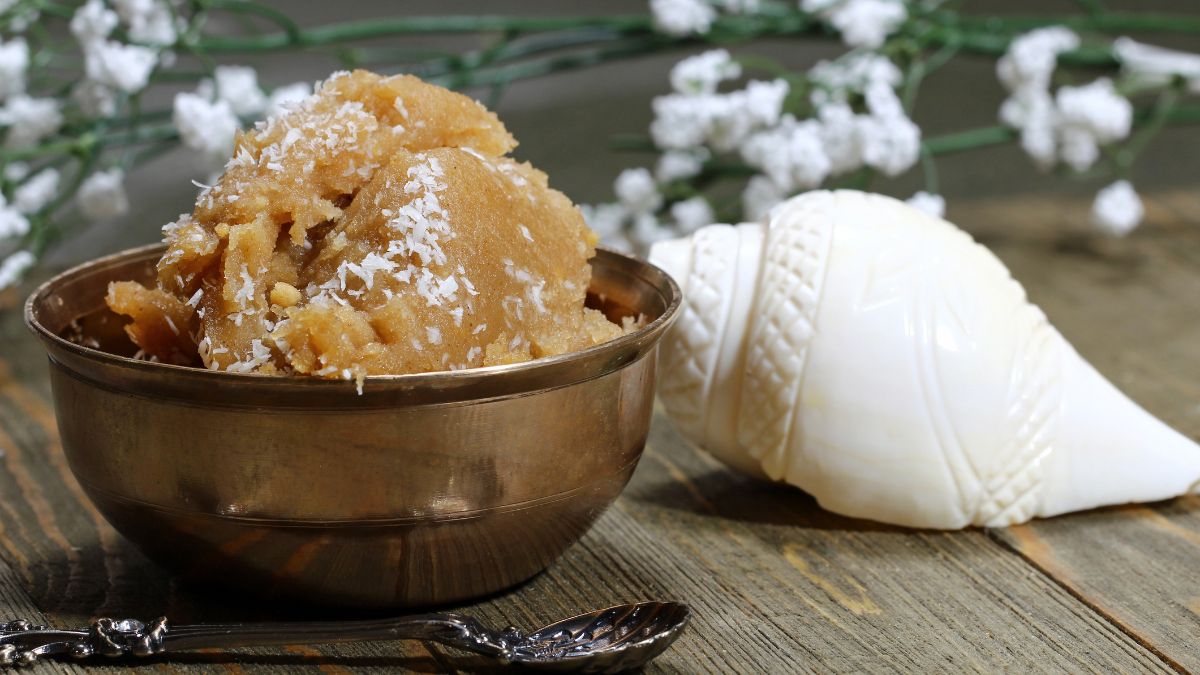
That sweet is karah prasad, also written kada prasad or karah parshad, and many North Indian families make a close cousin of it at home: atte ka halwa.
So are they the same dish?
Not quite. Here’s what separates the two, how halwa first reached India, what’s really in a bowl, and how to make the home version lighter without losing its charm.
In Sikhism, karah prasad is a sacrament, and the Sikh Rehat Maryada, the faith’s code of conduct, sets out how it is made. It calls for wheat flour, sugar and clarified butter in equal quantities, cooked in a clean vessel while scripture is recited.
Even the name comes from the kitchen. According to the Encyclopaedia of Sikhism, karah derives from the Sanskrit katah, a large boiling pan, and the offering is also known simply as deg.
The encyclopaedia also traces the tradition of offering it at a gurdwara to Guru Arjan, the fifth Guru, who took prasad to the Harimandar Sahib himself on some occasions.
Once cooked, the prasad is covered with a clean cloth and placed before the Guru Granth Sahib. The first five and the final stanza of the Anand Sahib are recited, the Ardas is offered, and the prasad is touched with a kirpan to mark its acceptance.
A share is first set aside for the Panj Pyare, the five beloved ones. A portion is also set aside for the person attending the Guru Granth Sahib before general distribution to the sangat, the congregation.
This is where the two dishes part ways. Karah prasad follows a prescribed method, while atte ka halwa is a family recipe, and families adjust recipes all the time. Everything in this piece about lightening halwa applies to the home dish alone.
The equal measures carry a message of their own. In a Food52 essay republished by Salon, Sahej M. reads them as a statement that no sex, caste, class or religion stands above another.
The idea runs deep in Sikh practice: Guru Nanak, the first Sikh Guru, founded the langar, or community kitchen, according to the Encyclopaedia of Sikhism. There, everyone ate together in the same rows, with no seating by caste or rank.
Karah prasad is shared in that spirit too. The Rehat Maryada asks that it be given out impartially, to Sikhs and non-Sikhs alike, with no one turned away because of caste.
If you visit a gurdwara, on Guru Nanak Gurpurab or any other day, you’ll be offered karah prasad. Receive it with both palms cupped together, seated if the sangat is seated.
If you’d like less, you can quietly ask the sewadar for a smaller portion. If you cannot eat it, you can explain this respectfully to the sewadar.
ALSO READ | Dev Deepawali Foods: Prasad And Varanasi’s Festive Favourites
Halwa itself has a much longer story. The word comes from the Arabic hulw, meaning sweet, and early recipes for it appear in Kitab al-Tabikh, a 13th-century Arabic cookbook, notes The Better India. Food historian Colleen Taylor Sen places its arrival in India during the Delhi Sultanate, according to Rajyasree Sen’s account in Scroll. The exact route and timing remain debated.
Once here, it settled into almost every pantry. Food scientist and historian KT Achaya, quoted in Scroll, described Indian halwas as “softly firm desserts” made from a long list of ingredients. Those range from wheat flour, semolina and vermicelli to gram flour, fruit, nuts and vegetables.
Which flour goes into the pan can depend on where you grew up. Chicago-based cookbook author Anupy Singla, of Indian As Apple Pie, tells of her mother’s first visit to her father’s village as a new bride.
Used to sooji halwa in her larger hometown, her mother was dismayed by the rustic atta version she was served, until a few bites changed her mind.
Singla’s own memory, as she writes on her blog, is of “the hot, warm ball of sweet dough made sweeter by the random juicy raisin.”
Start with the good news: atta is whole wheat flour, bran and all. The Indian Food Composition Tables 2017 list about 11.4 g of fibre per 100 g of dry whole wheat flour, against about 2.8 g in refined flour, or maida.
Bran from whole grains adds bulk and helps keep bowel movements regular. Some types of fibre can also be fermented by gut bacteria, according to the British Nutrition Foundation.
Still, the flour’s fibre is only part of the picture. A portion made using 25 g of dry atta starts with about 2.8 g of fibre from the flour. In an equal-parts recipe, it would also contain 25 g each of ghee and sugar. This is an illustrative portion, not a standard serving size or the weight of the cooked halwa; the amounts you eat depend on the recipe and portion.
Added sugar is another consideration. ICMR-NIN’s Dietary Guidelines for Indians advise keeping sugar below 5% of an adult’s daily energy. On a 2,000-kcal day, 5% is about 25 g of added sugar across all food and drinks. The illustrative equal-parts portion above would already reach that amount.
Ghee gives halwa its gloss and much of its flavour, but it is almost entirely fat. The same guidelines advise avoiding foods high in fat, sugar and salt.
So keep atte ka halwa for festive days rather than every day. That’s when many households make it anyway, for festivals, holidays and temple offerings.
Home halwa is usually a recipe handed down and tweaked along the way. Karishma, a guest on The Storied Recipe podcast, learnt hers from her grandmother. “Now at a distance, I make it too, but her expertise is unmatched,” she says.
A few small changes will make your version lighter without losing what makes it halwa.
“How can I balance a festive sweet with my other meals today?”
Consult a dietitian or your doctor if you have been advised to limit sugar or fat in your diet. They can help you work out a portion size that suits you.
Karah prasad and atte ka halwa have three common ingredients but serve two different purposes. While one is made according to a fixed formula and distributed equally to all, the other is a family recipe that you can alter to your taste.
When offered as prasad at a gurdwara, it is best to receive it as it is offered. At home, though, you can use less sugar and ghee in your usual recipe, roast the atta slowly and serve small portions to yourself and your loved ones.
Either way, it is meant to be shared.
Karah prasad is a sacred Sikh offering made with equal quantities of wheat flour, ghee and sugar and shared without discrimination. Atte ka halwa is a similar home preparation whose proportions can vary. The suggestions for reducing sugar and ghee here apply to the home dish.
Its three main ingredients are wheat flour, sugar and ghee in equal quantities. Water is also used in cooking. The Sikh Rehat Maryada prescribes its preparation and offering, including the recitation of scripture and distribution without discrimination.
Yes, the home version can be adjusted. Start with a quarter less sugar than your usual recipe and reduce the ghee gradually, keeping enough to roast the flour evenly. These suggestions apply to home halwa, rather than changes to the prescribed preparation of karah prasad.
No. Jaggery changes the flavour but still contributes added sugar. Replacing table sugar with gur does not make halwa a low-sugar dish, so the amount used and the portion served still matter.
It depends on the recipe and portion. Using the Indian Food Composition Tables 2017 value of about 11.4 g of fibre per 100 g of atta, 25 g of dry atta contributes about 2.8 g of fibre. This is an ingredient-based estimate, not a figure for every bowl of cooked halwa.