Whole grains retain more of the grain’s fibre-rich structure than refined grains. Here’s what that can mean for bowel regularity, gut fermentation and post-meal blood sugar — and why Khapli should be compared with refined flour differently from regular whole-wheat atta.
Whole grains retain more of the grain’s fibre-rich structure than refined grains. Here’s what that can mean for bowel regularity, gut fermentation and post-meal blood sugar — and why Khapli should be compared with refined flour differently from regular whole-wheat atta.
Are whole grains better for digestion than refined grains?
For many people, they can be a useful way to add more dietary fibre to the day. Whole grains retain the bran, germ and endosperm of the grain, while refining removes much of the bran and germ. That changes not just the fibre content, but the mixture of carbohydrates and other nutrients that reaches the digestive system.
Research comparing diets rich in whole grains with diets dominated by refined grains has found differences in bowel habits and some markers of gut fermentation. Whole-grain foods have also produced, on average, somewhat lower post-meal glucose and insulin responses than refined-grain foods in controlled trials.
But that does not mean every whole grain is automatically easier to digest, that refined grains cause bloating, or that switching grains guarantees you will immediately feel lighter after lunch.
The more accurate story begins with fibre.
What Is the Difference Between a Whole Grain and a Refined Grain?
A cereal grain naturally contains three main parts:
Bran: the outer portion, rich in dietary fibre and containing minerals and other plant compounds.
Germ: the part capable of sprouting into a new plant, containing fats and a range of micronutrients and bioactive compounds.
Endosperm: the large starchy portion of the grain, providing much of its carbohydrate and protein.
In a whole-grain food, these components are retained in their original proportions.
During refining, much of the bran and germ is removed, leaving predominantly the endosperm. That is how wheat can become refined flour such as maida, or brown rice can become polished white rice.
One important clarification for an Indian kitchen:
ordinary whole-wheat atta is already a whole-grain flour.
A phulka made from genuine whole-wheat atta is therefore not a refined-grain food simply because it is made from modern wheat.
That distinction becomes important when we discuss Khapli.
Whole Grains vs Refined Grains: What Actually Changes?
Refined grain
Whole grain
Bran and germ
Largely removed
Retained
Dietary fibre
Usually lower
Usually higher
Carbohydrate structure
Greater proportion of readily digestible starch
Includes more indigestible carbohydrate and fibre
Bowel function
Provides less fibre from the grain itself
Can contribute to stool bulk and regularity
Gut fermentation
Less grain fibre reaches the large intestine
Some grain fibres can be fermented by gut microbes
Post-meal glucose response
Often higher, depending on the food
Often modestly lower than a comparable refined-grain food
Micronutrients and plant compounds
Some are reduced during refining
More of the original grain is retained
These are broad category differences rather than guarantees about every food.
A finely milled whole-grain bread and an intact barley grain, for example, are both technically whole grain but will not behave identically in the body.
Processing still matters.
Why Does Fibre Matter for Digestion?
Fibre is the part of plant foods that is not fully digested and absorbed in the small intestine.
Different fibres behave differently.
Some help hold water and contribute to stool consistency. Others add bulk. Some can be fermented by microbes living in the large intestine.
That is why increasing whole grains can change bowel habits — particularly when the switch replaces foods that previously contributed relatively little fibre.
A controlled crossover trial comparing a whole-grain-rich diet with a refined-grain diet found higher stool frequency during the whole-grain period. It also found higher concentrations of some fermentation products, including faecal butyrate. Other gut measures did not all change, which is an important reminder that the response is not universal or all-or-nothing.
The useful takeaway is:
Whole grains give the digestive system more fibre to work with than their refined counterparts.
They are not a digestive medicine.
Can Whole Grains Help With Constipation?
Dietary fibre can help support bowel regularity, and whole grains are one recognised source alongside pulses, vegetables, fruit and nuts.
But more fibre is not automatically better.
Increasing fibre very suddenly can cause gas or bloating in some people, particularly when fluid intake does not increase alongside it.
If your diet is currently low in fibre, add whole grains gradually rather than replacing every refined cereal in the kitchen overnight.
And remember that the grain is only part of the picture.
A plate containing:
whole-grain roti + dal + vegetables
draws fibre from several sources.
That is generally a more useful model than expecting the roti to carry the entire day’s digestive workload.
What Happens to Whole-Grain Fibre in the Gut?
Not all fibre reaches the colon in exactly the same form, and not every grain contains the same mixture.
Some indigestible carbohydrates become substrates for microbes living in the large intestine.
When certain fibres are fermented, microbial communities can produce short-chain fatty acids such as acetate, propionate and butyrate.
This is one reason whole grains have attracted interest in microbiome research.
The human evidence is promising but not perfectly uniform. Some interventions have changed particular bacterial populations or fermentation products, while others have found relatively small changes in the overall microbiome.
So rather than saying:
“Whole grains create a healthy microbiome.”
it is more accurate to say:
Whole grains provide dietary fibres and other indigestible carbohydrates that can interact with gut microbes, and research has observed changes in fermentation and some microbial populations after whole-grain intake.
Do Whole Grains Cause a Smaller Blood-Sugar Spike?
On average, whole-grain foods can produce a lower post-meal glucose and insulin response than refined-grain comparators.
A systematic review and meta-analysis of randomised controlled trials found modest reductions in post-meal glucose and insulin responses when whole grains replaced refined grains.
That makes biological sense: grain structure, fibre, particle size and processing can all influence how quickly carbohydrate becomes available for digestion.
But avoid turning that into:
whole grain = slow digestion = no blood-sugar spike.
Individual foods vary considerably.
A heavily processed whole-grain cereal and intact barley are not metabolically identical simply because both qualify as whole grain.
Likewise, the complete meal — including protein, fat, vegetables and portion size — affects what happens after eating.
Does This Explain the Post-Lunch Slump?
Not by itself.
Feeling sleepy, heavy or hungry after lunch can have many causes: portion size, meal composition, sleep, hydration, time of day and individual glucose responses among them.
It is therefore too simplistic to say that refined starch produces a spike, then a crash, and that this is why you are tired at 3 pm.
What we can say is that replacing refined grains with whole-grain foods can alter fibre intake and may moderate post-meal glucose responses.
Whether you feel dramatically different is another question.
Your body is not a continuous glucose monitor with opinions.
Is Khapli Atta Better Than Regular Atta for Digestion?
This is where the distinction becomes especially important.
Khapli wheat is emmer wheat, or Triticum dicoccum. Aashirvaad Chakki 100% Khapli Atta is a whole-grain wheat flour.
But regular whole-wheat atta is also a whole-grain wheat flour.
So the whole-grain-versus-refined-grain argument should not be used to claim that Khapli automatically contains much more fibre or is categorically better for digestion than ordinary whole-wheat atta.
The current published Aashirvaad comparison makes that especially clear:
Aashirvaad Khapli Atta vs Regular Wheat Atta
Nutrient
Khapli Wheat Atta, per 100g
Regular Wheat Atta, per 100g
Energy
339 kcal
340 kcal
Protein
14.7g
10.5g
Carbohydrate
72.4g
76.8g
Total sugars
1.8g
4.8g
Dietary fibre
10.7g
10.8g
Total fat
1.3g
0g
Sodium
2.5mg
2.3mg
The fibre numbers are essentially the same.
That is worth saying plainly.
Khapli’s case should not be built on a claim that it contains dramatically more fibre than ordinary whole-wheat atta.
Its distinction lies elsewhere.
So What Is Different About Khapli Wheat?
Khapli is an emmer wheat, genetically distinct from the common bread wheat (Triticum aestivum) used for most modern atta.
Research comparing emmer and other ancient wheats with modern bread wheats has found compositional differences, including differences in protein and some micronutrients and bioactive compounds.
But the size and direction of those differences vary substantially by genotype, growing environment and the food ultimately produced.
That means it is safer to avoid statements such as:
“Khapli is richer in every micronutrient.”
or
“Ancient wheat is nutritionally superior to modern wheat.”
The evidence does not support that as a universal rule.
The Aashirvaad product comparison does, however, show one clear product-level difference: 14.7g protein per 100g for its Khapli atta versus 10.5g for the regular wheat atta used in its comparison.
That is a specific product claim.
It should not automatically be turned into a statement that every emmer wheat everywhere contains the same amount more protein than every modern wheat.
Does Khapli Have Less Gluten?
No reliable generalisation supports describing Khapli or emmer as “low-gluten”.
Khapli is wheat and contains gluten.
Comparative studies of ancient and modern wheats have actually found emmer and several other ancient wheats can contain as much or more total gluten than common bread wheat, although the proportions of different gluten proteins differ.
So:
Khapli is not gluten-free.
It is not appropriate for people with coeliac disease, and anyone with a diagnosed wheat allergy or medical reason to avoid wheat should follow professional guidance.
A person without these conditions may personally prefer how one wheat preparation feels compared with another.
That individual experience should not be converted into a universal “low-gluten” or “easier to digest” claim.
Is Khapli Better Than Maida?
This is a much more meaningful comparison.
A whole-grain Khapli atta retains the components of the whole grain.
Maida is refined wheat flour.
So if somebody is replacing a refined wheat product with a whole-grain Khapli preparation, they are making a genuine refined-to-whole-grain switch.
That can increase the amount of fibre and whole-grain material in the diet.
But if somebody already eats whole-wheat atta, changing from that atta to Khapli is a whole-grain-to-whole-grain change.
Those are two different nutritional questions.
The useful rule
Khapli vs maida: whole grain versus refined grain.
Khapli vs whole-wheat atta: one whole wheat versus another.
That one distinction clears up a remarkable amount of grain marketing.
What Other Whole Grains Can You Rotate Into Your Diet?
Khapli does not need to be the only whole grain in the kitchen.
Different grains bring different flavours, textures and fibre types.
Oats
Oats contain beta-glucan, a soluble fibre with substantial research behind it.
Barley
Barley is another particularly notable source of beta-glucan and works well in soups, porridges and grain-based meals.
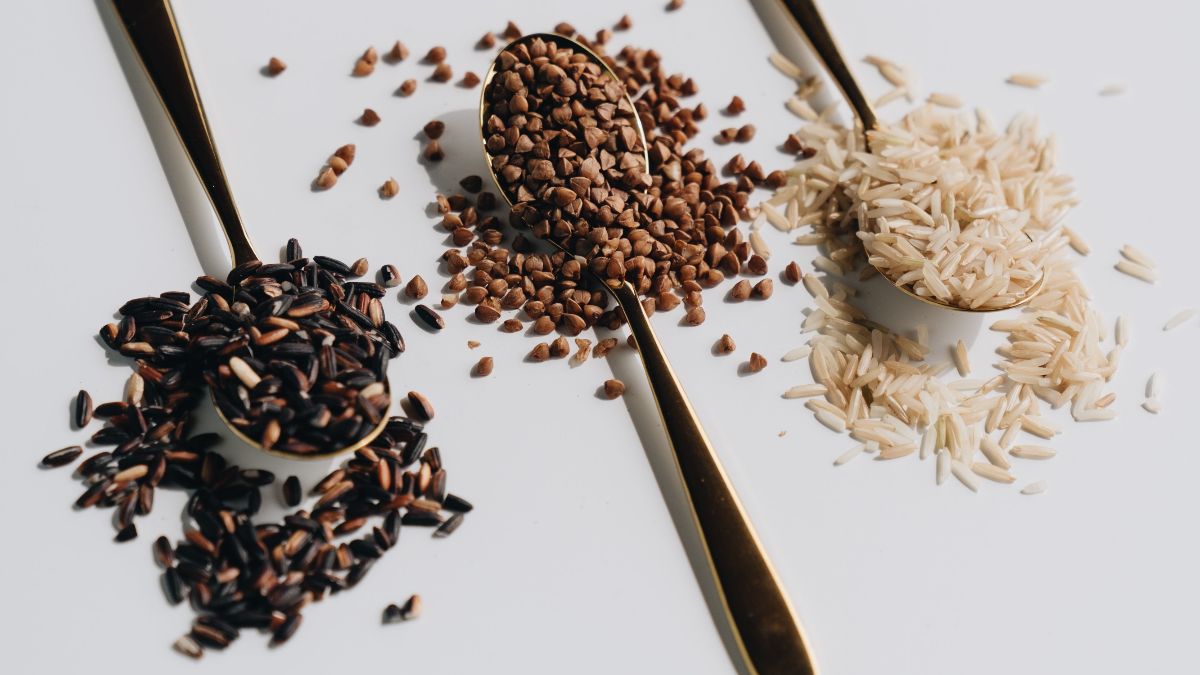
Brown or Red Rice
These retain more of the grain than polished white rice and offer a very different cooking format from wheat.
Jowar, Bajra and Ragi
These millets are naturally gluten-free in their pure form and offer another way to diversify the grain portion of Indian meals.
Other Whole-Wheat Attas
They count too.
Grain diversity does not require every wheat roti to be replaced with an exotic ingredient.
Regular whole wheat remains a whole grain.
Does Eating More Types of Whole Grain Improve the Microbiome?
Dietary diversity is generally a useful principle, but avoid making a simple promise that rotating grains will automatically produce a “more diverse microbiome”.
Human intervention studies show that whole grains and their fibres can influence gut microbes, but the results differ by grain, individual and study.
Different grains do provide different combinations of fibres and other plant compounds.
So rotating among wheat, oats, barley, rice and millets can broaden dietary variety even without claiming a guaranteed microbiome outcome.
That is a perfectly good reason to do it.
A 30-Second Grain Check
Before asking whether one grain is “better for digestion”, ask:
Is this food whole grain or refined?
How much fibre does the actual product contain?
Am I comparing Khapli with maida, or with another whole-wheat atta?
What else is in the meal — dal, vegetables, fruit, nuts or seeds?
Am I increasing fibre gradually?
Am I drinking enough fluids alongside a higher-fibre diet?
Am I judging a food by evidence, or by how healthy its grain name sounds?
The answers are usually more useful than a single “best grain” ranking.
FAQs About Whole Grains and Digestion
Are whole grains good for digestion?
Whole grains contribute dietary fibre, which can support bowel regularity and provide fermentable material for gut microbes. Individual tolerance varies, and increasing fibre too quickly can cause gas or bloating.
Are whole grains better for digestion than refined grains?
They generally provide more dietary fibre and retain more of the original grain. Controlled studies have found differences in bowel habits and some fermentation markers when whole grains replace refined grains.
Do whole grains help with constipation?
Fibre from whole grains can contribute to stool bulk and regularity as part of an overall fibre-containing diet. Fluids also matter, and fibre should be increased gradually.
Are whole grains better for blood sugar?
Randomised-trial evidence suggests that whole-grain foods, on average, produce modestly lower post-meal glucose and insulin responses than refined-grain comparators. The effect varies by food and preparation.
Does Khapli have more fibre than regular whole-wheat atta?
Not according to the current Aashirvaad product comparison. It lists approximately 10.7g fibre per 100g for Khapli atta and 10.8g for regular wheat atta — essentially comparable amounts.
Is Khapli atta better than maida?
Khapli atta is a whole-grain wheat flour, while maida is refined wheat flour. That makes this a meaningful whole-grain-versus-refined-grain comparison, particularly for dietary fibre and grain structure.
Is Khapli better than regular whole-wheat atta?
Neither needs to be universally ranked as “better”. Both can be whole-grain flours. Khapli is a different wheat species and the Aashirvaad product comparison shows more protein in its Khapli atta, while fibre is essentially comparable.
Is Khapli low in gluten?
Khapli contains gluten and should not be described as reliably low-gluten. It is unsuitable for people with coeliac disease.
Can whole grains make you bloated?
They can when fibre intake increases suddenly or when a particular food does not suit the individual. Increase higher-fibre foods gradually and maintain adequate fluid intake.
“Look at the grains I usually eat in a week and tell me which are whole grains and which are refined. Suggest simple swaps that would increase whole-grain variety without replacing foods that are already whole grain.”
The Bottom Line
The strongest case for whole grains is not that they perform a digestive miracle.
It is that refining changes the grain.
Remove much of the bran and germ and you generally reduce the fibre and other components that came with the intact grain. Keep the whole grain, and more of that structure reaches your plate — and ultimately your digestive system.
That can matter for bowel habits, gut fermentation and the way carbohydrate is processed after a meal.
Khapli belongs firmly in the whole-grain category.
But it does not need to be declared dramatically higher in fibre than ordinary whole-wheat atta to earn its place there. The current Aashirvaad figures show their fibre content is essentially comparable.
If you are replacing maida or another refined grain with whole-grain Khapli, the whole-grain switch is meaningful.
If you are choosing between Khapli and regular whole-wheat atta, you are choosing between two whole-grain wheat options — with different grain characteristics, product profiles and culinary experiences.
That is a more modest claim. It is also the more useful one.
Disclaimer:This article is intended for general educational purposes only and is not a substitute for personalised medical or dietary advice. Digestive responses to grains and fibre vary. People with coeliac disease, wheat allergy or persistent gastrointestinal symptoms should seek guidance from a qualified healthcare professional.
You are now being directed to an external website https://www.callr.live/aashirvaadexperts/premium-plan.
This link is provided for your information and convenience only and ITC Limited is not
responsible for the contents or services provided by Brand Touch India or any information that
you share with Brand Touch India.