What Your Gut Wishes You Knew Before Trying a Fad Diet
It is everywhere right now. Everyone you follow seems to be doing it. The before-and-after photos are compelling. Your gut has a very specific feeling about this, and it is not enthusiasm.
Table of Contents
It is everywhere right now. Everyone you follow seems to be doing it. The before-and-after photos are compelling. Your gut has a very specific feeling about this, and it is not enthusiasm.
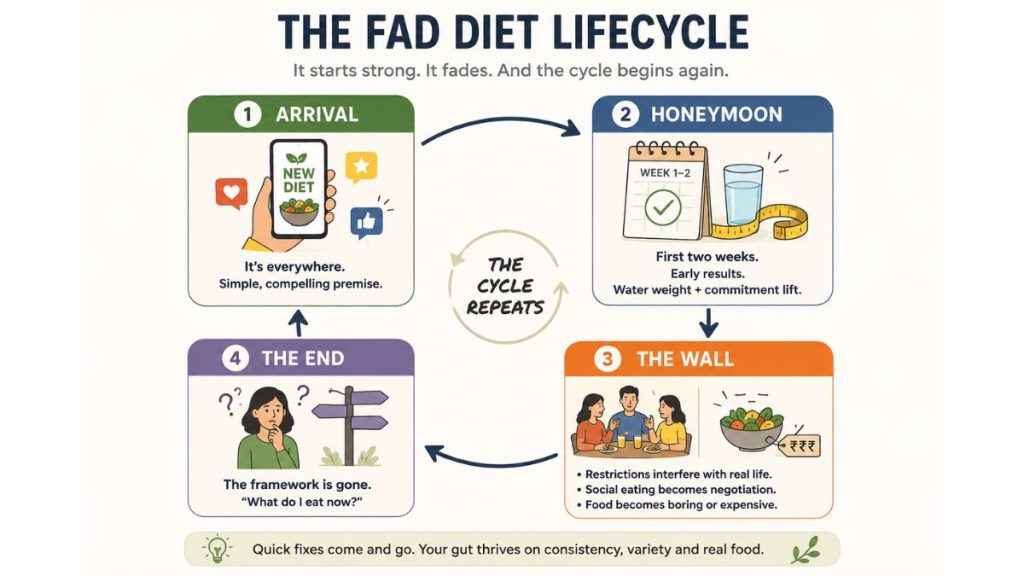
The lifecycle of a fad diet is remarkably consistent regardless of which fad it is. First: the arrival. It appears on your feed, in a podcast, from a friend who seems transformed. The premise is simple and compelling — cut this one thing, eat only these specific foods, follow this precise protocol. Second: the honeymoon. The first two weeks feel like they are working. You are doing something, which feels better than doing nothing, and the early results — largely water weight and the psychological lift of commitment — are encouraging. Third: the wall. Something becomes unsustainable. The restrictions start to interfere with real life. Social eating becomes a negotiation. The food you are allowed to eat becomes boring or inaccessible or expensive. Fourth: the end, and the question of what to eat now that the framework is gone.
Your gut has its own distinct experience of each of these phases, and it is worth knowing about before you begin.
Most fad diets work, structurally, through elimination. Cut carbs. Cut fat. Cut dairy. Cut nightshades. Cut whatever the current villain is. The premise is that removing the bad thing will improve how you feel.
The gut’s relationship with elimination is complicated. The microbiome — the community of bacteria that lives in your intestines and affects everything from digestion to immunity to mood — is built on dietary diversity. Different bacterial species thrive on different types of fibre from different plant sources. A diverse diet feeds a diverse microbiome. A restricted diet feeds a restricted microbiome.
When a fad diet eliminates entire food groups, it typically removes the fibre sources that a subset of gut bacteria depends on. Those bacteria reduce in number. After several weeks, the gut bacterial profile is noticeably less diverse than it was. The effects show up as the digestive changes that many people experience around week three of a strict elimination diet: altered bowel habits, bloating patterns that shift unexpectedly, a gut that is reacting differently to foods it previously handled without comment.
What is the best diet for gut health? The gut microbiome thrives on dietary diversity — different bacterial species depend on fibre from different plant sources. Rather than a specific diet, what the gut responds best to is a consistent whole-food pattern with varied fibre sources and regular meal timing. Incremental improvements to the existing diet outperform restrictive frameworks over time.
The fad diet almost always produces something in the first two weeks. Energy changes, weight shifts, a sense of cleansing or clarity. This feels like proof that the diet is working — and it is, in a limited way. Many of these early responses are the gut adjusting to a changed diet, or water weight shifting, or the placebo effect of doing something intentionally.
What they are not is evidence that the underlying theory of the diet is correct, or that the results will continue, or that this is the eating pattern the gut prefers. The two-week response is real. It is just not as informative as it feels.
Many popular fad diets were designed around dietary patterns that do not map well onto the Indian food tradition. Low-carb approaches that work reasonably well in food cultures where protein and fat are the primary dietary staples become significantly more complicated in a food culture where dal-rice and roti-sabzi are the foundation of every meal. The Indian diet is not a carb-heavy diet that needs reforming. It is a whole-food, grain-legume-vegetable diet that has sustained one of the world’s largest populations for thousands of years. The carbs in it are not the problem. The refinement of those carbs is the problem.
The fad that says cut all grains is asking you to remove the dal-roti that your gut has been running on for your entire life. The fad that says cut all fat is asking you to remove the ghee that makes your rotis digestible and your sabzi flavourful. The gut, which has been calibrated to a specific dietary pattern, does not respond well to the wholesale removal of its foundational foods.
The better version of the improvement impulse is upgrading the quality of the existing pattern rather than replacing it. A roti from Aashirvaad Chakki 100% Khapli Atta instead of a refined flour one. A whole grain instead of a processed one. Dal more prominently featured. Vegetables more generously present. This is not a fad. It is a gradual improvement to the foundation that the gut is already working with.
The feeling that prompted the fad diet research — that something could be better, that the current eating is not optimal, that there is a version of yourself that feels more energetic and comfortable in your own body — is a legitimate feeling and it is worth acting on. It just does not require the fad.
The gut’s preferred improvement path is incremental: slightly more whole food, slightly less processed, slightly more fibre, slightly more consistency. Over weeks and months, the cumulative effect of small improvements produces the better feeling that the fad promised in two weeks but could not sustain.
Swapping a refined flour roti for one made with Aashirvaad Chakki 100% Khapli Atta is exactly that kind of upgrade — it fits the kitchen you already have, the dal you already cook, the meal you already eat. No framework required.
The fad diet promises transformation. The gut is asking for consistent improvement. These are different things, and only one of them actually works.
Your gut has survived previous fad diets. It will survive this one too if you proceed. It just wanted you to know, before you commit, that there is a less disruptive path to the same destination.
This article is part of the What Your Gut Wishes You Knew Before… series on Happy Tummy. For general informational purposes only — not medical or dietary advice. Read more of the series here.