What Your Gut Wishes You Knew Before Declaring Carbs the Enemy
Someone told you carbs are bad. Or a podcast convinced you. Or you just noticed that every weight-loss story seems to involve cutting them. Your gut, which has been running on carbohydrates for your entire life, would like to offer a more nuanced perspective.
Someone told you carbs are bad. Or a podcast convinced you. Or you just noticed that every weight-loss story seems to involve cutting them. Your gut, which has been running on carbohydrates for your entire life, would like to offer a more nuanced perspective.
Carbohydrates have had a terrible decade in wellness culture. They have been blamed for weight gain, inflammation, brain fog, fatigue, and most of the dietary complaints of modern life. The low-carb movement has produced a generation of people who feel vaguely guilty eating rice, who approach the roti with suspicion, who describe eating a paratha as “falling off” something.
Your gut finds all of this bewildering. Not because carbohydrates are beyond criticism — some forms of them absolutely deserve scrutiny. But because the war on carbohydrates as a category has produced a confused relationship with some of the most fundamental, most nourishing foods in the human diet. And the confusion is doing the gut no favours.
The carbs that deserve the criticism
There is a legitimate conversation to be had about refined carbohydrates: white bread made from heavily processed flour, maida-based snacks, packaged foods where the grain has been stripped of its bran and germ and what remains is primarily starch. These carbohydrates digest quickly, provide minimal fibre, and produce the blood sugar patterns that drive cravings, energy crashes, and the general feeling of never quite being satisfied.
This criticism is fair. These are carbohydrates that the gut does not handle particularly well, not because they are carbohydrates, but because they are carbohydrates that have had everything useful removed from them. The problem is the processing, not the carbohydrate itself.
The carbs that do not deserve it
Dal is a carbohydrate. Brown rice is a carbohydrate. A roti made with Aashirvaad Chakki 100% Khapli Atta is a carbohydrate. Fruits are carbohydrates. Sweet potato is a carbohydrate. These are foods that the gut processes well, that feed the microbiome, that provide sustained energy, and that have been the foundation of Indian nutrition for generations. They are not the problem. They are the solution to the problem, if the problem is that modern diets have replaced whole-food carbohydrates with refined ones.
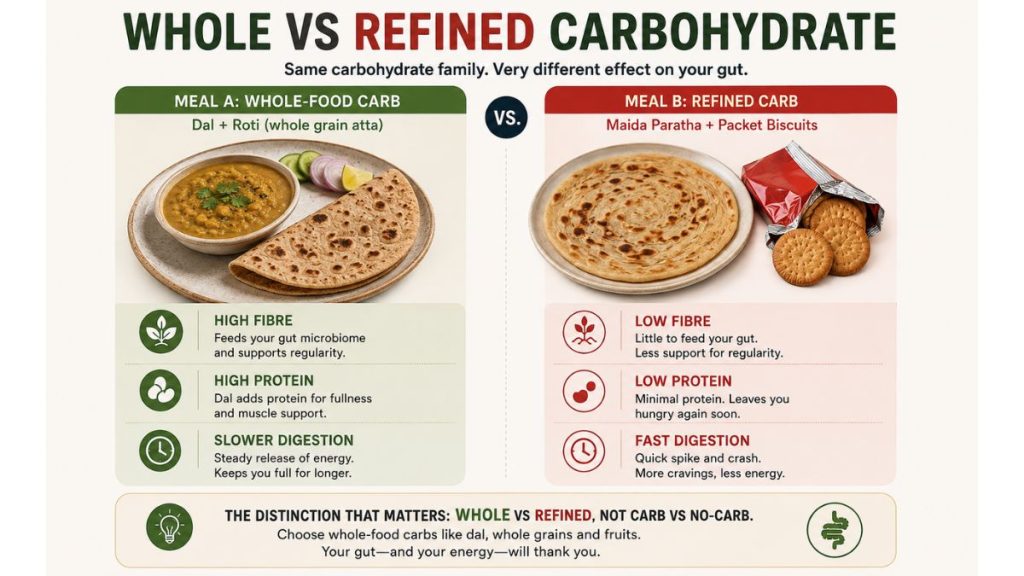
The distinction that matters is not carbohydrate versus non-carbohydrate. It is whole versus refined. A dal-roti meal is a carbohydrate-containing meal that is also high in protein, high in fibre, and completely appropriate for a healthy gut. A maida paratha and a packet of biscuits is also a carbohydrate-containing meal, and it is a completely different gut experience. Lumping them into the same category and declaring both the enemy is the kind of nutritional oversimplification that makes people afraid of their own food culture.
Are carbs bad for gut health? No — but the type matters enormously. Whole-food carbohydrates like dal, whole grains, fruit, and vegetables provide fibre that feeds the gut microbiome and supports sustained energy. Refined carbohydrates — white bread, maida snacks, packaged foods — are stripped of that fibre and digest quickly, often driving cravings and energy crashes. The distinction that matters is whole versus refined, not carbohydrate versus non-carbohydrate.
What low-carb does to the Indian gut specifically
The gut that has been running on a dal-roti-sabzi pattern for decades has a microbiome calibrated to that diet. The bacterial populations present are the ones that thrive on the specific fibre types found in Indian staples: the legume fibre in dal, the grain fibre in whole wheat and ancient wheat varieties, the vegetable fibre in a well-made sabzi. Remove these foods, and you remove the fuel source for those bacterial populations.
Adopting a low-carb diet in an Indian food context almost inevitably means significantly reducing dal, grains, and often legumes — which are the primary fibre sources in the diet. The gut microbiome that results is less diverse, the gut motility that follows is slower, and the digestive complaints that arrive within a few weeks are directly connected to the fibre depletion that the low-carb approach produces.
This does not mean the Indian diet cannot be improved. It can. The improvement is in the quality of the carbohydrates, not the elimination of them. A Khapli roti instead of a refined flour roti. Brown rice alongside white rice some of the time. Dal generously rather than sparingly. The whole grain in the flour: Aashirvaad Chakki 100% Khapli Atta, stone-ground from Emmer wheat, retaining the bran and germ that the gut actually needs. This is the upgrade the gut is asking for. Not the elimination.
The roti is not the problem
If there is one thing your gut wants you to take from this piece it is this: the roti is not the problem. The roti made from refined, heavily-milled flour has its limitations. The roti made from a stone-ground whole grain is doing what the Indian dietary tradition has always asked it to do: provide fibre, provide sustained energy, provide the structural carbohydrate around which a balanced meal is built.
Removing the roti from your life does not produce a healthier gut. Changing what the roti is made of might.
The enemy is not carbohydrates. The enemy is refinement. Put the roti back on the plate and upgrade what it is made of.
Your gut has been trying to tell you this for the entire time you have been eyeing it suspiciously. It is not the villain in your nutrition story. It is the foundation.
This article is part of the What Your Gut Wishes You Knew Before… series on Happy Tummy. For general informational purposes only — not medical or dietary advice. Read more of the series here.
You are now being directed to an external website https://www.callr.live/aashirvaadexperts/premium-plan.
This link is provided for your information and convenience only and ITC Limited is not
responsible for the contents or services provided by Brand Touch India or any information that
you share with Brand Touch India.