What Your Gut Wishes You Knew Before Your Pre-Workout Snack
You are about to go to the gym. You are doing the right things. You are even thinking about nutrition around exercise. Your gut is proud of you. It also has some thoughts about the specific thing you are about to eat.
You are about to go to the gym. You are doing the right things. You are even thinking about nutrition around exercise. Your gut is proud of you. It also has some thoughts about the specific thing you are about to eat.
The pre-workout snack is one of those fitness habits that sounds more scientific than it often is in practice. The idea is correct: eating something before exercise gives the body fuel to perform better. The execution, however, varies enormously. There are the people who eat a full meal forty minutes before a run and then wonder why the run is a disaster. There are the people who train completely fasted because they heard that is optimal and then feel terrible for the last thirty minutes of every session. And there are the people who are eating the specific pre-workout thing because someone on YouTube said it was what they did.
Your gut is somewhere in the middle of all of this, trying to give you adequate energy to exercise while also not being asked to digest a full meal simultaneously. The relationship between eating and exercise timing is actually quite important, and quite simple, and almost nobody explains it well.
What the gut is doing during exercise
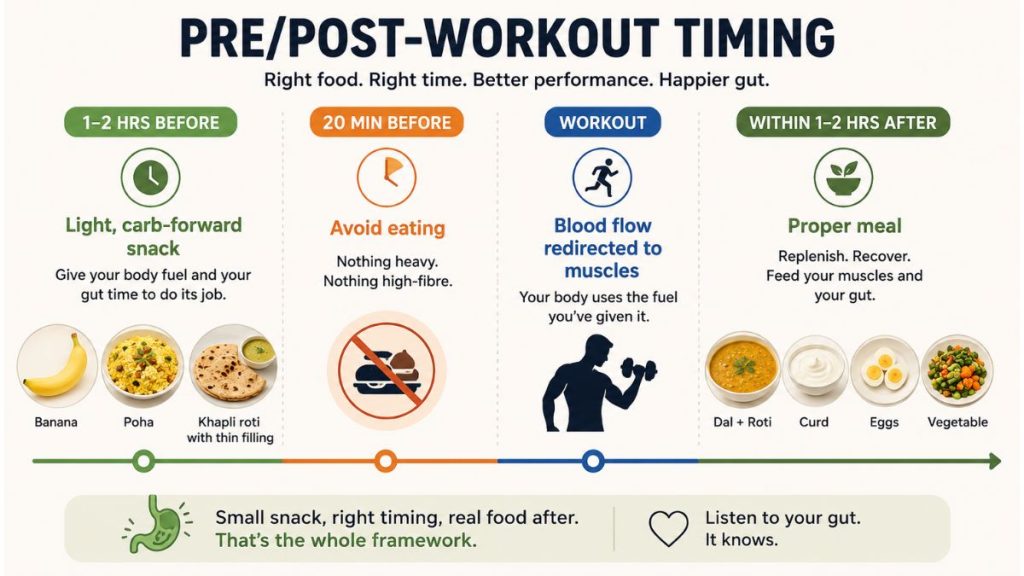
During physical exercise, blood flow is redirected to the working muscles and away from the digestive system. This is a normal and appropriate response — the muscles need the blood more urgently during exercise than the gut does. But it means that the gut is simultaneously receiving less blood flow and being asked to process whatever you ate before training.
A large meal eaten shortly before exercise is problematic because the gut needs significant blood flow to digest it properly, and exercise is actively diverting that blood flow. The result is the familiar side stitch, the nausea, the heavy feeling during a run, the general sense that the body cannot decide whether it is digesting or exercising and is not doing either well.
The timing that works is: a small, easily digestible snack one to two hours before exercise. Not a large meal. Not protein powder mixed with milk immediately before training. Something light, something with easily available carbohydrate for energy, something the gut can process quickly enough that it is mostly done by the time the session begins.
What easily digestible actually means
High-fibre foods, while excellent for everyday gut health, are not ideal immediately before exercise. Fibre slows digestion — which is a virtue at lunch but a complication when you need the stomach to be relatively empty before a run. High-fat foods have the same issue. The ideal pre-workout snack, in the final twenty to thirty minutes before training, is lighter and quicker to clear than your usual meal.
A banana. A small bowl of poha. A roti from Aashirvaad Chakki 100% Khapli Atta with a thin smear of something — eaten two hours before training rather than twenty minutes before. Fruit with a small amount of curd. These are the kinds of foods the gut can process efficiently, extract energy from, and largely finish with before the blood flow redirection of exercise begins.
The Khapli roti option is worth a specific note, because the timing does more work here than the food choice itself. A roti from Aashirvaad Chakki 100% Khapli Atta is not a low-fibre food — its fibre content is one of the things that makes it a genuinely sustaining everyday choice. Eaten two hours ahead rather than twenty minutes before, that fibre has time to do its job before training begins, so the gut is past the slow part of digestion and into a moderate, gradual energy release by the time you start. The same roti eaten twenty minutes before a session would be the wrong call — not because the grain is wrong, but because the timing is.
What should I eat before a workout? Something small, easily digestible, and carbohydrate-forward, eaten one to two hours before training — a banana, a small bowl of poha, or a roti with a light filling. Avoid large meals or high-fibre, high-fat foods in the final twenty to thirty minutes before exercise, since these take longer to digest and compete with muscles for blood flow during the session.
The fasted training question
Training completely fasted — which has become popular particularly in the context of morning workouts — works for some people and not for others, and the gut is a useful indicator of which category you fall into. If fasted training leaves you feeling energised, focused, and strong, your body is managing the fuel situation adequately. If it leaves you light-headed, weak past the twenty-minute mark, or ravenously hungry in a way that leads to eating everything in sight afterward, the fast is probably not serving you or your gut.
The post-fasted-training overeat is its own gut problem: arriving at food in a state of extreme hunger, eating fast, eating more than the body needs, and experiencing the digestive consequences of all three simultaneously. A small pre-workout snack that prevents the extreme hunger often produces better eating behaviour afterward and a more comfortable gut for the rest of the day.
The piece everyone forgets: post-workout
The gut’s most important performance nutrition window is not before exercise. It is after. The post-workout meal — eaten within an hour or two of finishing — is when the body is most efficiently using protein and carbohydrates for recovery. A proper post-workout meal with real food, eaten calmly and with some attention, does more for recovery, muscle maintenance, and gut function than any supplement.
Dal-roti, curd with fruit, eggs and a vegetable — these are not glamorous recovery meals but they are effective ones, and the gut processes them significantly better than another protein shake.
Your gut wants to support your training. It just needs the timing and the choices to make sense. Small snack, right timing, real food after. That is the whole framework.
Your gut is genuinely enthusiastic about the gym. It just wishes you would consult it about what to eat before you go.
This article is part of the What Your Gut Wishes You Knew Before… series on Happy Tummy. For general informational purposes only — not medical or dietary advice. Read more of the series here.
You are now being directed to an external website https://www.callr.live/aashirvaadexperts/premium-plan.
This link is provided for your information and convenience only and ITC Limited is not
responsible for the contents or services provided by Brand Touch India or any information that
you share with Brand Touch India.