

Table of Contents
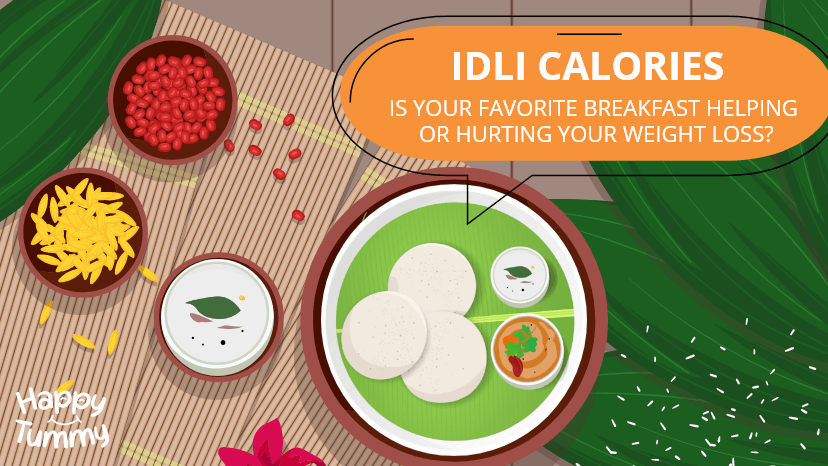
Soft, fluffy, and comforting idlis are one of India’s most loved breakfast choices. It’s often labeled as light, healthy, and perfect for weight loss. But is that really true?
While idli is definitely healthier than deep-fried breakfast options, its impact on your weight depends on how much you eat, what you pair it with, and how it’s prepared.
Let’s break down the calories in idli, its nutritional value, and how you can make it even healthier for sustainable weight loss.
So, How Many Calories Are in Idli, Really?
A single idli doesn’t look like much, and honestly, calorie-wise, it isn’t.
The calorie count of idli depends on its size and ingredients, but here’s a general estimate:
Small Idli (25g)[5]
| Nutrients | Values |
| Energy | 59.59 kcal |
| Carbohydrates | 12.11 gm |
| Protein | 1.81 gm |
| Fat | 0.28 gm |
| Fiber | 0.79 gm |
Medium Idli (45g)[5]
| Nutrients | Values |
| Energy | 107.26kcal |
| Carbohydrates | 21.79 gm |
| Protein | 3.26 gm |
| Fat | 0.51 gm |
| Fiber | 1.42 gm |
Large Idli (60g)[5]
| Nutrients | Values |
| Energy | 143.01kcal |
| Carbohydrates | 29.05 gm |
| Protein | 4.35gm |
| Fat | 0.68gm |
| Fiber | 1.89gm |
Because nobody eats one idli.
Two becomes three. Three becomes four. However, idli is rarely eaten alone.
When you add sambar and chutney, and before you realise it, your light breakfast has crossed 250–300 calories, depending on the portion sizes and ingredients.
Here, learn about Sambar Calories and How You can prepare a Healthy Sambar Recipe
The real issue isn’t that idli is high in calories. It’s that it’s too easy to eat more of it.
Why Idlis Feels Light, But Doesn’t Keep You Full
Idli is made from fermented rice and urad dal batter. It’s steamed, low in fat, and gentle on digestion. That’s the good part.
But here’s the other side of the story.
It’s also low in fiber and moderate in protein, which means your body digests it quickly. You feel light after eating it, but that lightness often turns into over consumption much sooner than you expect.
That’s why you find yourself reaching for snacks by mid-morning, even after a “healthy” breakfast.
The Real Culprit Sitting Next to Your Idlis
Let’s be honest for a second.
It’s rarely just idlis.
It’s the generous spoonful of coconut chutney. The drizzle of oil in podi. The extra serving because “it’s light anyway.”
Coconut chutney, for example, is healthy, but calorie-dense. Just a couple of tablespoons can quietly add 60–80 calories.
It must be noted that 1 tbsp of coconut chutney contains -22.72 kcal and 1tbsp of peanut chutney contains 38.45 kcal.
Hence, add oil, and the numbers climb faster than you’d expect.
So, while idli keeps its “healthy” image, your plate tells a slightly different story.
To make it a healthy meal, you can opt for other options to consume with idlis, such as vegetable sambar, dal chutney, tomato chutney, etc.
Learn about Biryani Calories and how can make it healthy!
Can You Still Eat Idlis for Weight Loss?
Absolutely! You don’t need to give it up.
But you do need to change how you eat it.
Think of idlis not as a complete meal, but as a base. What you add to it determines whether it becomes balanced or just another carb-heavy breakfast.
When you pair idli with protein-rich sambar, add some fiber, and keep portions in check, it becomes one of the most practical fat-loss meals in an Indian diet.
There are a variety of Idli options that can be healthy and help in making gut health better, like multigrain idli, jowar idli, millet idli, rava idli, ragi idli, etc.
The magic is not in removing idli. It’s in upgrading it.
5 Healthy Idli Recipes That Actually Keep You Full
Now let’s move from theory to your kitchen because this is where real transformation happens.
1. Oats Vegetable Idli: The “Stay Full Longer” Version
If regular idli leaves you hungry too soon, oats idli changes the game. It’s heavier in the best way, more fiber, more volume, and far more satisfying.
Oats and oatmeal aid in both weight gain and loss!
Ingredients
- 1 cup rolled oats (powdered)
- ½ cup curd
- ½ cup grated carrot
- ¼ cup finely chopped beans
- 1 tsp mustard seeds
- Curry leaves
- 1 green chilli (optional)
- Salt to taste
- Water as needed
- Eno or baking soda (a pinch)
Method
- Start by dry roasting the oats until they release a mild nutty aroma, then grind them into a coarse powder.
- In a bowl, mix this with curd and a little water to form a thick batter. Let it rest for about 10–15 minutes so the oats soften.
- Meanwhile, prepare a simple tempering with mustard seeds, curry leaves, and green chilli. Add this to the batter along with the vegetables and salt.
- Just before steaming, mix in a pinch of Eno to make the idlis soft. Pour into moulds and steam for 10–12 minutes.
What you get is an idli that feels more like a meal, not just a starter.
2. Ragi Idli/Finger Millet: The Blood Sugar Friendly Upgrade
Ragi adds depth and not just in flavour, but in nutrition. It’s rich in fiber and keeps your energy stable for longer.
Finger millet flour contains a lot of insoluble fibre, which aids in easy digestion. The dietary fibre of this millet is very important in ensuring the digestive system is healthy[1].
Read about Ragi/Finger Millet Benefits, Nutrition, and Uses on Happy Tummy!
Ingredients
- 1 cup ragi flour
- ½ cup idli rice batter (or urad dal batter)
- Aashirvaad Iodised Salt to taste
- Water as required
Method
- Mix ragi flour with prepared idli batter and enough water to reach a pourable consistency. Allow this mixture to ferment for 6–8 hours or overnight.
- Once fermented, grease your idli moulds, pour the batter, and steam as usual for about 12 minutes.
- The result is slightly denser than regular idli, but far more sustaining.
- You can also try Aashirvaad Ragi Flour, which is naturally gluten-free, full of iron, calcium, and protein, and high in fibre. It will also support you significantly in your gluten-free journey.
3. Vegetable Idli: The Volume Trick Your Body Loves
Sometimes, the smartest thing you can do is not reduce food but increase volume.
Vegetable idli lets you do exactly that.
Most green veggies are packed with essential nutrients, including fibre [2] that may support the proper facilitation of the digestion process.
To learn how much fibre there will be in your recipe, refer to My Meal Plan by Aashirvaad Atta.
Read: 9 Health Benefits of Green Vegetables
Ingredients
- 2 cups idli batter
- ½ cup grated carrot
- ¼ cup chopped beans
- ¼ cup capsicum
- 1 tspchilli powder
- Salt if needed
Method
- Simply fold all the vegetables into your regular idli batter.
- Mix gently so the airiness remains intact.
- Pour into moulds and steam for 10–12 minutes.
- These idlis feel more filling, not because of calories, but because of bulk.
4. Moong Dal Idli: The Protein Boost You Didn’t Know You Needed
If your goal is fat loss with muscle retention, this version deserves a permanent place in your routine.
Green gram contains strong anti-inflammatory properties, which hold protective potential against heat strokes, thirst, high body temperatures, etc. [3]
Learn more about green gram benefits!
Ingredients
- 1 cup yellow moong dal (soaked 4–5 hours)
- 2 tbsp urad dal
- 1 inch ginger
- 1 green chilli
- Salt to taste
- 1 tsp Aashirvaad turmeric powder
- 1 tsp Aashirvaad Jeera
- 1 tsp Aashirvaad coriander powder
Method
- Grind soaked dals with ginger and chilli into a smooth batter.
- Let it ferment overnight.
- Once ready, steam in idli moulds for 10–12 minutes.
- These idlis are softer than you’d expect and much more satisfying than rice-based ones.
- Make tadka and toss the idlis in it for an added flavor.
5. Quinoa Idli: The Modern Metabolic Upgrade
Quinoa brings a subtle nuttiness and a better protein profile, making this version ideal for those looking to upgrade their breakfast.
It being a complete protein source, all these 9 essential amino acids are found in quinoa.
Majority of the population resort to non-vegetarianism in order to obtain all these 9 essential amino acids but quinoa can be consumed by any individual regardless of his or her diet.[4]
Learn: Top 10 Health Benefits of Eating Quinoa
Ingredients
- 1 cup quinoa (soaked 5–6 hours)
- ½ cup urad dal
- Salt to taste
Method
- Grind quinoa and urad dal separately, then mix them together with salt. Allow the batter to ferment overnight.
- Steam just like regular idli.
- The texture is familiar, but the nutrition is upgraded.
Aashirvaad Atta with Multigrains introduces the Digestion Quotient, a 2-minute test to help you assess your digestive system’s health. Test your digestion now and learn how it works!
What Your Ideal Idli Plate Should Look Like
Instead of thinking in numbers, think in balance.
A satisfying, fat-loss-friendly idli meal feels like this: a couple of idlis, a generous bowl of vegetable & dal sambar, and just a touch of chutneys like peanut chutney, dal chutney, tomato chutney, are some good options, not the other way around.
That small shift changes everything.
Final Thought: Idli Was Never the Problem
Idli has always been one of the smartest traditional foods we have.
But somewhere along the way, we started eating it mindlessly instead of intentionally.
And that’s where things go off track.
So, the next time you sit down with a plate of idlis, don’t ask, “Is this healthy?”
Ask instead, “Am I eating this in a way that supports my goals?”
Because that’s the real difference between eating healthy and actually seeing results.
FAQs
1. How many idlis can I eat for weight loss?
For most people, 2–3 idlis per meal is a good range for weight loss. The key is to balance your plate with protein-rich sambar and avoid overeating chutney. Eating 4–5 idlis regularly can increase your calorie intake without keeping you full for long. For healthier options or weight management, you can opt for other types of idli such as multigrain, green moong, rava idli etc.
2. Is idli better than dosa for weight loss?
Yes, idli is generally a better choice for weight loss because it is steamed and contain very little fat, whereas dosa is cooked with oil or ghee. However, portion size and accompaniments matter more than the food itself.
3. Does eating idli at night cause weight gain?
Idli itself does not cause weight gain at night. What matters is your total daily calorie intake and portion size. However, since idli is carb-heavy and low in fiber, it may not be very filling at night unless paired with protein.
4. Which is the healthiest type of idli?
Healthier idli options include oats idli, ragi idli, moong dal idli, rava vegetable idli, and quinoa idli. These versions have more fiber or protein compared to regular rice idli, making them better for blood sugar control and satiety.
5. Can people with diabetes eat idli?
Yes, but in moderation. Regular idli has a moderate to high glycaemic impact, so it’s better to:
Limit portion size
Pair with protein-rich sambar
Choose alternatives like ragi or oats idli
This helps prevent sudden spikes in blood sugar levels.