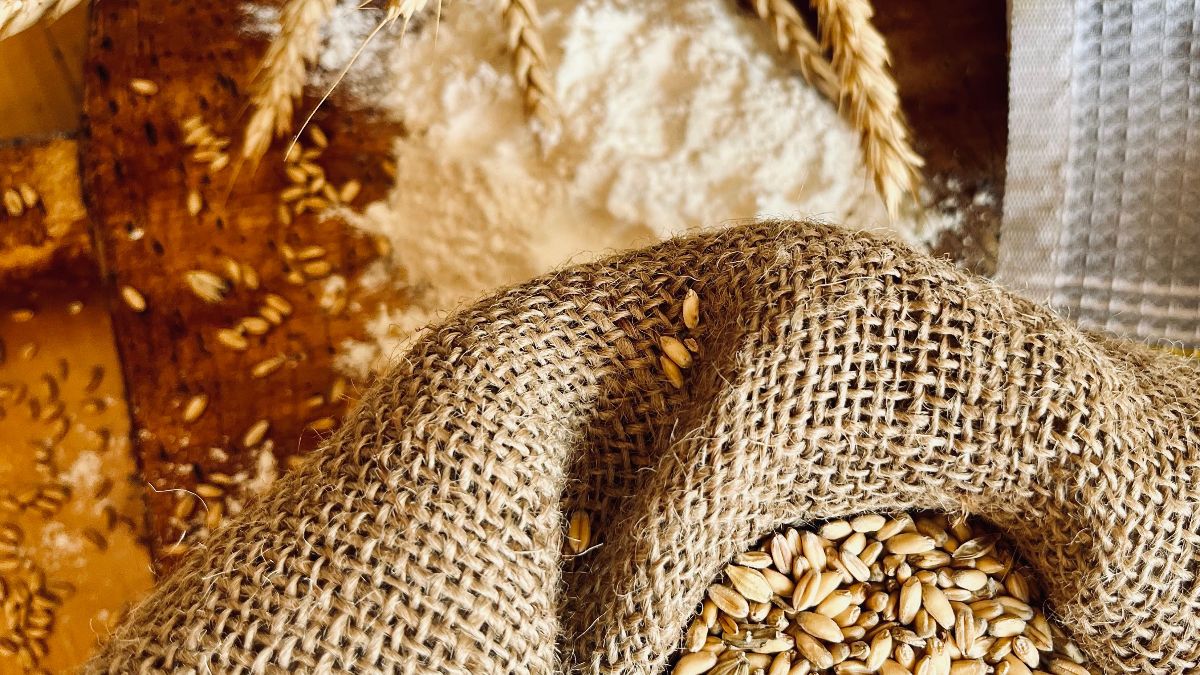
Why Whole-Grain Attas Have a Place in My Kitchen
From my grandmother's chakki to the rotis I make today, why I favour whole grains over refined flour — and why what suits your kitchen matters more than any single grain.
Table of Contents
Whole-grain atta retains the bran and germ of the wheat kernel, providing more dietary fibre and other nutrients than refined maida. Fibre can support bowel regularity, and some fibres are used by microorganisms in the large intestine.
Regular whole-wheat atta and whole-grain Khapli atta are broadly comparable in their total fibre content. Neither is automatically better for digestion. The more useful choice is a whole-grain flour that suits your household, alongside a varied diet and eating habits you can sustain.
There’s a particular kind of food memory I come back to often in my own practice: watching my grandmother check the grain before it went to the chakki, and the freshly ground atta afterwards, rubbing a little between her fingers, feeling for the bran. She wasn’t thinking about fibre grams. She was thinking about whether the roti would sit well, whether it would nourish, not just fill.
That instinct, it turns out, wasn’t just tradition for tradition’s sake. In Ayurveda, we talk about agni, digestive fire, and the idea that what you eat matters less in isolation than how well your body can actually process it.
A whole grain, with its bran and germ retained, brings more fibre and other grain components to the plate than refined flour. Some of those fibres help with bowel regularity, while others can be used by bacteria further along the gut. Depending on the food and preparation, fibre can also influence how quickly nutrients are absorbed and how satisfying a meal feels.
This is really the whole case for choosing a whole-grain atta — whole wheat, or a whole-grain Khapli atta like Aashirvaad Chakki 100% Khapli Atta — over maida for your everyday rotis.
I want to be precise here, because precision matters more to me than a good marketing line: Khapli and regular whole wheat are roughly comparable to each other on fibre. Neither is dramatically “better” than the other. What they both do, clearly, is offer meaningfully more fibre than refined maida, which has had much of its bran and germ removed in processing.
For a closer look at that distinction, read Whole Wheat, Khapli, Maida: The Fibre Numbers, Honestly Compared.
Many Indians consume less dietary fibre than recommended, and it’s rarely one dramatic change that closes that gap.
ICMR-NIN’s dietary fibre recommendations vary by sex and physical activity. Forty grams a day is one of its reference values, not a universal requirement for every adult.
But the principle remains: it’s the quiet, repeated choices that can make a difference.
Your daily roti is about as repeated as food gets, sometimes twice a day, every day, for a lifetime.
For a household that regularly uses refined flour, making that one switch to a whole-grain atta is one of the more practical ways to increase fibre intake, precisely because it doesn’t ask you to remember anything or change your routine. The atta just is what it is, meal after meal.
If your household already uses whole-wheat atta, though, you don’t need to change to Khapli simply to get more fibre. Both can be good whole-grain choices.
I hear the same objection often, so let me address it directly: whole-grain rotis do behave a little differently from maida-heavy ones.
The dough can feel slightly denser, the rolling takes a touch more practice, and some family members, particularly those who grew up on very refined flour, notice the difference in texture at first.
My advice is not to switch the whole household overnight.
Blend it in gradually if that’s easier, a portion of whole-grain atta mixed with what you’re already using, and let the ratio shift over a few weeks.
Many people find the adjustment manageable, particularly once the kneading technique catches up: a little more water, perhaps, and a little more resting time for the dough before rolling.
The exact water requirement depends on the flour, its milling and the recipe, so I prefer to work with the feel of the dough rather than prescribe one fixed proportion.
This isn’t about making everyone eat the same roti. It’s about making a nutritious choice practical enough that people will keep eating it.
In my own kitchen, I pair this with something I ask every student in my yoga classes to try at least once: eating the first few bites of a meal without any distraction, no phone, no scrolling, just noticing texture and taste.
It sounds almost too simple to matter.
But digestion doesn’t only begin in the stomach. Chewing and saliva are already part of the digestive process, and paying attention to a meal can help us notice its texture, taste and our own eating pace.
I find that a whole-grain roti eaten without rushing feels like a different experience from the same roti eaten in four minutes standing over the kitchen counter.
The fibre is doing its job either way. Eating slowly doesn’t necessarily change the flour’s fibre content, guarantee better enzyme release or transform how the body digests that particular roti.
But giving yourself time to chew, notice the meal and recognise feelings of fullness can be a useful practice.
For more on the evidence, read How Fast You Eat Changes How the Meal Feels.
None of this is a cure for anything, and I’d be doing you a disservice if I framed it that way.
It’s a foundation, something to build steadier everyday eating habits on, one ordinary meal at a time, without needing to overhaul everything else about how you eat.
There’s an Ayurvedic idea I keep returning to when people ask me why I don’t prescribe the same diet to everyone: satmya, roughly, what genuinely suits a person, including what they’re accustomed to and how their body responds.
Someone doing physical labour all day, someone recovering from an illness, someone managing a diagnosed digestive condition — these are not the same person, and none of them should be taking generic advice, mine included, as a substitute for what their own doctor or dietitian has told them.
What I can offer is a reasonable default for someone without a specific condition to manage: choose whole grains more often than refined flour, build variety into the rest of the plate, and eat without rushing when you can.
That default doesn’t need to be perfect to be useful.
It just needs to be sustainable enough that you’re still doing it in a year, not just this week.
I’ll also say something about sourcing, because it matters more than people assume.
Freshly ground atta, whether from your own chakki or a trusted mill, can have a noticeably different flavour from flour that has been stored for a long time.
Whole-grain flour contains oils from the grain’s germ, which can deteriorate during storage. Temperature, moisture, packaging and time all affect how well it keeps.
Freshness can affect both taste and how the flour behaves in your hands, although freshly milled atta isn’t automatically better or safer than a properly stored, quality-controlled packaged flour.
If you can, buy quantities your household will use comfortably within the product’s recommended shelf life, rather than one enormous sack meant to last half a year.
Store it in an airtight container somewhere cool and dry, away from direct sunlight and moisture. Check the best-before date, and discard flour that smells rancid, shows signs of mould or has been infested by insects.
Don’t be surprised if a fresh batch tastes different from what you’re used to.
This isn’t really about Khapli specifically. It’s about treating your everyday atta as an ingredient worth paying attention to, the same way you’d think about the quality of your dal or your ghee, rather than something you buy once and stop thinking about.
Happy Tummy’s guide to atta storage and shelf life has more practical advice.
Ayurveda places great importance on food as part of maintaining health, and that is an idea I have always valued.
My instinct is to look first at the quality and variety of ordinary food rather than assume that everyone needs another supplement.
A balanced diet built around whole grains, dals, vegetables, fruits, nuts and seeds can supply a broad range of nutrients.
But I wouldn’t go so far as to say that food alone has always provided everything everyone needs. Nutritional deficiencies have existed throughout history, and some people need supplements, fortified foods or medical treatment for specific reasons.
Pregnancy, diagnosed deficiencies, restricted diets and conditions affecting nutrient absorption are examples where individual advice matters.
For me, the food-first principle is about making everyday meals nourishing. It isn’t an argument against supplements when they’re genuinely needed.
The major shift in modern diets is how much of our food is processed and refined.
Refining wheat into maida removes much of its bran and germ, reducing dietary fibre and some naturally occurring nutrients.
Refined sugar supplies energy without the fibre and many of the nutrients that come with whole fruits. Replacing some sugary foods with whole fruit is therefore a useful change.
But jaggery, even though it is less refined and can contain small amounts of minerals, is still a form of added sugar. It shouldn’t be treated as a free pass simply because it is traditional.
Oils need a different kind of judgement.
Cold-pressed or unrefined oils can retain particular flavours and naturally occurring compounds, but that doesn’t mean every refined cooking oil is unhealthy or that every cold-pressed oil is better for every cooking method.
The types of fats in the oil, the amount used, how it is heated and whether it is repeatedly reheated all matter.
Similarly, we can’t conclude that diabetes and related conditions were uncommon in earlier times simply because people ate less-refined foods. Modern disease patterns reflect many influences, including lifestyle changes, ageing populations, improved diagnosis and other factors.
The useful nutritional distinction is not simply old food versus new food.
It’s understanding what processing changes, what remains in the finished ingredient, and how that ingredient fits into the rest of the diet.
If I were to reduce all this to a few decisions in my own kitchen, they would be straightforward.
I’d use whole-grain atta for most of the rotis we eat, whether ordinary whole wheat or Khapli.
I’d choose whole fruit more often than sugary drinks, keep added sugar modest whether it comes from refined sugar or jaggery, and use cooking oils suited to the dish and method rather than assuming the word “unrefined” settles the question.
I’d pay attention to the freshness of the flour, how the dough handles, and whether the people I’m feeding actually enjoy the food.
And I’d try to sit down for at least the first few bites without a screen competing for my attention.
A useful check before eating something is to ask what it contributes: fibre, protein, vitamins, minerals, energy, pleasure, or simply a familiar taste you enjoy.
Nutrition doesn’t have to turn every ingredient into a test. The point is to understand what your everyday choices add up to.
That, more than any single grain or any single claim, is the shift I’d actually want you to take from this: not a new rule, just a little more attention paid to the flour that ends up on your plate more often than almost anything else you eat.
This article is intended for general educational and informational purposes and reflects Dr Tanu Singh’s personal experiences and Ayurvedic perspective. It does not constitute medical advice, diagnosis or a personalised diet plan.
Whole grains and increased fibre intake may not be suitable in the same amounts for everyone. People with diagnosed gastrointestinal conditions or prescribed low-fibre diets should follow individual clinical advice. Khapli and regular wheat atta contain gluten and are unsuitable for people with coeliac disease.
Dietary changes are not a substitute for treatment of nutritional deficiencies, diabetes or other medical conditions. Supplements and therapeutic dietary changes should be discussed with an appropriately qualified healthcare professional.
Dr Tanu Singh is a yoga and Ayurvedic nutrition educator, holds a PhD in Yoga, and is the co-founder of Lifeyoga, New Delhi.
Whole-grain atta generally contains more dietary fibre than maida because it retains the bran and germ. Fibre can support bowel regularity and contribute to a varied diet. However, individual digestive tolerance differs, and whole-grain flour is not a treatment for a diagnosed digestive condition.
Khapli and regular whole-wheat atta can both be whole-grain flours. They are broadly comparable in total fibre according to the figures discussed in Happy Tummy's published comparison. Neither is automatically superior for digestion, and Khapli contains gluten because it is a wheat variety.
Dough hydration, kneading, resting time and cooking technique can influence roti texture. Different flours absorb different amounts of water, so adjustments are best made according to how the dough feels rather than using one fixed rule. If your household is accustomed to refined flour, a gradual transition can make the change easier.
Chewing is part of digestion, and eating without distraction can help people pay attention to their meals. Some research suggests slower eating may influence food intake, but it doesn't establish that every meal will digest better or that eating slowly guarantees improved digestive health.
Jaggery is less refined and may contain small amounts of minerals, but it is still added sugar. It does not become a substitute for moderating sugar intake. Whole fruit offers a more substantial nutritional difference because it also provides fibre and other nutrients.
No. Some cold-pressed oils retain flavour and other compounds, but their nutritional suitability depends on fatty-acid composition, cooking method, quantity and storage. Refining alone does not establish that an oil is harmful, and unrefined oils aren't automatically better for high-temperature cooking.
Freshly milled atta may differ in flavour and dough behaviour, but freshness alone doesn't establish nutritional superiority. Good-quality packaged atta can also retain whole-grain components and be stored safely. Pay attention to the type of flour, its quality, storage conditions and shelf life.