What Your Gut Wishes You Knew Before Replacing Every Meal With a Protein Shake
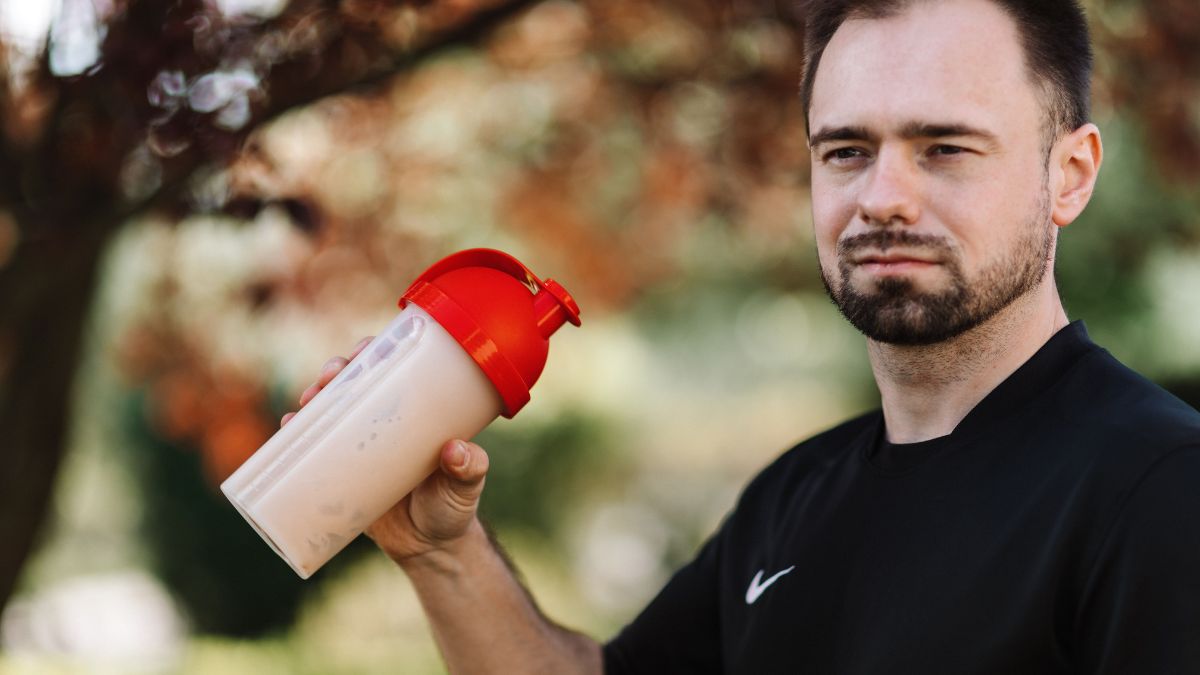
The shaker bottle is clean. The powder is measured. The macros are perfect. Your gut, which has been processing whole food for your entire life, is looking at the shake with a very specific expression.
The shaker bottle is clean. The powder is measured. The macros are perfect. Your gut, which has been processing whole food for your entire life, is looking at the shake with a very specific expression.
The protein shake meal replacement is having a moment. It is quick, it is measurable, it removes the decision-making from meals, it is heavily marketed to people who want to be efficient about nutrition, and in the fitness community it has become so normalised that eating an actual meal sometimes feels like an inefficient use of time.
Your gut disagrees. Not with protein. Not with shakes as a supplement or a post-workout option. But with the specific proposition that a liquid processed product is equivalent to or better than a meal made from whole food. On this, the gut has a clear position.
What the gut does with whole food that it cannot do with a shake
Digestion is not just about extracting nutrients. It is a complex, multi-stage process that begins in the mouth and involves mechanical breakdown, enzyme activity, gut bacteria fermentation, and a sequence of hormonal signals that regulate appetite, satiety, and metabolic function. This process is designed for whole food — food that has structure, fibre, texture, and the complex matrix of compounds that whole ingredients contain.
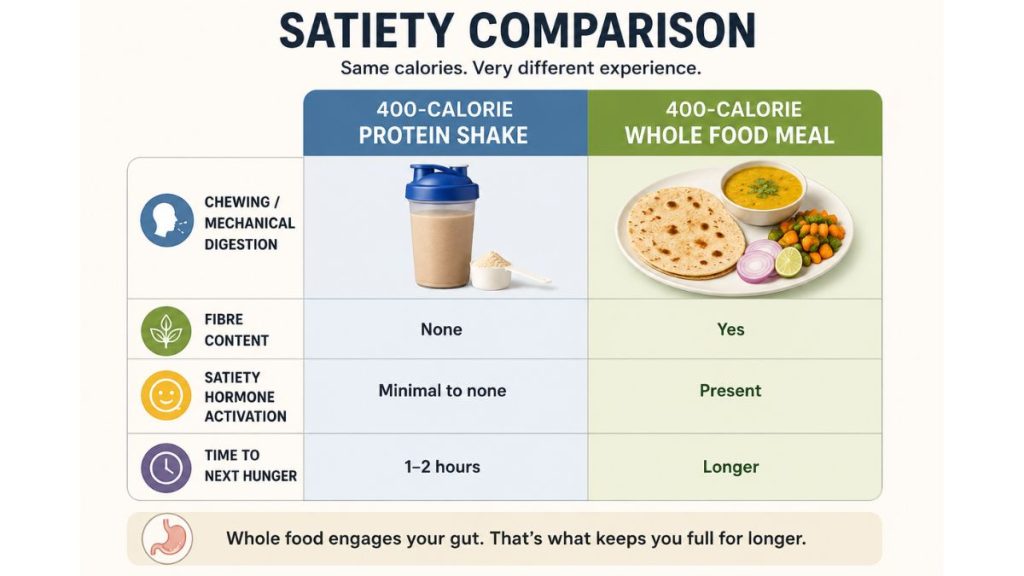
A protein shake delivers nutrients in a pre-broken-down, rapidly absorbable form. This is useful in specific contexts — post-workout recovery when the window for protein absorption matters. As a meal replacement, it bypasses most of the digestive process that whole food engages. The chewing does not happen. The gradual release does not happen. The fibre that feeds the gut microbiome is largely absent. The satiety hormones that respond to the mechanical presence of food in the stomach are not activated in the same way.
The result: a shake that is 400 calories produces less satiety than a meal of 400 calories. The gut is not satisfied because it has not been engaged. The hunger returns faster. The craving for actual food — something with texture, something that requires chewing, something that feels like eating — arrives within an hour or two.
Is a protein shake as good as a meal? Not for the same number of calories. A shake bypasses much of digestion — no chewing, minimal fibre, reduced activation of the satiety hormones triggered by the mechanical presence of food in the stomach. A 400-calorie shake leaves you hungry sooner than a 400-calorie whole food meal. Shakes work well as supplements or post-workout additions; as meal replacements, the gut notices the difference.
The microbiome problem
Gut bacteria depend on dietary fibre. Most protein shake meal replacements contain minimal fibre — some contain none at all. A diet that replaces multiple meals a day with shakes is a diet that is significantly fibre-depleted, regardless of how good the macro profile looks.
The microbiome responds to fibre deprivation the same way regardless of how it happens: diversity decreases. The bacterial populations that depend on prebiotic fibre from whole grains, vegetables, and legumes reduce. Over weeks of meal replacement shakes, the gut bacterial profile shifts in ways that affect digestive regularity, immune function, and the gut-brain axis signals that regulate mood and appetite.
This is why the protein shake regime that felt fine for the first two weeks starts producing gut complaints by week four. The microbiome adjustment happens on a timeline, and by the time it arrives, many people have already committed to the habit.
What protein shakes are actually good for
A protein shake after a workout, when the body has a genuine window for protein absorption and when whole food is not immediately practical, is genuinely useful. A shake as a supplement to a diet that is already adequate in whole food does no harm and may provide benefit.
The problem is the replacement logic. The idea that a shake is a more efficient, more optimised version of a meal is one that the gut does not accept. The meal — with its fibre, its texture, its whole food matrix, its engagement of the full digestive process — is not inefficient. It is exactly what the system was designed for.
A roti from Aashirvaad Chakki 100% Khapli Atta with dal takes fifteen minutes to prepare and eat. It engages digestion properly, provides fibre for the microbiome, activates the satiety hormones that the shake does not, and keeps the gut running the way it is supposed to. This is not a slower option. It is a more complete one.
The conversation worth having with yourself
If the protein shake meal replacement appeals to you, it is worth asking what it is solving. If the answer is time, a quick whole food option — a thepla made with Aashirvaad Chakki 100% Khapli Atta, curd and fruit, a small bowl of dal — often takes less time than the shake preparation once the novelty has worn off. If the answer is calorie control, fibre-rich whole food is more satiating per calorie than a shake, which is the more effective tool for the same goal. If the answer is macro tracking, the macros of whole food are trackable too.
The shake is not the upgrade. Whole food is the upgrade. The shake is just a louder version of the same old shortcut.
Your gut wishes you knew this before the order. Not to stop you buying protein powder entirely. Just to suggest that it belongs in the supplement category, not the meal category, and that the distinction matters more than the marketing would have you believe.
This article is part of the What Your Gut Wishes You Knew Before… series on Happy Tummy. For general informational purposes only — not medical or dietary advice. Read more of the series here.
You are now being directed to an external website https://www.callr.live/aashirvaadexperts/premium-plan.
This link is provided for your information and convenience only and ITC Limited is not
responsible for the contents or services provided by Brand Touch India or any information that
you share with Brand Touch India.