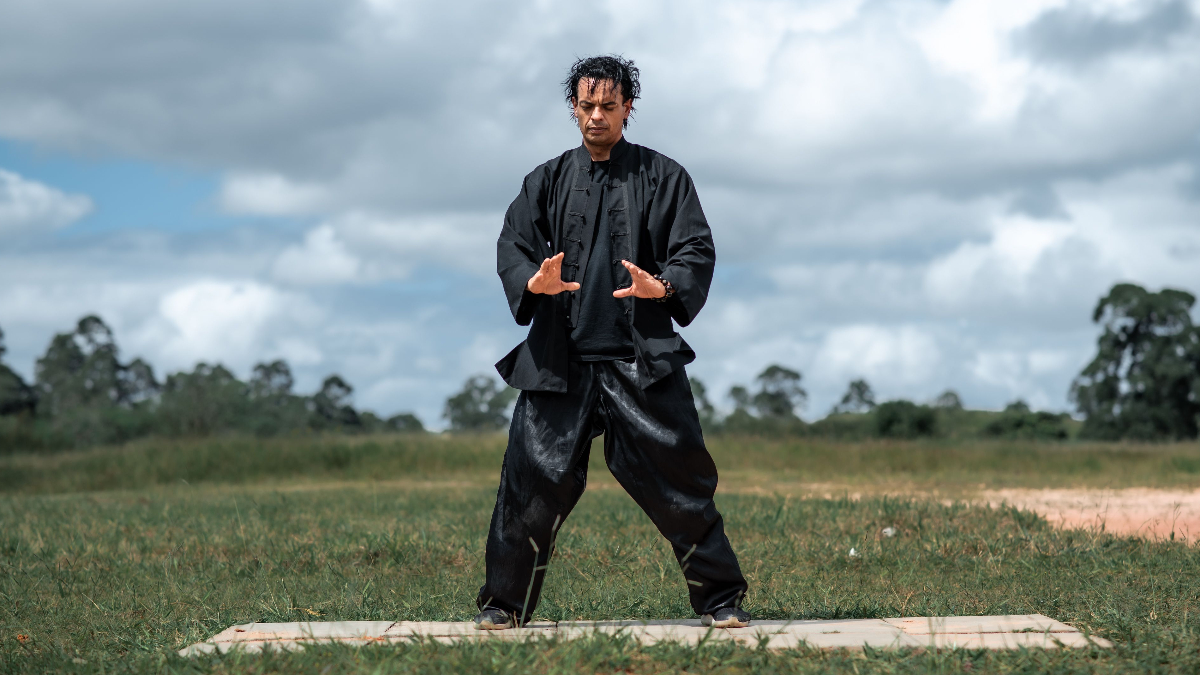
Tai Chi Walking: Can Slowing Down Help Your Gut?
The slow walking trend sounds appealing. Its health claims need a closer look.
Table of Contents
Tai chi walking is a slow, deliberate walking drill adapted from tai chi footwork. It may be a way to practise balance and focused movement, but the available studies do not establish a digestive benefit from the walking drill itself. Small gut studies have tested broader tai chi programmes, while a separate walking study measured bowel sounds rather than constipation relief. If you enjoy the practice, it can be one way to move more; there is no evidence that you need it for a healthier gut.
If tai chi walking has been popping up in your feed or between YouTube videos, the appeal is easy to see: no gym, no special kit, and a few slow steps that look manageable. Vogue India covered the trend in August 2026, and Harvard Health published an explainer in September.
Whenever a wellness trend takes off, the claims tend to grow with it. For Happy Tummy readers, the useful question is what those steps can actually tell us about digestion.
Tai chi is a Chinese martial art and movement practice. Full routines, called forms, connect a series of postures and steps. Tai chi walking concentrates on the footwork, so you can practise weight transfer without learning an entire sequence.
In a simple version, you place the next foot gently on the ground before gradually shifting your weight onto it. Once that leg supports you, the other foot becomes light enough to move. Move slowly enough to control each transfer. Teachers may use different stepping patterns.
Traditional teachings may describe the practice through qi, or life energy. That is a cultural framework, not a digestive mechanism demonstrated by the studies discussed here.
The distinction between the walking drill and the whole practice matters. The US National Center for Complementary and Integrative Health summarises evidence that full tai chi programmes can help balance and reduce falls in some older adults. Those findings do not automatically establish the same results for a short walking drill.
Tai chi instructor Stanwood Chang explains in Harvard Health that deliberate weight shifting challenges balance and draws attention to how the feet meet the ground. This makes movement awareness a reasonable aim for the drill. Its effects on health outcomes need more direct research.
Two small studies help explain the interest, but neither tested tai chi walking on its own.
In a 2022 feasibility study, 27 adults with irritable bowel syndrome with constipation (IBS-C) began an adapted tai chi programme delivered through eight online sessions over about seven weeks. Symptom scores improved, but bowel-movement frequency did not improve significantly. Without a comparison group, the study could not establish that tai chi caused the changes.
The programme included more than stepping, with movements adapted for digestive symptoms. It was also designed to explore whether a larger trial would be practical, rather than to establish a treatment recommendation.
A 2025 randomised trial enrolled 80 people with functional constipation; 73 were included in the final analysis. Participants practised structured tai chi or aerobic exercise for four one-hour sessions a week over eight weeks.
Both groups improved on symptom and quality-of-life measures. Tai chi had a small advantage on one symptom score, while most measured outcomes did not differ significantly between the groups. Participants knew which exercise they were doing, and the trial was short.
The findings are preliminary. They do not establish that a few minutes of tai chi walking can relieve constipation or that it is better than an ordinary walk.
No study identified for this article directly compared tai chi walking with ordinary walking for digestive outcomes. One cannot be declared the winner from research on different activities and different groups of people.
A 2025 study from Fujita Health University asked 21 healthy adults to walk on a treadmill for 20 minutes. Bowel-sound measures increased one to two minutes after the walk. These sounds were an indirect marker of gut activity; the study did not establish faster bowel emptying or constipation relief.
That immediate response to a treadmill walk cannot be assumed for tai chi walking. It is also different from demonstrating symptom relief.
For a different question, a 2015 Hong Kong trial compared full tai chi with self-paced walking in 374 middle-aged adults. Over 12 weeks, both exercise groups had modest changes in weight and waist circumference. Average weight fell by about 0.50 kg in the tai chi group and 0.76 kg in the walking group from their own starting weights. There was no statistically significant difference between the exercise groups on the outcomes measured.
Those results concern full tai chi, not the walking drill, and offer no basis for large weight-loss promises. The trial did not measure digestion.
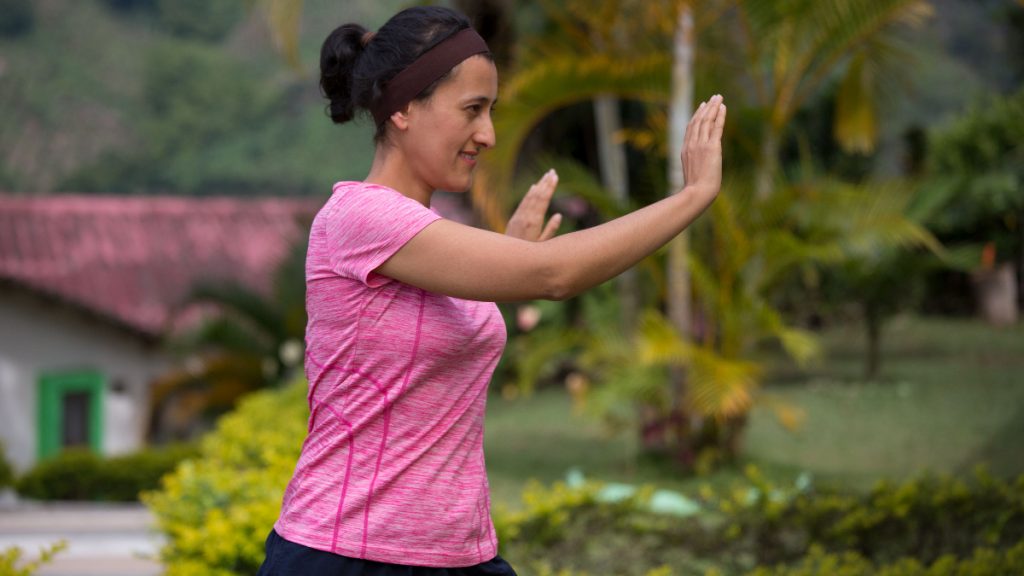
Slow movement and attention to breathing may feel calming for some people. That can be a reason to enjoy tai chi walking, but feeling calmer does not, by itself, prove a change in bowel habits.
Stress can influence digestive sensations and symptoms through the gut-brain connection. However, the studies do not separate the effects of movement, breathing and attention, or establish a digestive benefit from the walking drill through this route.
Tai chi walking, full tai chi and ordinary walking have different emphases.
| Activity | What you practise | What the gut evidence covers |
| Tai chi walking | Slow steps, gradual weight transfer and attention to balance | No direct digestive trial identified for the walking drill |
| Full tai chi | A broader sequence of postures and movements | Small symptom studies with important limitations |
| Ordinary walking | Continuous movement at a pace you choose | One small study measured bowel sounds after a treadmill walk |
If your main aim is to break up a day spent at a desk, an ordinary walk around your building may be the simplest place to start. If you enjoy practising careful weight transfer, tai chi walking may appeal. Choose something you can do comfortably and repeat.
For general health, WHO guidance recommends 150–300 minutes of moderate-intensity aerobic activity a week for adults, or an equivalent amount of vigorous activity, plus muscle-strengthening activity on at least two days. These are general activity targets, not a prescription for digestion.
Some movement is better than none. Whether tai chi walking reaches moderate intensity depends on the effort involved; very slow practice will not necessarily count towards that total. A brisk walk is more likely to do so.
If you want to try it, begin with a simple forward-stepping drill. Harvard Health describes several versions; these steps outline the one without extra rocking or turning.
Try a few controlled steps on a clear, well-lit, non-slip surface, wearing stable footwear. Keep a sturdy counter or fixed support within reach if you feel uncertain. Getting the idea quickly is different from developing a stable technique.
If you have dizziness, recent falls, significant balance problems, a recent injury or surgery, get individual advice before trying the drill. An instructor or physiotherapist can help adapt it. Knee or hip pain also deserves guidance on how to place and load the feet. Stop if you become dizzy, faint, unusually breathless or in pain.
Movement is one part of the picture, alongside your meals and fluid intake. Think of the day as a whole: dal, vegetables, fruit and whole grains deserve attention too. Our guide to fibre, water and movement explains how these fit together. Persistent digestive symptoms need individual assessment.
For help fitting movement into a busy day, try this prompt in Happy Tummy GPT: “I spend most of my day sitting. Suggest a realistic routine with short movement breaks that fits around work and my usual Indian meals.”
If tai chi walking appeals, learn it carefully. If it does not, you are not missing a secret to better digestion.
Disclaimer: This article is for general information and is not a substitute for medical advice, diagnosis or treatment. Get individual guidance if a health condition or injury affects your balance or ability to exercise. Seek medical advice for persistent digestive symptoms, and prompt care for blood in stool, unexplained weight loss or severe abdominal pain.
Tai chi walking is a deliberate walking drill adapted from tai chi footwork. You place each foot gently and gradually transfer your weight before taking the next step.
Tai chi walking practises balance, weight transfer and focused movement. Research on full tai chi programmes is stronger; benefits from those programmes cannot automatically be attributed to the walking drill.
The studies identified here do not establish a digestive benefit from tai chi walking. Small gut studies tested broader tai chi programmes, so they cannot answer that question for the drill.
Neither is universally better. Tai chi walking emphasises controlled weight transfer; a brisk ordinary walk is more likely to provide moderate aerobic activity. There is no direct digestive comparison.
There is no good evidence for large weight loss from tai chi walking. A 2015 trial found modest weight changes with full tai chi, which is a different activity.
Start with simple steps on a clear, non-slip surface. Weight shifting can challenge balance, so seek guidance if you are unsteady, have had recent falls or are recovering from injury.