Soluble vs Insoluble Fibre: The Difference, in Everyday Indian Foods
Soluble and insoluble fibre work differently, but you don't need to track them separately. Learn where both types show up in everyday Indian foods and why variety matters more.
Table of Contents
What’s the difference between soluble and insoluble fibre, and do I actually need to know? The short answer: soluble fibre dissolves in water and forms a gel that slows digestion and helps you feel full; insoluble fibre stays intact and adds bulk to keep things moving. Most fibre-rich foods contain both, and a standard Indian meal — dal, sabzi, roti, a piece of fruit — already gives you a mix of the two without any planning.
If you’ve ever read a health article, nodded politely at ‘soluble and insoluble fibre,’ and carried on, you’re in good company. It sounds exactly like the kind of school science fact that feels important to know and impossible to actually use. So let’s try this a different way.
Meet Meera. She’s been eating well for a few months — more dal, more vegetables, fruit in the afternoon — and her digestion has genuinely improved. Then she reads an article about fibre types and starts to panic. Is she eating the right kind of fibre? Too much of one type? Not enough of the other? She spends an afternoon cross-referencing her food choices against a list and ends up more confused than when she started.
Meera is solving a problem she doesn’t actually have. Her plate is already doing the right thing. What she needed was a mental model, not a checklist.
Not all fibre behaves the same way once it reaches your digestive system. Think of them as two different personalities working toward the same goal:
Soluble fibre likes water. It dissolves as it moves through the gut, forming a soft gel-like substance that slows digestion and helps create a feeling of fullness after meals. Think of it as the fibre that settles you down.
Insoluble fibre doesn’t dissolve. It stays largely intact, adds bulk to stool, and helps food move through the digestive system more efficiently. Think of it as the fibre that keeps things moving.
Most fibre-rich foods contain a mix of both. It’s not a competition — your gut benefits from having both working together.
If you’ve ever made oats and watched them thicken as they cook, you’ve seen soluble fibre at work. That gel-forming quality is the same mechanism that slows digestion and contributes to a longer-lasting sense of fullness.
In the Indian kitchen, soluble fibre shows up in dal and legumes (moong, masoor, chana, rajma), oats, the soft flesh of fruits like apples, pears and bananas, and psyllium husk (isabgol) — which forms a gel so visibly that it’s probably the clearest demonstration of soluble fibre you’ll ever see.
Insoluble fibre is why a bowl of vegetables feels different in your gut than a bowl of white rice, and why whole grains create a different kind of fullness from refined ones. It bulks up, moves through largely intact, and speeds things along.
In the Indian kitchen, insoluble fibre shows up in the skins and fibrous parts of vegetables (lauki, palak, broccoli, cauliflower), whole wheat and other whole grains, the bran layer removed when wheat is refined into maida, and cooked whole pulses — the skins of whole moong or kala chana contribute insoluble fibre that split dal doesn’t.
Meera’s core worry was whether she had the ratio right. Here’s the thing: unless you’re eating a very restricted diet, the ratio tends to sort itself out if you’re eating a variety of whole foods.
The more useful question isn’t ‘am I eating the right type of fibre?’ but ‘does my plate include vegetables, pulses, fruits and whole grains most days?’ If yes, she’s already getting both types in reasonable amounts, and the rest is detail.
That said, it’s worth knowing that some fibres — particularly inulin-type fructans found in onions, garlic and some fortified foods — are fermented more actively by gut bacteria, producing more gas. This is why a sudden jump in certain vegetables or supplemental fibres can cause noticeable bloating even when the overall approach is good. It’s not a sign the fibre is wrong; it’s a sign the gut needs time to adjust.
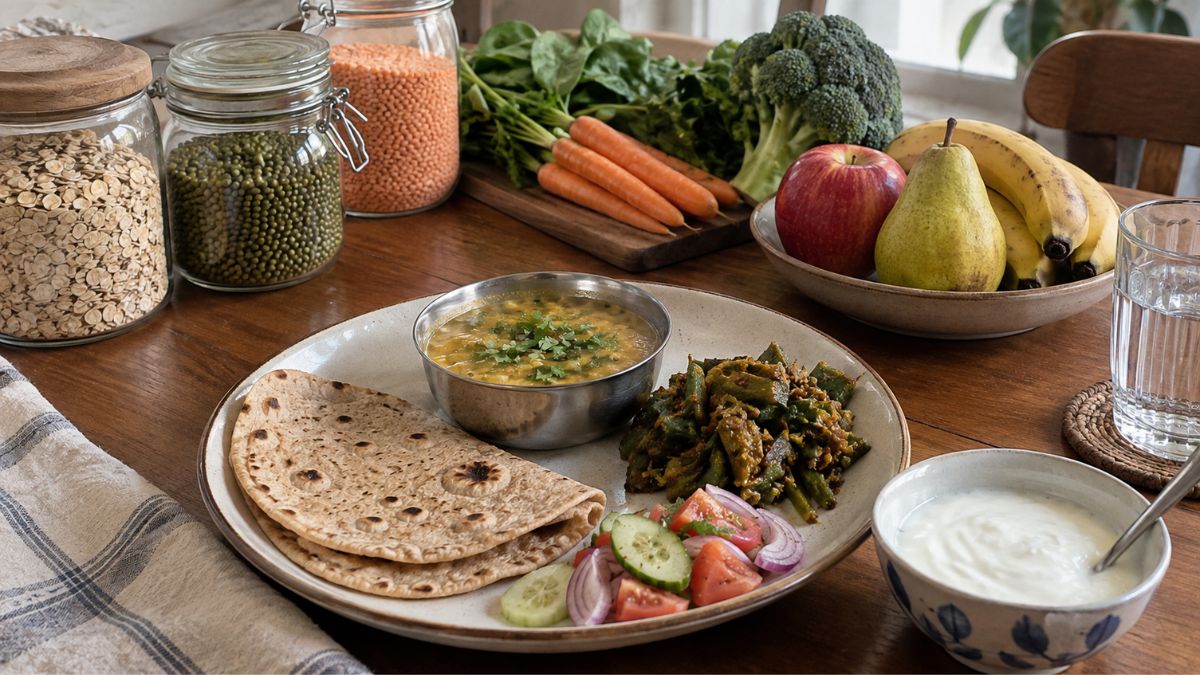
A lunch of dal, sabzi, two rotis and a piece of fruit is already a fibre-type portfolio, and nobody planned it that way:
Nobody planned that meal as a fibre-type strategy. It just works because it follows the whole-food, varied, traditional Indian plate logic that’s been around a lot longer than fibre research.
Curious which fibre type your last meal had? That’s actually a fun question to run through Happy Tummy GPT — paste your meal and ask.
For the fuller picture of what fibre actually does in your gut, “Fibre, Without the Lecture: What High-Fibre Foods Actually Do for You” is the pillar read for this cluster. And for a more concrete sense of where your daily fibre should actually be coming from on an Indian plate, “Fibre-Rich Foods in India: Where Your Fibre Should Actually Come From” maps it out.
“Here’s what I typically eat in a day. Can you identify which foods are contributing soluble fibre, which are contributing insoluble fibre, and whether I’m getting a reasonable mix of both?”
Or if you’ve been gassy after upping your fibre: “I often feel bloated after eating more fibre. Looking at my meals, can you help me identify whether I may be increasing fibre too quickly or relying too heavily on one type?”
Soluble and insoluble fibres aren’t rivals — they’re teammates. One slows digestion and helps you feel full; the other adds bulk and keeps things moving. Most whole foods contain both, and most traditional Indian meals deliver both without any planning at all.
The goal isn’t to memorise fibre categories. It’s to keep the plate varied: vegetables, pulses, fruits, whole grains. The rest follows naturally.
Disclaimer: This article is for general informational purposes only — not medical or dietary advice.
Soluble = dissolves in water, slows digestion, helps with fullness. Insoluble = doesn’t dissolve, adds bulk, keeps things moving. Both are useful; most plant foods contain some of each.
For most people, no. A varied diet with vegetables, fruits, pulses and whole grains naturally provides both types. Tracking becomes relevant only if you’re managing a specific digestive condition on medical advice.
Some fibres, particularly fermentable ones found in pulses, onions and garlic, feed gut bacteria that produce gas as a byproduct. This is normal and usually settles as your gut adapts. Moving gradually rather than overhauling your plate overnight helps reduce the initial reaction.