Puffed Rice vs Poha vs Chivda: What's The Difference Between These Festive Snacks?
All three may begin with rice, but air, water, oil, mix-ins and portions turn them into very different types of 'faral'. Here is how to read the bowl without labelling one good and another bad.
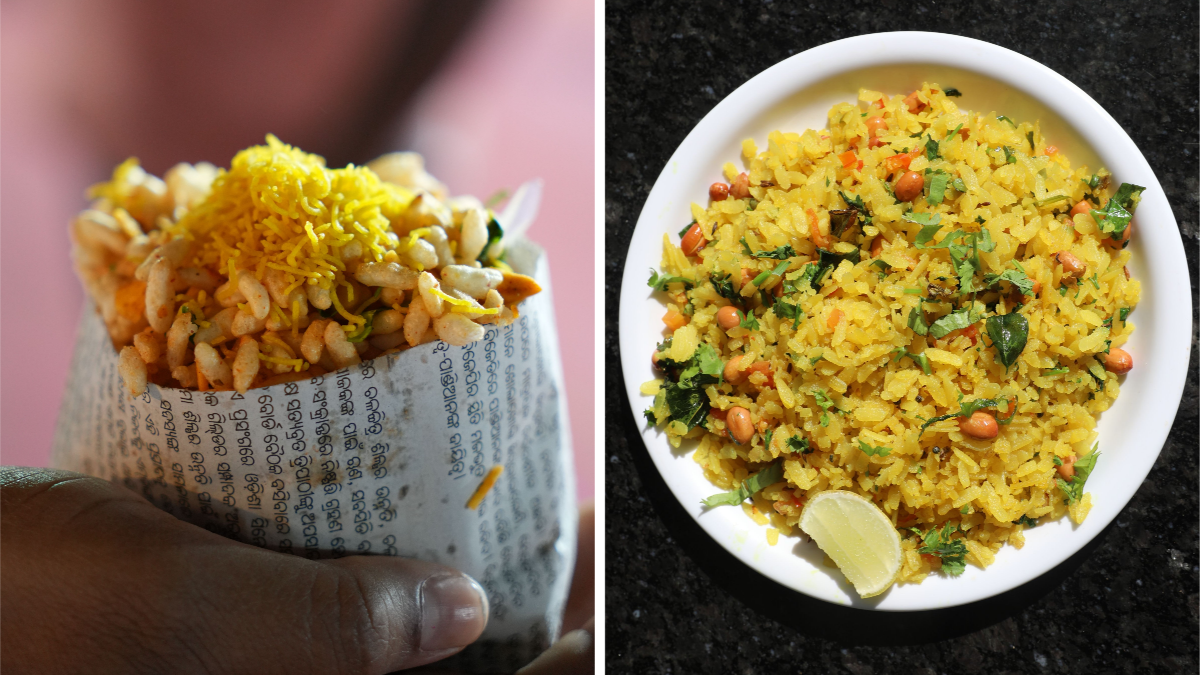
Puffed rice, poha and chivda are not three interchangeable foods. Puffed rice, or murmura, is rice expanded into airy grains. Poha is rice flattened into flakes, which may be cooked with water or roasted dry. Chivda is a seasoned mixture rather than a single ingredient; its base may be thin poha, puffed rice or another crisp ingredient. In a festival snack bowl, the biggest changes come from water, oil, peanuts, pulses, vegetables, salt, fried additions and repeated refills—not from the name alone.
A festival snack bowl has a peculiar talent for disappearing. It begins neatly piled on a table, perhaps with murmura, peanuts, curry leaves and green chillies. Then conversations move from room to room, the bowl follows, and somebody quietly fills it again.
In one home, muri may be tossed with mustard oil, onion and chilli. In another, poha arrives warm with peanuts and lemon. Somewhere else, a dry, crackling chivda waits in a steel dabba for the entire festive week.
They may share rice as their starting point, but they do not remain nutritionally or culinarily identical. The useful question is not which is “good” and which is “bad”. It is what changes when the form of rice, preparation, additions and portion change.
Puffed Rice vs Poha vs Chivda: The Quick Comparison
Puffed rice or murmura
Cooked poha
Dry chivda
What is it?
Rice grains expanded by heat
Flattened rice softened and cooked
A seasoned mixture, often based on thin poha or puffed rice
Typical texture
Airy and crisp
Soft, with some crunch from additions
Dry and crunchy
Role of water
Usually remains dry unless chutneys or vegetables are added
Absorbs water during rinsing and cooking
Kept dry for storage
Common additions
Onion, cucumber, coriander, chutneys, mustard oil, peanuts or roasted chana
Onion, potato, peas, peanuts, curry leaves and lemon
Peanuts, roasted gram or dal, coconut, curry leaves, spices, sev or fried ingredients
Usual eating occasion
Freshly assembled snack
Breakfast, snack or light meal
Make-ahead festive or tea-time snack
What is easy to overlook?
A large bowl can contain very little rice by weight but dense additions can accumulate
Water changes the weight and volume of the finished dish
Oil, salt and fried additions can vary enormously between recipes
This is why the word “light” needs care. It can describe texture, volume or how a food feels to one person. It does not automatically describe fibre, calories, salt or how satisfying the finished bowl will be.
Does Puffed Rice Have More Calories Than Poha? Read the Serving First
Online comparisons often place 100 g of dry puffed rice beside 100 g of cooked poha and declare a winner. That is not a useful like-for-like comparison.
Puffed rice contains a great deal of air, so 100 g occupies a very large volume. Cooked poha has absorbed water, which contributes weight without contributing calories. A bowl of each can therefore contain very different amounts of dry rice.
The finished recipe matters even more. A bowl of plain murmura is different from bhel loaded with sev and chutneys. Plain poha flakes are different from kanda poha cooked with oil, potato and peanuts. Chivda containing mostly thin poha is different from a mixture with generous amounts of nuts, fried dal, coconut and namkeen.
For a meaningful comparison, look at:
The portion you will actually eat
Whether the food is being measured dry or cooked
The quantity of oil used
The proportions of peanuts, pulses and vegetables
Any fried or sweet additions
Whether you are eating one serving or returning to the bowl repeatedly
A calorie number without that context may be precise on paper and still useless at the table.
Puffed Rice Starts With Airiness
Murmura, muri or puffed rice has a texture that few other cereal preparations can imitate. The grains are brittle and voluminous, allowing a relatively small weight of rice to fill a large bowl.
That airiness is a physical property, not a nutritional shortcut. Plain puffed rice remains largely a cereal base. What accompanies it determines whether the finished snack offers much beyond that base.
Bengali muri may be mixed with mustard oil, onion, green chilli and spices. Other preparations turn puffed rice into bhel-like mixtures with cucumber, tomato, coriander, chutneys, peanuts or roasted chana.
Fresh vegetables bring moisture and texture. Peanuts and roasted chana bring another food group into the bowl. Sev, fried papdi and sweet chutney move it in a different direction again.
ICMR-NIN’s Dietary Guidelines for Indians 2024 lists puffed rice among minimally processed cereal foods. “Minimally processed”, however, does not mean nutritionally complete on its own. The broader eating pattern—including pulses, nuts, vegetables and fruit—still matters.
Poha begins as flattened rice. Once rinsed or soaked, the flakes soften and swell. A tempering of oil, mustard seeds, curry leaves, chilli and turmeric then turns those flakes into a cohesive cooked dish.
Kanda poha is a familiar example. Onion, chilli, curry leaves, mustard seeds and peanuts bring softness, crunch, heat and fragrance. Potato, peas, coriander and lemon may join them depending on the region and household.
Flake thickness also matters. Thicker poha is usually chosen for cooked dishes because it holds its shape after rinsing. Thin poha is more often roasted and seasoned to make dry chivda.
That distinction is why “poha” cannot be assigned one universal calorie count, glycaemic index or nutrition profile without specifying the preparation.
Research on rice shows that variety, starch structure and processing can affect the body’s glycaemic response. The results are not identical across every study or variety, however, and research on a particular rice product should not be casually transferred to every homemade bowl of poha.
More importantly for an ordinary eater, plain rice flakes are not the same meal as poha containing vegetables and peanuts. The whole preparation—and the amount eaten—matters.
Chivda Is a Recipe, Not an Ingredient
Chivda, also spelt chiwda, is where the comparison becomes most interesting because the word describes a family of mixtures rather than one standard recipe.
A thin-poha chivda may contain peanuts, roasted gram, curry leaves, coconut, sesame and spices. A murmura chivda begins with puffed rice. Another version may use cornflakes, sev or other crisp ingredients.
Two bowls can therefore share the name “chivda” while having very different compositions. One may be mostly roasted poha with a scattering of peanuts. Another may contain a much larger proportion of fried dal, nuts, coconut, sev, oil and salt.
For homemade chivda, the recipe tells you what is in the bowl. For packaged chivda, use the ingredient list and nutrition panel rather than relying on descriptions such as “light”, “traditional” or “roasted”.
What Do the Additions Change?
Addition
What it brings to the bowl
What to notice
Peanuts
Crunch, richness, plant protein, fat and some fibre
A scattering and a peanut-heavy mixture are not equivalent
Roasted chana or dal
Crunch, savouriness, plant protein and fibre
Check whether the pulse is roasted or fried
Fresh vegetables
Moisture, freshness, colour and some fibre
Add immediately before eating; the snack will not store like dry chivda
Oil or ghee
Carries spices, coats the flakes and adds richness
A measured tempering differs from heavily coated namkeen
Coconut
Flavour, texture and richness
Fresh coconut shortens storage life; fried or dried coconut changes the mixture differently
Sev and fried additions
More crunch and seasoning
These can add further oil and salt even when the base itself is roasted
Salt and seasoning mixes
Savoury flavour
Easy to underestimate when several salted ingredients are combined
Peanuts, roasted chana and dal do more than decorate the bowl. They change a cereal-only snack into a mixed preparation. That does not make unlimited quantities necessary; it simply means the additions count.
Salt Is Easy to Miss Because You Cannot See It
Salt does not announce itself the way peanuts, curry leaves or sev do. In a homemade mixture, the cook controls what goes in. In packaged chivda, the sodium is already incorporated, sometimes across several seasoned components.
WHO recommends that adults consume less than 2,000 mg of sodium a day, equivalent to less than 5 g of salt from all dietary sources. This is not a prescription for one bowl of chivda. It is context for a day that may also contain salted nuts, namkeen, pickles, papad, chutneys and catered festival food.
When comparing packaged snacks, check the sodium figure on the nutrition panel. Compare products using the same column—preferably per 100 g—and then consider how much you will realistically eat. A manufacturer’s serving size may be smaller than the portion that ends up in your bowl.
The Five-Question Festival Snack Test
Before deciding whether a snack is “light”, “healthy” or somehow guilt-inducing, ask:
What is the base? Puffed rice, thin poha, cornflakes or a mixture?
What else is in it? Vegetables, peanuts, roasted pulses, sev, coconut or sweet chutney?
How was it prepared? Cooked, roasted, shallow-fried or deep-fried?
How much oil and salt entered the recipe? Check the packet when you did not make it.
How many times has the bowl been refilled? Festival grazing can make portions difficult to notice.
The fifth question is often the one that changes the answer.
Which One Should You Choose?
There is no universal winner. Choose according to the role the food needs to play.
For a freshly assembled snack: Muri or murmura with onion, cucumber, coriander, roasted chana or peanuts gives you plenty of control over the mixture.
For breakfast or a small meal: Cooked poha can carry vegetables, peanuts and other additions more comfortably than plain puffed rice.
For a make-ahead festive snack: Dry chivda is designed for storage and sharing. Serve it into a small bowl rather than eating directly from the packet or tin.
For a packaged option: Compare the ingredient list, sodium and serving information instead of assuming every chivda has the same recipe.
Puffed rice, poha and chivda may all begin with rice, but air, water and assembly take them in different directions.
Puffed rice offers airy volume. Cooked poha absorbs water and becomes a dish. Chivda is a recipe whose character depends on the proportions of flakes, nuts, pulses, oil, salt and other additions.
None needs to be crowned the perfect festival snack. Look at the bowl you are actually eating, not the health halo—or suspicion—attached to its name.
And remember: the first bowl may be modest. The magically self-refilling bowl is a different nutritional event.
Ask Happy Tummy GPT
Have puffed rice, peanuts and a few vegetables at home? Ask Happy Tummy GPT:
“Help me build a satisfying Indian snack with murmura, peanuts and vegetables without making it too oily or salty.”
To look beyond one festival snack and understand your everyday digestive habits, take the Digestive Quotient Test.
This article provides general food and nutrition information and is not medical advice. Recipes, brands and portions vary considerably, so use the ingredient list and nutrition panel for the product you are actually eating. Seek qualified professional advice for personalised dietary needs.
FAQs
Is puffed rice healthier than poha?
Neither is automatically healthier. Puffed rice is airy and usually eaten dry, while poha absorbs water and is commonly cooked with vegetables, peanuts and tempering. Compare the finished dishes and actual portions rather than the rice forms alone.
Does puffed rice have more calories than poha?
A simple number can mislead if dry puffed rice is compared with cooked poha. Cooked poha contains absorbed water, while puffed rice contains a great deal of air. Oil, peanuts, vegetables and other additions can change the finished bowl considerably.
Is chivda the same as poha?
No. Poha is flattened rice. Chivda is a seasoned snack mixture that may use thin poha, puffed rice, cornflakes or another crisp ingredient as its base.
Is chivda healthy?
It depends on the recipe and portion. A roasted thin-poha chivda with peanuts and chana is different from a heavily fried mixture containing generous amounts of sev, oil and salt. The name alone cannot answer the question.
Is poha or puffed rice better for weight loss?
Neither food causes weight loss by itself. Puffed rice offers considerable volume for its weight but brings limited fibre or protein on its own. Cooked poha can become a more substantial meal when prepared with vegetables and peanuts. The complete recipe, portion and broader eating pattern matter more.
Does puffed rice have a high glycaemic index?
Some studies have found high glycaemic-index values for puffed rice cakes and other processed rice products. Those results should not be converted into an exact GI for every Indian murmura preparation. Rice variety, processing, portion and the other foods in the bowl can all affect the response.
Is packaged chivda high in salt?
It can be, but products vary. Check sodium on the nutrition panel and compare products per 100 g. Also consider your actual portion rather than relying only on the manufacturer’s suggested serving.
How can I make chivda less oily and salty?
Roast the flakes, measure the oil used for tempering, use unsalted peanuts or roasted chana where possible, and build flavour with curry leaves, chilli and spices. Avoid combining several heavily salted additions in the same mixture.
You are now being directed to an external website https://www.callr.live/aashirvaadexperts/premium-plan.
This link is provided for your information and convenience only and ITC Limited is not
responsible for the contents or services provided by Brand Touch India or any information that
you share with Brand Touch India.