Jeera, Ajwain and Saunf: India’s Kitchen Digestives, Explained
Jeera, ajwain and saunf have long been used after meals and in everyday cooking. Here's what their traditional digestive role gets right—and where the evidence ends.
Table of Contents
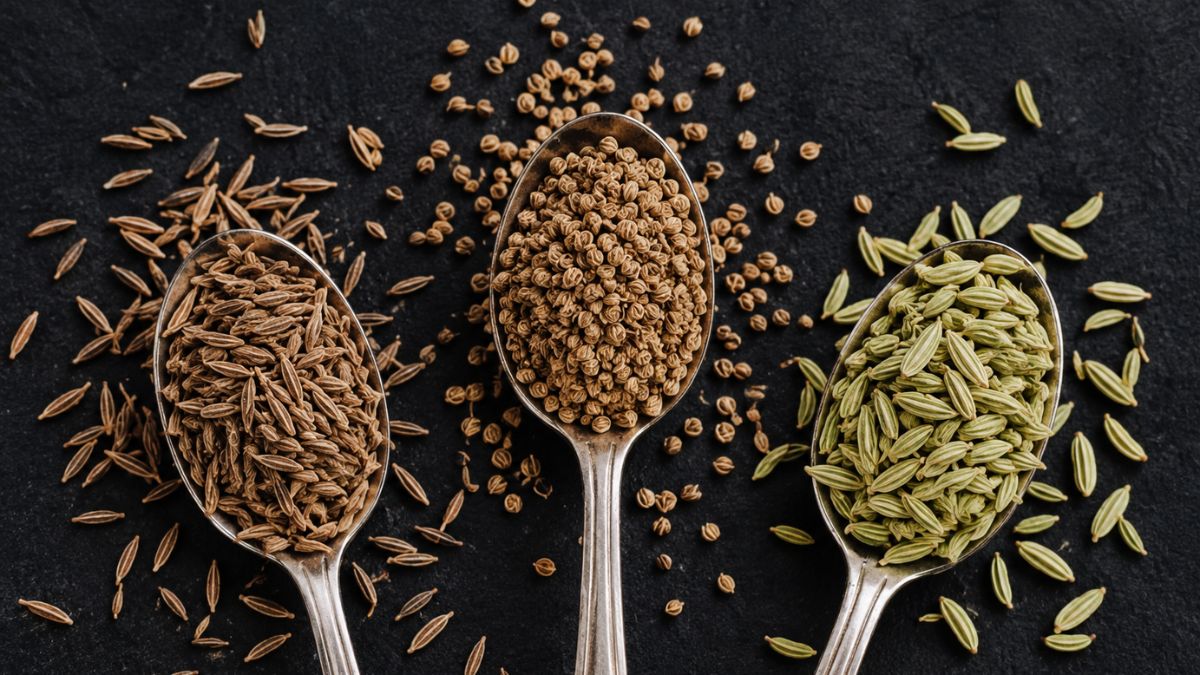
Jeera, ajwain and saunf are three of the oldest kitchen remedies in Indian cooking, and three of the most searched. They’re chewed after meals, steeped in hot water, added to tadkas, kept on dining tables. The question ‘are they actually good for digestion?’ deserves a serious answer rather than either dismissing them as superstition or overclaiming them as proven medicines. The honest version: all three have plausible mechanisms, long cultural histories, and a modest body of traditional and some scientific interest behind them. None of them is a medicine. All of them earn their place in the Indian kitchen.
Jeera — cumin seeds — is the foundation of most Indian tempering. It appears in dal tadkas, rice preparations, chaas, raita and spice blends across virtually every regional cuisine in India. Its traditional association with digestive comfort rests partly on the aromatic compounds it contains, which are thought to stimulate digestive enzymes and improve gut motility. Jeera water — whole seeds steeped in water, drunk warm — is one of the most commonly searched traditional remedies for bloating, acidity and morning digestive discomfort. The research on cumin and digestion is modest and mostly preliminary, but the traditional use is broad and the plausibility isn’t zero.
| ⓘ Three Kitchen Digestives, at a Glance Jeera (cumin): aromatic compounds plausibly linked to enzyme stimulation and gut motility; foundation of Indian tadka Ajwain (carom): contains thymol, which has established antimicrobial properties; traditionally used for gas and cramps Saunf (fennel): carminative properties well-recognised; used post-meal across India for freshness and digestion None of the three is a medicine or a proven treatment for any digestive condition All three have long, cross-regional traditional use that isn’t random or placebo-dependent |
Ajwain contains thymol — an aromatic compound with established antimicrobial properties that also appears in some research on gut motility and smooth muscle relaxation. This is probably the strongest mechanistic basis of the three for a genuine digestive effect: thymol has been studied more directly than the equivalent compounds in jeera or saunf. Ajwain is traditionally used for stomach cramps, gas, and acute digestive discomfort — a small amount chewed directly, steeped as ajwain water, or added to a simple preparation of ajwain with warm water and a pinch of salt. As with jeera, this is traditional medicine territory with a plausible basis, not a clinical intervention.
Saunf — fennel seeds — is probably the most widely used post-meal digestive in India, chewed at restaurant entrances, served after meals in households across regions, and combined with sugar-coated mukhwas variants that have made the habit more palatable for children and those who don’t like the pure fennel flavour. Fennel has well-recognised carminative properties — it helps relax smooth muscle in the gut, which may ease the passage of gas and reduce cramping. This is a category of digestive effect (carminative = helps release trapped gas) with enough traditional and pharmacological support that this series is comfortable saying the saunf habit has a real basis, even without a specific clinical trial to point to.
Most Indian households already use all three, often without thinking of them as medicinal: jeera goes into the tadka at the start of most dals and rice preparations; ajwain goes into parathas, mathri and some pickles; saunf goes into mukhwas and is served at the meal’s end. The question of ‘should I add these for gut health’ is, for most people, already answered by habit — they’re already there. The more useful question is whether the traditional post-meal saunf ritual, specifically, is worth maintaining or reviving if it’s been lost. The answer, on the evidence this series is comfortable citing, is yes.
None of these three spices is a cure for chronic digestive conditions. Persistent bloating, acidity, IBS-type symptoms or pain that recurs regularly should be evaluated by a doctor rather than managed with kitchen remedies alone. The role of jeera, ajwain and saunf is as everyday digestive aids — supporting ordinary, occasional discomfort after a heavy meal, or as habitual post-meal rituals that may ease the transition from eating to whatever comes after. This is genuinely useful territory; it’s just different from medical territory, and worth knowing the distinction.
This series set out to separate what’s true, what’s traditional and what’s overstated across twenty everyday Indian foods. Jeera, ajwain and saunf are a fitting close — three foods where the traditional knowledge turns out to be directionally correct, where the science is modest but not absent, and where the honest answer is ‘yes, there’s something here, it’s not a medicine, and it’s been in your kitchen all along.’ That’s been the series’ answer in one form or another for nineteen pieces. It’s the right answer for the twentieth too.
The small bowl of mukhwas — saunf, mixed seeds and sometimes sugar-coated variants — at restaurant exits and at the ends of meals across India is part of a tradition of post-meal digestive herbs that predates modern nutrition discourse by centuries. It’s not superstition: the carminative and aromatic properties of the seeds in a typical mukhwas mix are real, even if the mechanisms are better described in traditional pharmacology than in randomised controlled trials. The fact that this particular tradition survived across regions, religions and cooking styles for so long suggests it earned its place on sensory and functional grounds, not just out of custom.
The simplest way to get the benefit of all three is to let them do the jobs they’re already designed for: jeera in the tadka as the starting flavour base of dals and rice; ajwain kneaded into paratha dough or added to a masala for something heavy; saunf chewed after a larger or richer meal. None of this is a new habit — it’s paying attention to habits already present in most Indian kitchens, and being willing to credit them for the genuine, if modest, value they carry.
Disclaimer: This article is for general informational purposes only — not medical or dietary advice.
Jeera contains aromatic compounds plausibly linked to digestive enzyme stimulation and gut motility. The traditional use as a digestive is well-established; the clinical evidence is modest and preliminary, but the plausibility is real.
Ajwain contains thymol, which has some antimicrobial and gut-motility properties. Traditional use for gas and stomach cramps is the strongest mechanistic case of the three spices covered here.
Saunf has well-recognised carminative properties — it helps relax gut smooth muscle, which may ease gas and cramping. The post-meal saunf ritual has a genuine physiological basis, not just cultural habit.
No — these are everyday digestive aids for ordinary, occasional discomfort, not treatments for chronic conditions. Persistent or severe digestive symptoms need medical evaluation.
Both have plausible digestive mechanisms. Fennel (saunf) has slightly better-recognised carminative properties; jeera has a longer tradition as a general digestive tonic. Both are reasonable, and choosing between them is largely personal preference.
Traditionally: a small amount chewed directly, steeped in warm water, or mixed with warm water and a pinch of salt. These are traditional home-remedy applications, not a prescribed dose.