
What Your Gut Wishes You Knew Before Starting Another Monday Diet
It is Sunday evening. The weekend happened. Monday is a fresh start. The plan is forming. Your gut has been through seventeen of these and it has some thoughts about the seventeenth.
Table of Contents
It is Sunday evening. The weekend happened. Monday is a fresh start. The plan is forming. Your gut has been through seventeen of these and it has some thoughts about the seventeenth.
The Monday diet is one of the most optimistic and one of the most reliably short-lived traditions in the wellness calendar. It has a logic that is almost impossible to argue with: Monday is a beginning, beginnings are good for discipline, and the symbolic clean slate of a new week makes it feel like the right time to start something. You can feel the clarity of the decision on Sunday evening. You know exactly what Monday looks like. You are ready.
Your gut knows what Monday looks like too. It has been here before.
Most Monday diets make it to approximately Thursday. Not because the person lacks commitment, but because the diet was designed for a version of the week that does not quite match the actual week. Monday through Wednesday, motivation and novelty carry it. Thursday the social lunch appears, or the work event, or the exhaustion that makes the original plan feel like a different person’s idea. Friday is written off. Saturday and Sunday are the weekend, which is a separate category. And Sunday evening, the plan forms again.
The gut experiences this as the Monday-to-Monday cycle: periodic restriction, periodic loosening, never quite settling into a stable pattern. The gut does not have a fresh-start response to Monday. It has a continuous experience of whatever has been happening, and the weekly reset that feels meaningful to the brain is invisible to the digestive system, which just registers: not enough fibre this week, then a large catch-up, then not enough again.
Monday diets fail for predictable reasons, and they are not the ones most people think. It is not lack of willpower. It is that the plan was designed for optimal conditions — the version of the week with no social events, no meetings that run through lunch, no days where cooking is simply not happening. Real weeks do not look like optimal conditions. Real weeks have Thursdays.
Why do diets fail? Usually not from lack of willpower, but because the plan was designed for an optimal week — one with no social events, no late meetings, no days where cooking does not happen. Real weeks have all three. A plan that only works under ideal conditions will only be followed under ideal conditions, which is why diets that need a fresh-start moment to begin tend to need another one every few weeks.
A diet that requires optimal conditions to maintain is a diet that will not be maintained for long. The plan that needs Monday morning motivation to restart every week is the plan that is always restarting rather than running continuously.
The gut’s preferred alternative is not a plan at all. It is a default. A way of eating that is the baseline on normal days, that does not require a decision or a resolve or a fresh start, that absorbs the Thursday lunch and the Friday dinner and continues on Saturday as if nothing happened. This is not motivating in the Sunday evening sense. It is just what works.
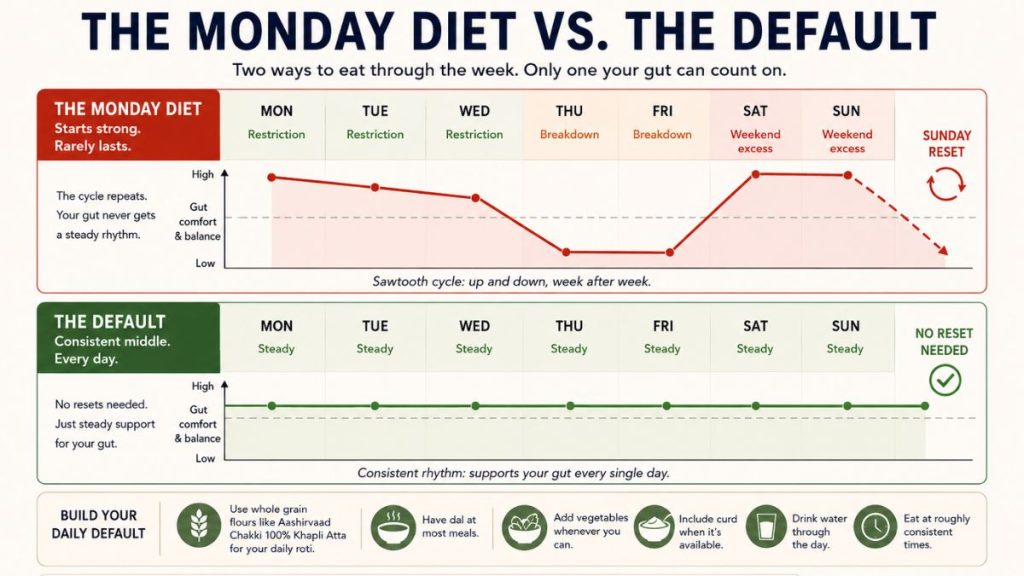
The default that the gut prefers is also, not coincidentally, the simplest one to describe. Whole grain flour for the daily roti. Dal at most meals. Vegetables when you can manage them. Curd when it is in the fridge. Water through the day. Meals at roughly consistent times. That is the whole framework.
Aashirvaad Chakki 100% Khapli Atta as the everyday flour is part of this default because it is genuinely better than a refined alternative without requiring any additional effort, any new recipe knowledge, or any Monday morning motivation to begin. You use the same atta, in the same recipe, in the same pot. The difference is in what the flour is made from: stone-ground Emmer wheat with the bran and germ intact, providing the fibre and the satiety that the gut needs from the meal it anchors.
A roti from Aashirvaad Chakki 100% Khapli Atta with dal is not a Monday diet. It is just dinner. And dinner, done quietly and consistently, does considerably more for the gut than the Monday reset ever will.
The other thing the Monday diet is usually trying to solve is the weekend. If the weekend eating is significantly different from the weekday eating — more, richer, less restrained — the Monday restart is the correction mechanism. But the correction mechanism is needed because the pendulum swings.
A weekday default that is actually satisfying — that does not feel like deprivation, that keeps the gut comfortable and the hunger managed — produces weekends that do not require a Monday correction. Not because the weekend suddenly becomes boring and restrained, but because the account is not in deficit. There is nothing to balance.
The Monday diet is not the problem. The gap between Monday and the rest of the week is the problem. Close the gap and Monday becomes just another day.
Your gut does not need a fresh start. It needs a consistent middle. And consistent middles do not begin on Monday. They begin with the next meal, whatever day that happens to be.
This is the last piece in the series. Your gut has said what it wanted to say. The rest, as always, is up to you.
This article is part of the What Your Gut Wishes You Knew Before… series on Happy Tummy. For general informational purposes only — not medical or dietary advice. Read more of the series here.