What Your Gut Wishes You Knew Before Cutting Out Rotis Completely
The decision has been made. Rotis are out. You have your reasons. Your gut, which grew up on rotis, which has been processing rotis for decades, which has strong feelings about this development, would like a word.
The decision has been made. Rotis are out. You have your reasons. Your gut, which grew up on rotis, which has been processing rotis for decades, which has strong feelings about this development, would like a word.
There is a specific moment that many people who have decided to cut out rotis describe: the first week feels like clarity, the second week feels like discipline, and by the third week there is a very particular craving that is not quite hunger and not quite anything else. It is the gut asking, in its own way, where the thing went that used to be there.
This piece is not going to argue that rotis are sacred and cannot be reduced or changed. Your body, your choices. But there is a meaningful difference between reducing rotis, changing what they are made of, and eliminating them entirely. And the case for elimination is considerably weaker than the case for upgrading.
What the roti was actually doing
The roti in the Indian diet is not just a carbohydrate vehicle. In the context of a complete meal — roti with dal, with sabzi, with curd — it is the structural anchor. It provides the fibre that slows digestion of the whole meal. It provides the complex carbohydrate that sustains energy through the afternoon. When made from a whole grain flour, it provides iron, protein, and the prebiotic fibre that the gut microbiome feeds on.
When the roti disappears from the meal, what usually fills its space is either nothing (the meal becomes less substantial) or something that is not a straightforward improvement. A bowl of salad leaves does not provide what a roti from Aashirvaad Chakki 100% Khapli Atta provides. The absence is real and the gut notices it.
The fibre cliff
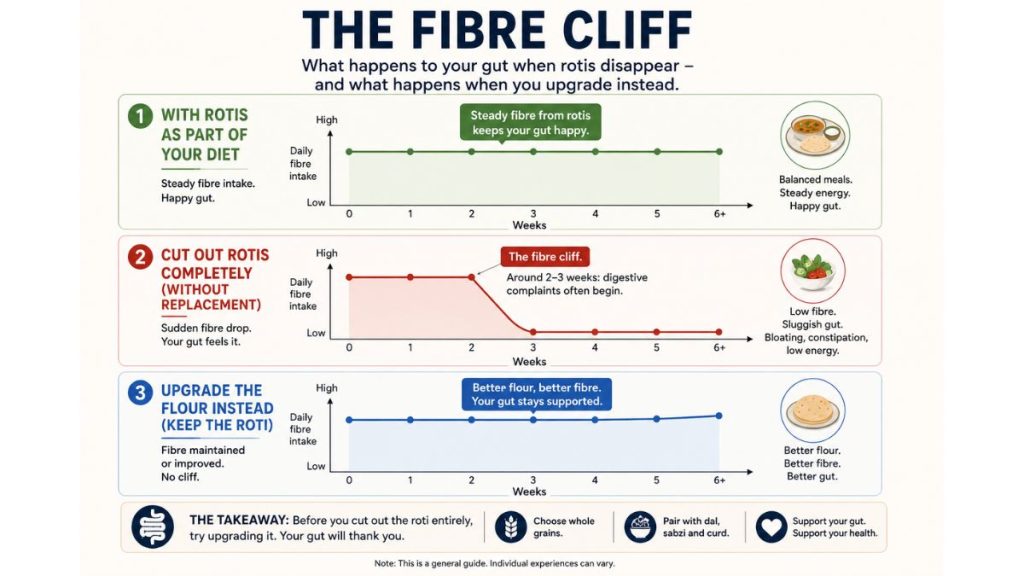
For most people eating a traditional Indian diet, whole grain rotis are the primary source of dietary fibre in the daily meal. Remove them without replacing the fibre from another source and you have created what might be called a fibre cliff: a sudden and significant drop in one of the most important inputs the gut receives.
The gut responds to a fibre cliff predictably: gut motility slows, the microbiome begins to shift as the bacterial populations that depend on grain fibre reduce, and the digestive complaints that arrive a few weeks later seem unconnected to the roti elimination but are directly caused by it. Constipation. Bloating. A gut that was running smoothly and is now not.
This is why “I cut out rotis and felt great” is a common short-term experience and “I cut out rotis and continued to feel great indefinitely” is considerably rarer. The short-term improvement is often the gut adjusting and the weight-related motivation boost of early dietary change. The medium-term experience, when the fibre deficit starts to accumulate, is considerably different.
What happens if you stop eating roti? For most people on a traditional Indian diet, rotis are the primary daily source of fibre — cutting them without replacing that fibre creates a sudden drop the gut notices within weeks. Gut motility slows, the microbiome shifts as fibre-dependent bacteria reduce, and constipation or bloating often follow. The early ‘I feel great’ phase is usually the gut adjusting, not evidence the change is sustainable.
The problem is rarely the roti itself
Most people who decide to cut out rotis entirely are responding to something real: the feeling that the current roti is too heavy, that it is leaving them bloated, that it is not sitting well. These are legitimate experiences. They are just not the roti’s fault in the way that complete elimination implies.
A roti made from refined, packaged atta that digests quickly and provides minimal fibre is a different thing from a roti made from a stone-ground whole grain like Aashirvaad Chakki 100% Khapli Atta, which is made from ancient Emmer wheat with the bran and germ intact, which digests more slowly, which keeps you fuller, and which the gut processes more comfortably than a refined flour equivalent.
Many people who have decided that rotis do not agree with them have never eaten a well-made Khapli roti. The experience is different enough that the conclusion — rotis are the problem — does not necessarily survive the encounter with the alternative.
What to try before the elimination
Switch the flour. Just that, first. See what happens over two to three weeks with a stone-ground whole grain atta. If the bloating and heaviness that prompted the roti elimination were connected to the quality of the flour, they tend to reduce significantly. If they persist regardless of the flour, then the investigation can continue — but from a more informed position.
Reduce the number rather than eliminating entirely. Two Khapli rotis with a generous dal and a vegetable is a complete, balanced, fibre-rich meal. It is not a large carbohydrate load. It is the foundation the gut needs.
Pay attention to what accompanies the roti. A roti eaten with a thin dal and very little else is a different meal from a roti eaten with a proper sabzi, a legume, and curd. The roti’s effect on how you feel is partly about the roti and partly about everything around it.
Before you cut out the roti entirely, try upgrading it. The problem might not be the roti. It might be the flour.
Your gut is not asking you to eat rotis forever regardless of how they make you feel. It is asking you to make sure you have identified the actual problem before eliminating something that has been part of your diet for your entire life.
This article is part of the What Your Gut Wishes You Knew Before… series on Happy Tummy. For general informational purposes only — not medical or dietary advice. Read more of the series here.
You are now being directed to an external website https://www.callr.live/aashirvaadexperts/premium-plan.
This link is provided for your information and convenience only and ITC Limited is not
responsible for the contents or services provided by Brand Touch India or any information that
you share with Brand Touch India.