Is Onam Sadya Healthy for Your Gut? A Nutritionist Explains
From matta rice and vegetable diversity to curd-based dishes, rasam and payasam, nutritionist Adrija Regimi decodes what an Onam Sadya gets right for the gut — and where the health halo goes too far.
IS THE ONAM SADYA GOOD FOR YOUR GUT? Genuinely, yes, in several of the ways that matter most. A full Onam Sadya can pack an unusual amount of plant diversity into one sitting, includes curd-based dishes that may retain live cultures depending on how they are prepared, and follows a traditional sequence that makes culinary sense across a very long meal.
It is also a large, ghee- and coconut-rich, dessert-heavy feast, which is exactly what a once-or-twice-a-year celebration meal is supposed to be — not a template for Tuesday lunch. And while the banana leaf itself is a lovely, sustainable tradition, claims that it actively boosts the meal’s nutritional benefits run considerably ahead of the evidence.
A Feast Built From More Dishes Than Most People Eat in a Week
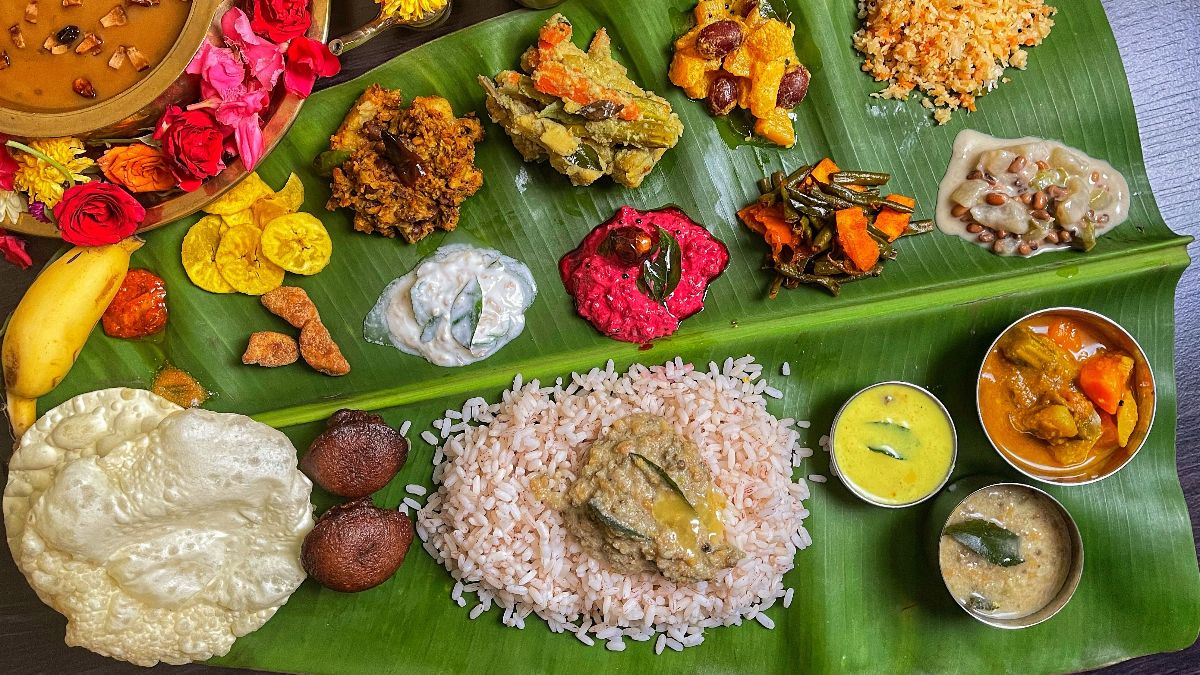
The Onam Sadya is Kerala’s harvest-festival feast, served on Thiruvonam, the tenth and most significant day of the ten-day Onam festival, falling on 26 August in 2026. The word sadya simply means feast in Malayalam, and it’s traditionally eaten seated on the floor, off a fresh banana leaf.
What lands on that leaf is the real story. Depending on the household, region and scale of the celebration, a Sadya can run from around 20 dishes to well over 25, each with an assigned place on the leaf and a particular order of serving. Kerala Tourism itself describes the feast as often exceeding 25 items, while other traditional versions can be even more elaborate.
That scale alone makes the Sadya worth a closer look from a gut-health perspective. Instead of asking the usual question, “Is this single dish good for you?”, it invites a broader one: what does an entire, carefully constructed meal tradition get right?
Decoding it fairly means going dish category by dish category rather than treating the whole spread as one undifferentiated “healthy tradition” or waving it off as “just a big feast.” Both instincts miss what’s actually going on.
The leaf itself carries meaning before a single dish is served. It’s placed with the narrow tip pointing to the diner’s left, and the arrangement of dishes follows a traditional pattern. Customs vary across regions and households, but the broader point holds: this is a meal built with attention to detail at every level, not simply a long list of dishes assembled for volume.
Does Eating On a Banana Leaf Have Health Benefits?
Banana leaves do contain real, measurable plant compounds, including polyphenols, flavonoids and tannins, and laboratory research on banana-leaf extracts has demonstrated antioxidant and antimicrobial activity.
Where the claim gets stretched is the jump from “the leaf contains these compounds in a laboratory extract” to “eating off the leaf transfers enough of them to meaningfully benefit your food and your gut”.
That’s a much bigger claim, and the evidence for it is considerably thinner. A leaf briefly holding hot food for the length of a meal isn’t the same as a concentrated extract, and there is no strong evidence that polyphenol transfer during an actual Sadya produces a measurable health benefit.
The honest version is simpler: eating off a banana leaf is a genuinely pleasant, biodegradable and culturally significant tradition. It does not need to become a health intervention to be worthwhile.
Matta Rice, Parippu and the Sadya’s Plant Diversity
The meal’s foundation is Kerala matta rice, a parboiled, reddish-hued rice that typically retains more of the grain’s outer layers than highly polished white rice, depending on how it has been milled.
It’s served first with parippu curry, a simple dal, often made from moong or another pulse, cooked soft with turmeric and finished with a spoon of ghee. A good-quality dal, something like Aashirvaad Organic Dals, makes a genuine difference to a dish this simple, since there’s nowhere for a lower-quality lentil to hide when the preparation itself is this plain.
What follows on the leaf is where the Sadya earns its gut-health credentials most convincingly: an extraordinary spread of vegetable preparations, each cooked differently.
Avial brings mixed vegetables in a coconut-curd gravy. Olan is an ash-gourd and cowpea preparation with coconut milk. Thoran is a dry grated-coconut stir-fry, and different households make it with cabbage, beans or greens on rotation. Erissery combines pumpkin or yam with coconut and often legumes. Add sambar’s lentil-and-vegetable base, and a single Sadya plate can contain a remarkably wide range of vegetables and pulses.
That diversity matters more than crowning any one Sadya dish a “gut superfood”. Human research has found associations between greater dietary variety and greater gut-microbiota diversity, although microbiome responses remain highly individual and diet is only one of many influences.
It’s worth pausing on why this happens at all rather than treating it as incidental. Onam is fundamentally a harvest festival, and the Sadya’s structure reflects that directly: it’s built around an abundance of vegetables, pulses and seasonal produce, each getting its own dedicated preparation rather than disappearing into one mixed dish.
A modern nutrition framework might call this dietary diversity. Kerala’s agricultural calendar arrived at something very similar generations earlier for a much more practical reason: celebrating a good harvest meant actually using what the harvest produced.
Are the Curd-Based Sadya Dishes Probiotic?
This is where the language needs to be precise.
Dishes like appam and idli are fermented and then cooked with enough heat to kill the live microorganisms in the batter. Their value does not disappear — fermentation has already changed the flavour, texture and composition of the food — but the finished cooked dish should not automatically be called probiotic.
The Sadya’s curd-based dishes are different, although even here preparation matters.
Kaalan, pulissery, pachadi and kichadi all use curd or buttermilk, but different recipes expose that dairy to different amounts of heat. Pachadi and kichadi may involve very little heating of the curd itself, while some versions of kaalan and pulissery are heated more substantially.
So the careful answer is that some curd-based Sadya dishes may retain live cultures when the curd is added after cooking or exposed only to limited heat. How many organisms survive will depend on the recipe, temperature and time.
And “contains live cultures” is still not the same thing as “probiotic”. To call a food probiotic in the strict scientific sense, specific live microorganisms need to be present in an adequate amount and have a demonstrated health benefit.
The culinary value of curd in the Sadya is much easier to defend. A meal this rich in coconut, ghee and strong flavours benefits from something tangy to cut through it. Curd does exactly that, resetting the palate between heavier preparations and making a very long meal easier to navigate.
That’s not a clinical digestive claim. It’s simply good meal design.
Is There Really Digestive Logic to the Order of a Sadya?
The order in which dishes are eaten isn’t arbitrary, although it would be a mistake to turn every traditional sequence into modern nutritional science after the fact.
Rasam, thin, peppery and tangy with tamarind, traditionally arrives towards the latter part of the savoury meal. Its warmth, acidity and spices provide a sharp contrast before the meal moves towards its sweeter conclusion.
Inji puli, the tamarind-and-ginger preparation placed on the leaf, has long been understood within Kerala food culture as a digestive accompaniment. Ginger itself has been studied for its effects on gastrointestinal motility, although that does not mean a spoon of inji puli acts as a treatment for digestive problems.
None of this should be overstated into a clinical claim. A traditional meal sequence developed over generations of shared eating isn’t the same thing as a designed intervention, and no rasam course is doing enough digestive heavy lifting to offset everything around it.
What it does show is that the order dishes appear in isn’t purely aesthetic. Over a very long period of time, communities arrived at a sequence that balances salty, sour, spicy, rich and sweet foods remarkably well.
The Honest Part: This Is a Feast, and It Behaves Like One
None of the above should be read as an argument that the Sadya is some secretly optimised health meal. It isn’t, and treating it that way would undersell what it actually is: a celebration feast, and celebration feasts are supposed to be generous.
Ghee appears in the parippu. Coconut, in grated, milk or oil form, runs through many of the savoury dishes. Pappadam and banana chips are fried. Sharkara varatti combines fried banana with jaggery. A full Sadya typically finishes with at least one payasam, often more, built around combinations of milk or coconut milk, rice or ada, pulses and sugar or jaggery.
A proper Sadya, eaten the way it’s meant to be, with second helpings of rice pressed on you by whoever’s serving, is a substantial meal by design.
That’s not a flaw in the tradition.
A meal can be genuinely strong on some dimensions — dietary diversity, pulses, vegetables, fermented dairy and thoughtful culinary structure — while also being rich enough that eating it at that scale every day isn’t the goal.
Once or twice a year, with the intention and company a festival meal deserves, is exactly the context for something built this generously.
If you’re hosting or attending a Sadya and want to eat it comfortably rather than uncomfortably, the traditional structure already helps.
Taking modest portions of the many vegetable preparations rather than filling the leaf with only two or three favourites means you actually get the diversity the meal is built around. Pacing the rice through the meal rather than filling up on the first serving leaves room for the rest of the courses. And allowing payasam to be the meal’s deliberately indulgent finale tends to be considerably more comfortable than arriving at dessert already overfull.
Onam Sadya at a Glance
Category
Example dishes
What they bring
Base
Matta rice, parippu
Grain + pulse combination; fibre varies with the rice and degree of milling
Vegetable and coconut dishes
Avial, olan, thoran, erissery
Plant diversity, fibre and a range of vegetables and legumes
Curd-based dishes
Kaalan, pulissery, pachadi, kichadi
Fermented dairy; some preparations may retain live cultures depending on heating
Tangy accompaniments
Rasam, inji puli
Acidity, spices and contrast within a rich meal
Fried and rich foods
Pappadam, banana chips, sharkara varatti
Celebratory indulgence rather than everyday staples
Sweet finale
Payasam
A traditional dessert course, often rich in sugar or jaggery and dairy or coconut milk
The Honest Takeaway
The Onam Sadya genuinely earns credit on dimensions that matter to a balanced diet: an unusual amount of vegetable and pulse diversity in a single meal, fermented dairy through its curd-based dishes, and a culinary structure that prevents an enormous spread from becoming one undifferentiated plate of food.
It’s also, honestly, a rich and generous festival feast, not a template for daily eating, and no amount of banana-leaf antioxidant talk changes that second fact.
Both things can be true at once. A tradition this old and this thoughtfully constructed doesn’t need to be oversold to be worth celebrating exactly as it is.
Frequently Asked Questions
Is Onam Sadya healthy?
It has several nutritional strengths, particularly its variety of vegetables, pulses and plant foods. But a traditional Sadya also includes generous amounts of coconut, ghee, fried foods and sweet dishes, so it is better understood as a varied celebration feast than an everyday “health meal”.
Is Onam Sadya good for gut health?
Potentially, in several ways. The meal can provide unusually high plant diversity in one sitting, along with pulses, vegetables and fermented dairy. That does not make the Sadya a digestive treatment, and individual tolerance to such a large meal will vary.
Does eating off a banana leaf have health benefits?
Banana leaves contain plant compounds with antioxidant and antimicrobial activity in laboratory studies. There is no strong evidence, however, that enough of these compounds transfer into food during a normal meal to produce a meaningful health benefit. The leaf’s sustainability and cultural importance are much clearer advantages.
Do the curd-based Sadya dishes contain probiotics?
Not automatically. Some preparations may retain live cultures if the curd is not subjected to prolonged heating, but the amount and type of surviving microorganisms will vary. A food should only be called probiotic when specific live strains, in adequate amounts, have demonstrated a health benefit.
Is idli or dosa probiotic because the batter is fermented?
No. The batter is fermented, but steaming an idli or cooking dosa on a hot tawa kills the live microorganisms. They remain fermented foods, not sources of live probiotic cultures.
Why is rasam served towards the end of a Sadya?
Rasam provides a hot, tangy and peppery contrast towards the latter part of the savoury meal before the sweeter courses arrive. There is a traditional digestive logic associated with its spices, but the serving order should be understood primarily as part of the Sadya’s culinary structure rather than a proven digestive intervention.
Is matta rice healthier than white rice?
Matta rice is parboiled and is often less highly polished than ordinary white rice, so it can retain more of the grain’s outer layers and consequently more fibre. The exact nutritional difference depends on how both rice products have been milled.
How many dishes are there in an Onam Sadya?
There is no single compulsory number. A traditional Sadya can include more than 20 dishes, and elaborate versions may exceed 25 or even considerably more. The exact menu varies by family, region and occasion. Kerala Tourism describes the feast as often containing more than 25 dishes.
Is it okay to eat a large Sadya once in a while?
For most healthy people, an occasional festival meal does not need to be treated like an everyday nutrition plan. Eat at a comfortable pace, enjoy the variety and stop when you are pleasantly satisfied rather than treating every second helping as compulsory.
You are now being directed to an external website https://www.callr.live/aashirvaadexperts/premium-plan.
This link is provided for your information and convenience only and ITC Limited is not
responsible for the contents or services provided by Brand Touch India or any information that
you share with Brand Touch India.