Punugulu: Andhra & Telangana’s Fermented Breakfast
Punugulu takes familiar fermented rice-and-urad batter and drops it into hot oil. What survives from the fermentation — and what does deep-frying change?
Table of Contents
Punugulu is one of the Telugu food world’s fried expressions of fermented rice-and-urad batter: small, crisp dumplings made either from purpose-fermented batter or, very commonly, from leftover idli or dosa batter. It is strongly associated with Andhra Pradesh, especially Vijayawada and coastal Andhra, and belongs as comfortably to the tea-time and street-food table as it does to breakfast.
The fermentation has already changed the batter before it reaches the oil, affecting its flavour, texture and nutritional chemistry. What it does not do is make the finished punugulu a probiotic food. Deep-frying subjects the batter to high heat, so the cooked snack should not be treated as a source of live probiotic microorganisms. And because it is deep-fried, the cooking method contributes oil to the finished food — something the word fermented neither cancels out nor needs to apologise for.
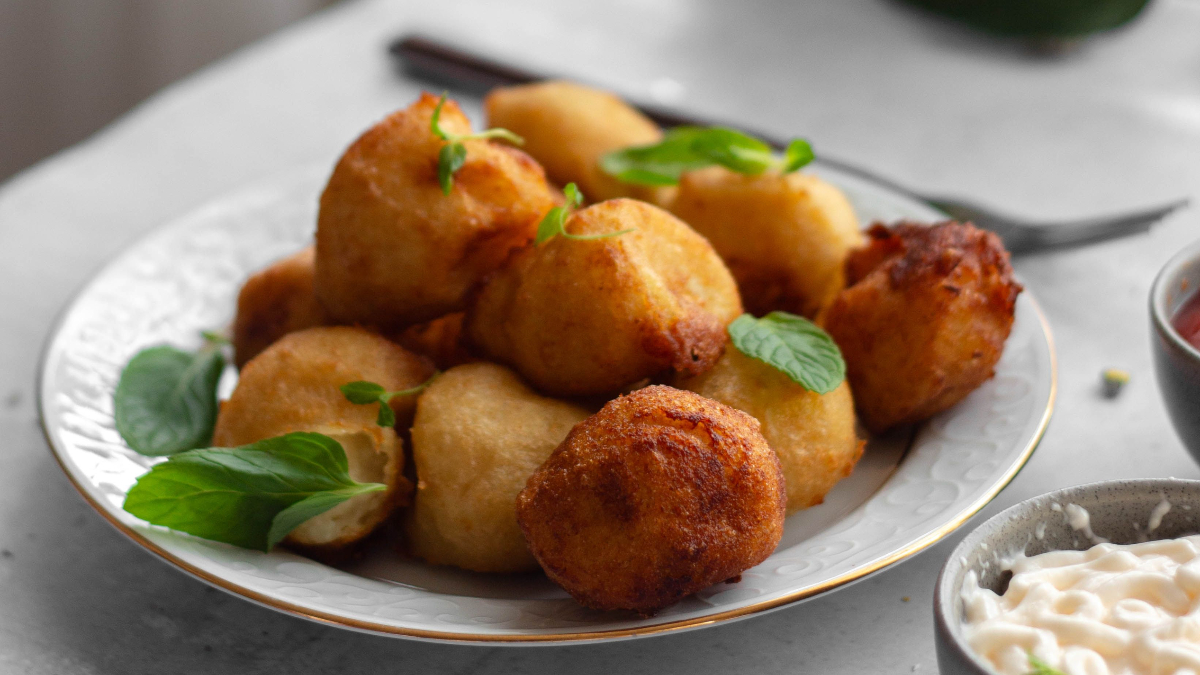
Punugulu is a deep-fried Andhra snack particularly associated with Vijayawada and parts of coastal Andhra, although it is familiar more broadly across Telugu-speaking food culture, including Hyderabad. Small portions of fermented batter are dropped into hot oil and fried until the outside turns deeply golden while the centre remains soft and slightly tangy. It is the kind of food that moves easily between breakfast, evening tea and street snack without seeming misplaced at any of them.
The batter commonly belongs to the same rice-and-urad family used for idli and dosa, seasoned with ingredients such as green chilli, ginger, cumin, curry leaves or onion depending on the household or vendor. Some versions add a little semolina, poha or another dry ingredient to adjust the batter’s body and help the exterior crisp during frying. There is no single canonical formula here, which is part of why punugulu can look slightly different from one stall or kitchen to another.
Its relationship with leftover batter is particularly useful. Safely refrigerated idli or dosa batter that has developed a little more tang can work beautifully here, turning what might otherwise be the unexciting end of yesterday’s breakfast into something people actively want to eat. That kitchen economy is part of the dish’s appeal. A food designed around using what is already there often survives more robustly than one that needs a separate project every time.
The sourness should come from properly handled fermented batter, of course, not from simply leaving batter out indefinitely and assuming more sour always means better. Fermentation and spoilage are not synonyms either.
Punugulu is traditionally served with chutney — peanut or palli chutney is especially familiar, though coconut, tomato and dal-based chutneys all appear — and a hot batch alongside chai belongs very naturally to the evening-snack landscape.
Punugulu brings us back to the fermented rice-and-urad batter already encountered in the Tamil Nadu and Karnataka pieces, so the underlying food science is familiar.
During fermentation, microorganisms use available carbohydrates and produce acids, gases and other metabolites. Enzymatic activity can alter starches and proteins, while research on fermented rice-and-pulse batters has also found reductions in compounds such as phytate and changes in the bioaccessibility of minerals including iron and zinc.
Those are meaningful changes to the batter.
What they do not establish is that every person will necessarily find punugulu easier to digest, or that the snack acquires a special “gut-friendly” status that overrides everything else about how it is prepared. The evidence is much stronger for biochemical changes during fermentation than for broad clinical promises about how one finished dish will make everybody feel.
That is the distinction this whole series has kept returning to.
Researchers have isolated live lactic-acid bacteria from fermented dosa batter and found strains with promising probiotic characteristics in laboratory testing. That tells us something genuinely interesting about the microbial ecology of the raw fermented batter. It does not make every food cooked from that batter a probiotic product.
ALSO READ | Kerala’s Fermented Breakfasts: Appam & Vattayappam, Decoded
The international consensus definition is useful here: fermented foods and probiotic foods are not interchangeable, and a food should only be described as containing probiotics when defined live microorganisms are present in adequate amounts and have demonstrated health benefit. Heat-treated fermented foods remain fermented foods even when viable microbes are no longer present.
Punugulu is deep-fried. Whatever microorganisms helped create the batter, the finished snack should therefore not be treated as a reliable source of live probiotic cultures.
The fermentation still mattered. It just mattered before the frying.
EXPERT LENS | What Survives a Cooked Fermented Food?
Fermentation can leave behind much more than living microbes. Before cooking, microorganisms may already have produced organic acids and other metabolites, changed the batter’s physical structure and altered the availability of particular nutrients.
This is why a cooked fermented food can still be meaningfully different from an unfermented one without needing to contain live probiotics. “The bacteria are dead, therefore fermentation no longer matters” is no more accurate than “it was fermented, therefore the finished food must be probiotic”.
This is where Punugulu earns a genuinely different place in the four-part series.
Idli is steamed. Dosa and uttapam are cooked on a griddle. Paniyaram cooks in an oiled cavity pan. Punugulu is submerged in hot oil.
Deep-frying therefore introduces cooking fat into the food in a way steaming does not. But I would resist turning this into a neat numerical hierarchy in which punugulu must always contain exactly X times more fat than paniyaram or dosa. Oil uptake during frying depends on the food’s composition and surface, frying temperature and time, crust formation, draining and other preparation variables.
So the accurate statement is the simpler one: punugulu is a deep-fried snack and should be understood as one.
That does not make it nutritionally worthless. It also does not become “light” because the batter fermented first. Those two facts can sit beside each other without requiring a verdict.
This is perhaps the neatest place to end the larger series, because the same broad fermented rice-and-urad tradition can become foods with strikingly different identities:
| Dish | What Happens After Fermentation | What That Changes |
|---|---|---|
| Idli | Steamed in moulds | Soft steamed texture; no frying fat required |
| Dosa | Spread thin on a griddle | Crisp, broad surface; added oil or ghee varies |
| Uttapam | Kept thick on a griddle | Soft pancake-like texture; toppings cook into the surface |
| Paniyaram | Cooked in an oiled cavity pan | Rounded pieces with browned surfaces; oil use varies by preparation |
| Punugulu | Deep-fried in hot oil | Crisp exterior, soft centre; frying introduces cooking oil into the finished snack |
The batter does not tell you the whole nutritional story. Neither does the cooking method on its own. What you eat is the product of both.
Leftover, safely refrigerated idli or dosa batter is the obvious starting point and a very practical one. Slightly tangier batter can suit punugulu particularly well, although you do not need to wait for a particular number of days or deliberately over-ferment it to make the dish.
Season it according to preference — onion, green chilli, ginger, cumin and curry leaves are all familiar additions — and adjust the consistency if necessary so that small portions hold together when they hit the oil rather than spreading apart.
Frying temperature matters. Oil that is not hot enough can leave the food greasy and poorly set; excessively hot oil can brown the exterior before the centre has cooked. Frying in manageable batches also helps the temperature remain more stable.
Once cooked, allow the excess surface oil to drain before serving. The point is not to engineer the fat out of a fried snack until it stops being the thing you wanted to eat. It is simply to cook the food well.
Punugulu is a particularly good final stop for this series because it makes the central lesson impossible to miss.
The same broad fermented batter can become a steamed idli, a thin dosa, a thick uttapam, a cavity-pan paniyaram or a deep-fried punugulu. Fermentation happened before all five, but what happens after fermentation changes the finished food just as meaningfully.
Punugulu should not be sold as a probiotic snack simply because the batter fermented, nor does fermentation turn deep-frying into something other than deep-frying. But neither fact makes the dish somehow nutritionally illegitimate.
The honest reason to eat punugulu is simpler: it is a very good use of fermented batter, it belongs to a living Telugu food tradition, and — served hot with chutney while the outside is still crisp — it is delicious.
Across four states and four pieces, that may be the more useful conclusion anyway. Fermentation is a process. It changes food. It does not need to become a health halo before the food itself is worth understanding.
Punugulu is commonly made with fermented rice-and-urad batter of the same broad type used for idli and dosa. It may be seasoned with ingredients such as onion, green chilli, ginger, cumin and curry leaves before being deep-fried into small dumplings.
“Healthy” is not especially useful as a yes-or-no label here. Punugulu begins with a fermented cereal-and-pulse batter and is then deep-fried, so both parts of that description matter. It can fit into a varied diet, but it should be understood as a fried snack rather than presented as a low-fat food because its batter happens to be fermented.
Yes. Using safely refrigerated leftover idli or dosa batter is a common and practical way to make it, and slightly tangier batter can work particularly well with the dish.
The finished dish should not be treated as a probiotic food. Live microorganisms may be present during batter fermentation, and researchers have isolated strains with probiotic potential from fermented dosa batter, but punugulu is then deep-fried at high temperature. Fermented foods and probiotic foods are not automatically the same thing.
Fermentation changes the rice-and-urad batter and can alter starches, proteins, phytate and mineral bioaccessibility. Research supports those biochemical changes, but there is not enough direct evidence to promise that every person will find the finished punugulu easier to digest.
Not exactly. Bonda refers to a broader family of fried snacks made from several different batters, doughs or fillings and does not necessarily imply fermentation. Punugulu is more specifically associated with a rice-and-urad batter preparation in Andhra cuisine.
No. It can appear at breakfast, but it is equally at home as an evening snack or street food, particularly in Andhra Pradesh. That flexibility is part of why it sits slightly differently from the breakfast-centred dishes elsewhere in this series.