Goan Bebinca: Ingredients, Layering Technique And Portuguese Influence
Egg yolks, coconut milk, ghee and patient baking: discover what gives bebinca its layers and its place in Goan celebrations.
Table of Contents
Bebinca is a traditional Goan layered pudding made with egg yolks, coconut milk, wheat flour, sugar and ghee. Its thin layers are baked one after another in the same pan.
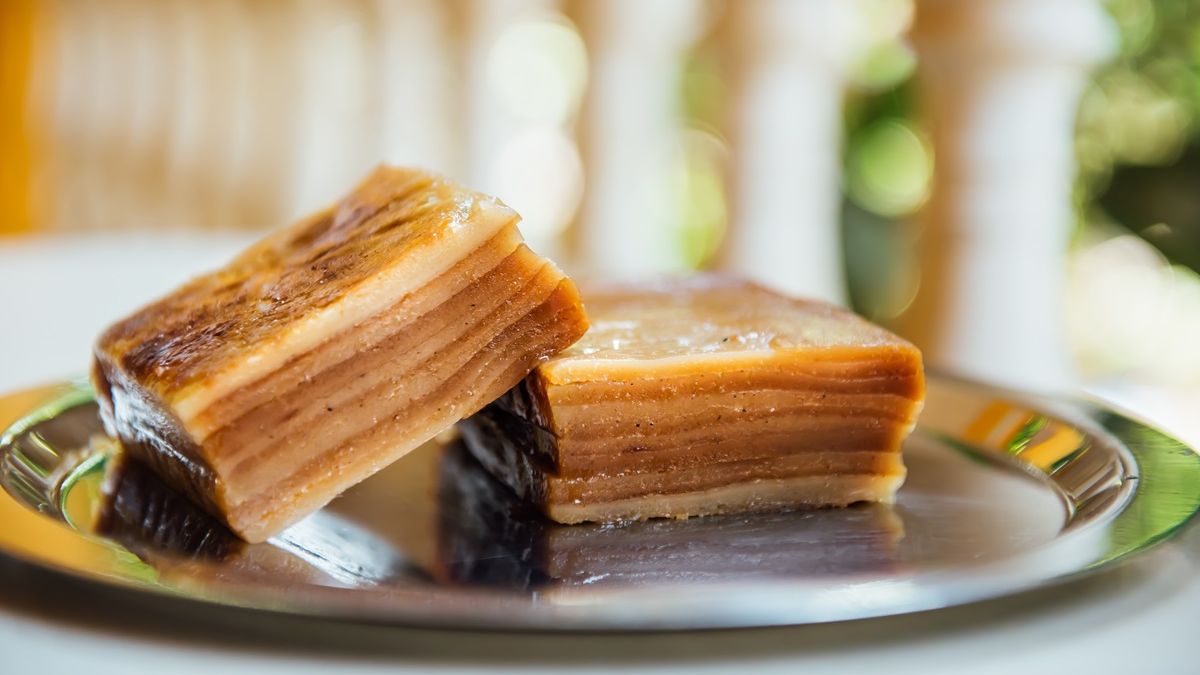
A slice of Goan bebinca is pretty recognisable long before you even take the first bite. Its alternating bands of golden brown and pale caramel look almost like a mathematician’s dream cross-section of a carefully constructed pudding. But these layers are not from different desserts or sources; they are made from the same batter, patiently cooked one after another in a single piece of cookware. Each new addition goes over a surface that has already set and browned, with ghee being generously brushed between the layers. The result is rich, gently chewy and fragrant, with a lightly caramelised finish that is very different from an ordinary sponge cake, with a special culinary identity of its own.
Bebinca is one of Goa’s most iconic traditional sweets, closely interwoven with the essence of Christmas, weddings, and celebratory meals for Goans. Its ingredients reflect the coastal pantry authentically, highlighting the utility of coconut milk, egg yolks, wheat flour, sugar, and ghee, with spices such as nutmeg or cardamom, for this layered dish. Plus, Bebinca’s technique also showcases a unique culinary history that has been culturally shaped by centuries of exchange between local Goan kitchens and Portuguese-era food traditions. Popularly crowned the queen of Goan sweets, the dessert’s appeal is not just its richness or stunning appearance. It is also the fruit of patient cooking and a lot of effort, as the batter must be consistent, each layer should get adequate time to attain the desired cooked colour, and the heat must be controlled so that the base does not burn while the upper layers are still being made.
Traditional bebinca recipes use a fairly short ingredient list: egg yolks, coconut milk, wheat flour, sugar and ghee. Some recipes include nutmeg or cardamom, but these spices should not dominate the flavour of the bebinca. The proportions and quality of the main ingredients are important.
Egg yolks contain proteins that set during cooking, helping bebinca’s layers hold together. They also contain fat, which gives the dessert a fuller mouthfeel. Lecithin, a natural emulsifier in egg yolks, helps fat- and water-based ingredients combine more evenly.
Coconut milk is central to bebinca’s characteristic flavour and rich texture. Replacing it entirely with dairy milk would change the dessert’s coconut flavour. Traditionally, freshly extracted coconut milk is used. The first extraction is thicker and more concentrated than later extractions. Recipes use these in different proportions, and the yield depends on how much water is added during extraction. The batter therefore needs to be judged by its consistency, rather than by assuming every coconut yields the same quantity of milk.
Wheat flour, usually maida, is used to give the batter enough structure to form slices rather than remaining a loose custard. It also helps create the characteristic dense, slightly chewy bite. But remember, moderation is the key to success, as too much flour can make the finished dessert heavy or doughy, while too little may leave the layers too delicate and fragile. The batter needs to be smooth and pourable, without lumps that could cause uneven patches during cooking.
Sugar does more than sweeten the dessert. As each thin layer cooks, the sugars contribute to browning and the development of caramel-like aromas. The degree of browning is important: a properly cooked layer should be golden to deep amber, not pale and underdone, but it should not taste acrid or burnt either.
Ghee is used between the layers and is one of the most important ingredients in the technique. It adds its own nutty aroma and richness, but it also helps create a distinct boundary between successive cooked surfaces. A thin, even coating is more useful than allowing the fat to collect in pools.
The defining feature of bebinca is its repetitive and long cooking process. Unlike a layered celebration cake, where separate sponges are stacked together with cream or icing, bebinca is built inside one cooking vessel. A measured quantity of batter is poured into a greased pan and cooked until its upper surface sets and turns golden. Then ghee is added, followed by another portion of batter, and the process is repeated. This continues until the desired height of Bebinca is reached. A recipe published by the ICAR-Central Coastal Agricultural Research Institute (ICAR-CCARI) specifies layers that are roughly a quarter-inch thick and have been cooked under a grill until golden before the next batter portion is added.
It also advises monitoring the surface frequently and consistently, since the difference between deep caramelisation and burning is very small. The reason for cooking each layer separately is visible the moment you cut a slice. Since the first portion of batter sets and develops a browned surface before the next layer is spread over it to cook into another distinct band, repeating this process creates the beautiful stripes that make bebinca so recognisable. Inclusion of ghee between every layer contributes to their separation and prevents the dessert from becoming one uniform block. So, it comes as no shock that heat management is crucial to acing this iconic dessert.
In many traditional methods, heat from below helps the first layer cook through and establish a firm base. However, subsequent layers are often browned using heat from above, so that the already cooked layers are not exposed to prolonged direct heat from the bottom. In older cooking arrangements, this could mean using an earthen oven with firewood below and embers on the lid. In these arrangements, the heat beneath the vessel is removed after the first layer to help prevent the base from burning. Nowadays, modern ovens and grills make the process even more accessible and kitchen-friendly, but you will still need to judge each layer individually. Always add the next portion of batter only after the preceding surface has properly set to support it.
A popular legend traces the origin of bebinca to Sister Bebiana at the Convento de Santa Mónica in Old Goa. According to this story, she created the dessert using egg yolks left over after egg whites had been used to starch convent garments. In one version of the story, her seven layers are said to represent the seven hills of Lisbon and Old Goa. It is a memorable story, but it should be treated as a popular origin legend rather than an established historical fact.
Some recipes use seven or eight layers, while others build more, depending on the size of the pan, the amount of batter and the cook’s preferred presentation. What matters technically is that the layers are evenly cooked and clearly visible when the bebinca is sliced.
Bebinca shows how Portuguese influence helped shape baking and confectionery in Goa, particularly the use of eggs in rich sweets. Describing it simply as a Portuguese dessert introduced to India, however, overlooks its distinct Goan character. The dish brings together egg-rich preparations and layered baking with coconut milk, ghee and other local ingredients.
Goa’s historical recipes help show how dishes from Portugal and other Portuguese settlements were adapted to local conditions and available produce. The dessert’s present-day regional identity is formally recognised as well, since Goan Bebinca received Geographical Indication registration, or GI tag, in 2023, with Goa specified as its geographical area. This recognition places Bebinca among India’s region-specific foods and acknowledges its association with Goan culinary heritage.
Christmas is one of the occasions most closely associated with Bebinca. In Goan Christian households, festive sweet-making can involve several preparations, including dodol (a dense, dark sweet generally made with coconut milk, rice flour and jaggery), neureos (filled pastries), kulkuls (deep-fried pastry curls), and bolinhas (coconut-based biscuits). Bebinca often takes longer than these smaller sweets because every layer has to be cooked and checked individually and patiently. Therefore, it is a preparation that rewards planning, and families may make it ahead of Christmas gatherings rather than leaving it until the day itself. The sweet is also served at weddings and other celebrations. Bebinca’s dense texture makes it suitable for slicing into portions, while its layered appearance gives it a natural place on a festive dessert table. It is often eaten on its own, although a little vanilla ice cream has become a pretty popular contemporary accompaniment. Some prefer it slightly warmed, when the ghee becomes softer and the aroma is more pronounced, while others enjoy it at room temperature, when the layers are firmer and easier to cut cleanly.
Bebinca is a traditional Goan layered pudding made with egg yolks, coconut milk, wheat flour, sugar and ghee. Its thin layers are baked one after another in the same pan.
Each layer must set and brown before the next portion of batter is added. This creates bebinca's distinct bands, while careful heat control helps prevent already-cooked layers from burning.
The number varies. Some recipes use seven or eight layers, while others build more. The pan, batter quantity and cook's preferred finish determine how many layers are made.
A popular legend credits Sister Bebiana, a nun at the Convent of Santa Monica in Old Goa. This is part of local oral tradition, rather than a confirmed account of the dessert's invention.
Yes. Goan Bebinca received Geographical Indication registration in 2023. The official registry lists Goa as its geographical area and gives the certificate date as 1 August 2023.