

Table of Contents
Jowar, bajra and ragi contain broadly comparable amounts of fibre, but differ considerably in flavour, texture and cooking use. Compare the three, and try one simple recipe for each.
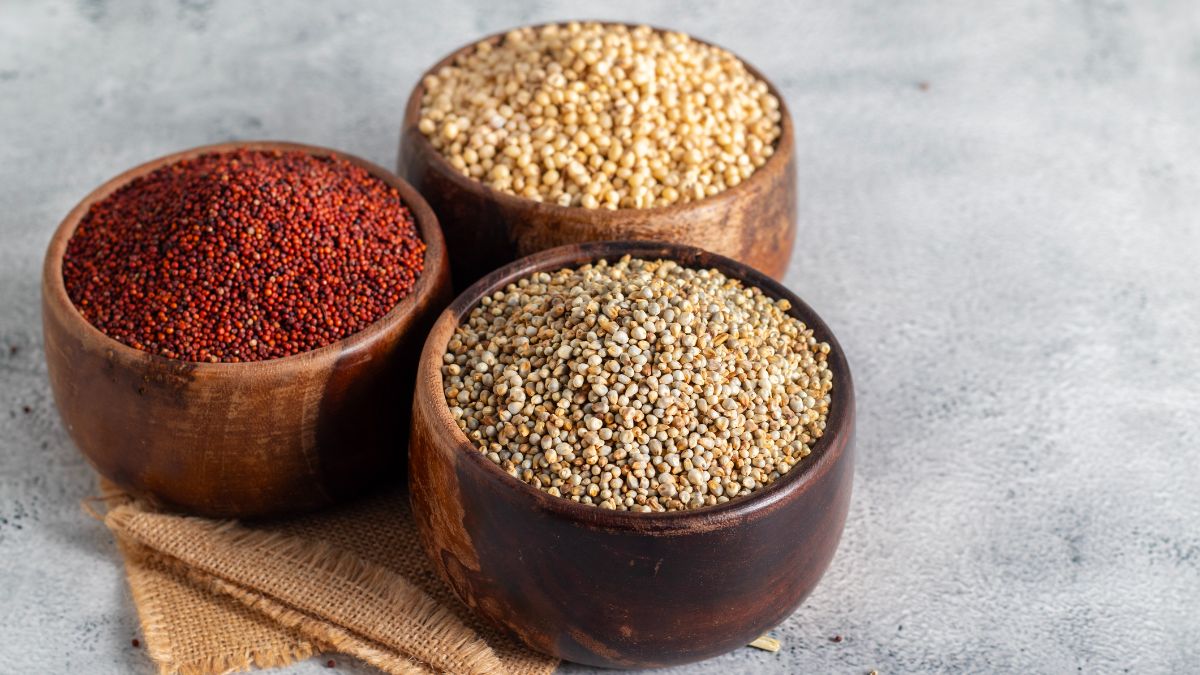
THREE MILLETS, three distinct characters, three different places in Indian culinary tradition — but broadly similar on fibre. Jowar, bajra and ragi are India’s most widely eaten millets, and if you’re trying to understand which one to start with, which suits your cooking style, or why any of them is worth including in a wheat-dominant diet, this piece is the side-by-side guide.
Jowar vs Bajra vs Ragi: How Do They Compare?
Jowar, bajra and ragi contain broadly comparable amounts of fibre. According to the Indian Food Composition Tables 2017, bajra provides approximately 11.49g of fibre per 100g, ragi about 11.18g and jowar about 10.22g. Whole-wheat atta, for comparison, contains approximately 11.36g per 100g.
These are composition figures for 100g of the food, not the amount in one roti or serving. The quantity on the plate depends on how much flour or grain is used. The small differences between the three are not meaningful enough to crown one a universal fibre winner; their more practical differences lie in flavour, texture and the dishes they suit.
| ⓘ The Big Three: Fibre Side by Side Bajra (pearl millet): ~11.49g fibre per 100g Ragi (finger millet): ~11.18g per 100g Jowar (sorghum): ~10.22g per 100g Whole wheat atta: ~11.36g per 100g Figures are based on IFCT 2017. Serving values vary with the quantity used. |
Jowar: Mild-Flavoured and Well Suited to Bhakri
Jowar, or sorghum, has a relatively mild flavour and is widely used for bhakri in Maharashtra and parts of the Deccan. Its gluten-free dough behaves differently from wheat dough and can be more delicate to shape, but the finished bread pairs easily with dal, pithla, chutney and vegetable preparations.
Try It: Simple Jowar Bhakri
You need: 1 cup jowar flour, approximately ¾ cup hot water, a pinch of salt and extra flour for shaping.
Mix the salt into the flour. Add hot water gradually, stirring until cool enough to handle. Knead into a smooth, soft dough and divide into four portions. Pat or roll each portion gently between sheets or on a generously dusted surface. Transfer carefully to a hot tawa. Cook until the surface begins to dry, flip, and cook the other side. Finish briefly over a direct flame where practical, or continue on the tawa until cooked through. Serve hot; millet bhakri becomes firmer as it cools.
Bajra: Earthy, Robust and Suited to Hearty Dishes
Bajra, or pearl millet, has an earthy flavour and works especially well with bold spices, dals and vegetables. It is traditionally made into rotis and bhakris, but using the grain in a soft khichdi offers a less technique-heavy first encounter than learning to shape a gluten-free flatbread.
Try It: Bajra and Moong Dal Khichdi
You need: ½ cup cleaned bajra grain, ¼ cup yellow moong dal, 3½–4 cups water, ½ teaspoon cumin, a pinch of turmeric, salt and 1 teaspoon ghee or oil.
Rinse the bajra and dal. Soak the bajra for several hours or follow the packet instructions, since processing affects cooking time. Heat the ghee or oil in a pressure cooker, add cumin, then stir in the drained millet, dal, turmeric and salt. Add the water and pressure-cook until both are very soft. Adjust with hot water for a looser texture. Serve with curd, chutney or a vegetable preparation.
Use whole bajra grain, not bajra flour, in this recipe.
Ragi: Distinctive and Useful Beyond Roti
Ragi, or finger millet, has an earthy flavour and a darker colour than jowar or bajra. Its particular advantage in a beginner’s guide is not that it is objectively “most versatile”, but that it already appears in several different formats: dosa, idli, mudde, roti and porridge. It is also notably richer in calcium than most other cereals, although it should not be presented as a treatment for calcium deficiency.
Try It: Quick Savoury Ragi Dosa
You need: ½ cup ragi flour, ¼ cup rice flour, 2 tablespoons curd, approximately 1¼ cups water, salt, chopped onion, cumin and coriander.
Whisk the ragi flour, rice flour, curd, salt and water into a thin, pourable batter. Stir in onion, cumin and coriander and rest for 10–15 minutes. Heat a tawa and lightly grease it. Pour the batter from the outside towards the centre rather than spreading it like a conventional dosa. Cook until the edges lift and the surface looks dry; flip briefly if needed. Stir the batter before each dosa because the flour may settle. Serve with chutney or sambar.
Which Millet Should You Try First?
Start with the dish, not a nutritional ranking.
Choose jowar if you want to try a relatively mild millet bhakri with accompaniments your household already enjoys. Choose bajra if earthy flavours and soft khichdi-style dishes appeal to you. Choose ragi if dosa, porridge or batter-based preparations feel more approachable than a millet roti.
The best first millet is not necessarily the one with a marginally higher nutrient figure. It is the one attached to a recipe you are willing to make again.
How to Rotate All Three Across a Week
There is no need to use all three millets at once or to remove wheat from the kitchen. One jowar bhakri meal, a bajra khichdi and an occasional ragi dosa already introduce three different grains through three different cooking methods.
Existing habits are the easiest bridge. Someone comfortable making bhakri may begin with jowar; someone who regularly makes khichdi may try bajra grain; someone accustomed to dosa batter may find ragi the least disruptive entry point.
Rotation is useful precisely because it does not demand a permanent winner. A grain earns a place in the pantry when it becomes part of a dish the household actually enjoys—not simply because it has been labelled healthier.
FAQs
What is the difference between jowar, bajra and ragi?
Jowar has a relatively mild flavour and is widely used for bhakri. Bajra tastes earthier and works in rotis, bhakri and khichdi. Ragi has a darker colour and distinctive flavour and is used in dosa, idli, mudde, roti and porridge.
Which contains the most fibre: jowar, bajra or ragi?
IFCT 2017 lists bajra at approximately 11.49g fibre per 100g, ragi at 11.18g and jowar at 10.22g. The differences are small, and all three are broadly comparable to whole-wheat atta at approximately 11.36g.
Are jowar, bajra and ragi gluten-free?
The pure grains are naturally gluten-free. Packaged flours may encounter gluten during milling or handling, and any blend containing wheat is not gluten-free. People with coeliac disease should choose suitably labelled products.
Which millet is easiest to start cooking?
It depends on the dish you already know. Jowar may suit bhakri makers, bajra can be tried in khichdi, and ragi works well in dosa or porridge. A familiar cooking method is usually a better starting point than a universal ranking.
Can jowar, bajra and ragi all be used for roti?
Yes, although none contains gluten, so the doughs behave differently from wheat dough. Traditional techniques often use hot water and hand-patting rather than ordinary rolling.
Can all three be used for dosa and idli?
Ragi is commonly used in dosa and idli preparations. Jowar and bajra can also be incorporated into batters, but recipes and regional usage vary; they are not limited to roti.
Can I eat these millets instead of wheat every day?
They can form part of regular meals, but a complete switch is unnecessary. Rotating wheat and different millets is generally more practical and offers greater culinary variety.
Next Steps
- Do: Scan Your Plate — did a millet show up in your day?
- Ask Happy Tummy GPT: “Which of the three millets should I try in my kitchen?”
- Reflect: “Have you tried jowar, bajra or ragi recently?”
Disclaimer: This article is intended for general educational purposes. Nutritional composition and cooking behaviour may vary according to the grain variety, flour, product and preparation method. People with coeliac disease or another medical need for strict gluten avoidance should check product labelling and cross-contact controls.
Sources:
Indian Food Composition Tables 2017 — ICMR–National Institute of Nutrition
Millet Recipes: A Healthy Choice — ICAR–Indian Institute of Millets Research
Coeliac UK: Guide to Common Plants, Seeds, Grains, Cereals and Flours