Raspberries look like little jewels, but their real appeal is how effortlessly they fit into everyday eating.
They’re sweet-tart and fragrant, and can lift the flavour of breakfast bowls, smoothies, salads, or even simple curd.
Because they feel indulgent, it’s easy to forget they’re still just fruit—best enjoyed within habits that support overall health.
Rather than treating raspberries as a “superfood,” this article takes a realistic view: what they are, how they’re commonly used, and which wellness areas they may support when included regularly.
If you want a subtle, tasty upgrade to your plate, raspberries are worth learning about before you add them to your routine.
Let’s break it down clearly and cautiously.
About Raspberries
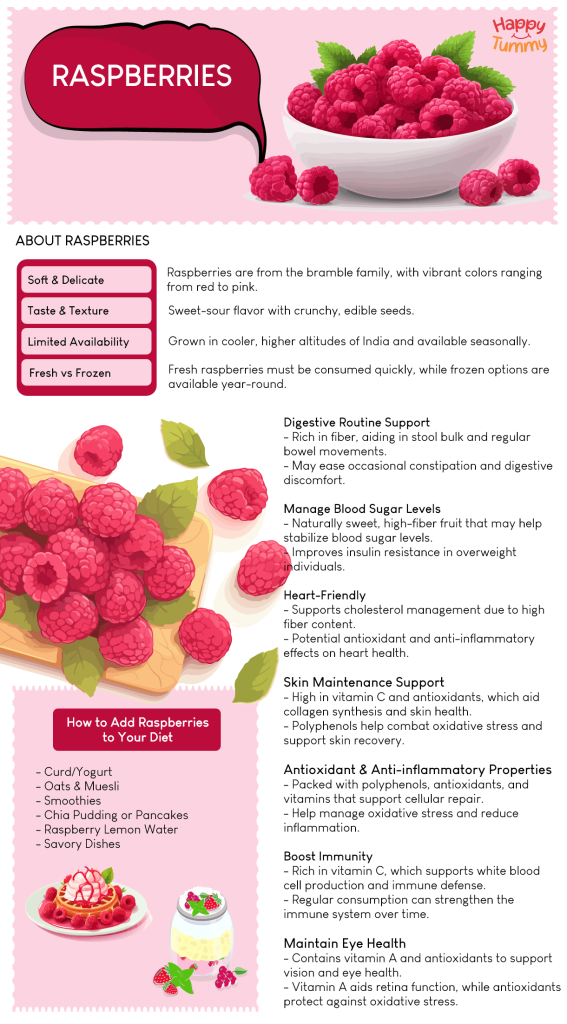
Raspberries are soft, delicate berries from the bramble family; the common red raspberry is Rubus idaeus.
Their colour ranges from bright red to deep pink, and they have a pleasant floral smell, a sweet-sour taste, and tiny edible seeds that also give a crunchy texture.
Raspberries are not so widespread in India, but are cultivated in small areas, mainly in the higher, cooler parts of the country, and on isolated farms by means of covered cultivation, so that they may be seasonal and local in supply.
Fresh berries must be consumed shortly after purchase, whereas frozen raspberries can be used year-round.
Potential Health Advantages of Raspberries
#1 Digestive Routine Support
Raspberries may support digestive comfort because they contain dietary fibre, which helps bulk stools and promote regular bowel movements.[1]
For people aiming to manage occasional constipation or a “heavy” feeling after meals, a fibre-rich fruit can be a gentle, food-first option.
That said, too much fibre too quickly can trigger gas or bloating in sensitive stomachs. Start with a small portion, drink enough water, and increase gradually.
Pairing them with yoghurt can make the snack feel more satisfying.
Raspberries in the form of fermented raspberry juice considerably increase the gut microbial diversity and promote the abundance of beneficial gut bacteria.[2]
Aashirvaad Atta and Multigrains introduced the Digestion Quotient. Now you can take a two-minute quiz to see how well your digestive system is performing.
2. Manage Blood Sugar Level
Raspberries may also act as a suitable option of fruits if you are experiencing energy crashes or sugar spikes following meal intake.
These are naturally sweet and high in fibre, which may delay the uptake of sugars, especially when taken as part of a balanced meal.[3]
Dietary berries have been shown to improve insulin resistance in overweight and obese adults, especially those with insulin resistance.[4]
Raspberries can be added to oats, nuts, or curd and seeds, rather than being served in a large bowl. The portion sizes are also substantial, and individual responses can vary if you monitor glucose levels and track trends.
3. Heart-Friendly
Raspberries might be helpful in heart-healthy dieting, as they can be easily integrated into patterns that support cholesterol management. Their fibre will make you feel fuller and help you eat fewer ultra-processed snacks.
Plant compounds naturally present in Raspberries are also the subject of research on their antioxidant and inflammatory-modulating activities, which researchers attribute to their potential for long-term heart health.
Raspberries may help increase HDL cholesterol, also known as good cholesterol, thereby improving cardiac health. [5]
The potassium content in berries helps regulate heartbeat and blood pressure. Raspberries are rich in minerals like manganese, copper, and iron, which produce red blood cells.[6]
Think of raspberries as one helpful piece: the bigger impact comes from your overall diet quality, activity, and sleep. Embrace diversity daily.
4. Skin Maintenance Support
Raspberries may support skin health because they provide nutrients and plant compounds that are often linked to skin maintenance.
They include vitamin C and antioxidants, which support normal collagen synthesis, and polyphenols, which can help the body cope with oxidative stress.[7]
It does not imply that raspberries cure acne, pigmentation, or ageing, but when combined with other foods on the plate, they can help support the basics, including hydration and general recovery.
Add sufficient protein and healthy fats to make it a more holistic solution.
5. Antioxidant Properties and Anti-inflammatory Properties.
Raspberries contain anti-inflammatory compounds and antioxidants in abundance, and these may help the body against oxidative stress and inflammation.
Polyphenols, vitamins, and minerals present in raspberries aid in cellular repair and recovery, and therefore, are beneficial to health. [8]
Although they do not purport to cure specific disorders, when taken as part of a balanced diet, they may help manage inflammation and protect against free radicals.
This is in combination with other nutrient-rich foods, which only increase their potential value.
6. Boost Immunity
Vitamin C and other nutrients that aid the immune system are closely found in raspberries.[9] Vitamin C is significant in the synthesis of white blood cells and in boosting the body’s defense systems.[10]
A raspberry, when added to a diverse and nutritious diet, would enable you to build your immune system in the long run.
Combine them with other boosting immunity foods, such as leafy greens and healthy fats, to have a balanced approach to immunity.
7. Maintain Eye Health
Raspberries also provide essential nutrients, such as vitamin A and antioxidants, that support eye health.[11]
Vitamin A promotes vision by helping the retina function, whereas antioxidants help protect the retina against oxidative stress that may contribute to other eye diseases, such as macular degeneration. [12]
Although raspberries themselves are not a cure, their presence in a healthy diet rich in nutrients and vitamins benefits the overall health of the eye.
To achieve maximum performance, raspberries should be taken with other foods, such as carrots and leafy greens, to assist the eyes in performing their duties.
How to Add Raspberries to Your Diet (easy + realistic)
- Add to curd/Greek yoghurt with nuts/seeds
- Mix into oats, muesli, or overnight oats.
- Blend into a smoothie (with protein to make it more filling)
- Use as a topper for chia pudding or pancakes.
- Prepare a quick raspberry lemon water.
- Experiment with something savoury: raspberries in salads with paneer/feta, or just a basic berry chutney with mint.
Aashirvaad Atta with Multigrains collaborated with renowned nutritionists to make the My Meal Plan test. The test tells you how much fibre you consume each day, then creates a meal plan tailored to you.
Caution
- Oral allergy syndrome (people with pollen-food allergy syndrome): Individuals are allergic to some foods because of cross-reactivity with pollen. It is commonly accompanied by itching/tingling in the mouth and throat. [13]
- Highly sensitive digestion (IBS): Larger portions of certain fruits can trigger symptoms in some people; starting small is often more comfortable.
- Anyone with a known food allergy: Rare reactions can happen—stop and seek medical advice if you notice symptoms like hives, swelling, or breathing issues.
The Bottom Line
Raspberries are a sweet-tart, versatile berry that can add colour and freshness to meals and snacks.
Used regularly, they may support a few practical wellness goals: helping you manage digestive regularity with fibre, supporting steadier post-meal energy when portions are sensible, and aligning with heart-friendly eating patterns that prioritise whole foods.
Their mix of nutrients and plant compounds may also help skin maintenance over time—without promising dramatic cosmetic changes.
The most helpful way to think about raspberries is as a minor upgrade you can repeat: add them to curd, oats, smoothies, or salads, and keep portions comfortable for your gut.
Most importantly, a balanced diet is the key to long-term well-being, and no single fruit can replace consistent habits.
If you have allergies, IBS, diabetes, or any medical conditions, consult a healthcare professional for personalised guidance.
Choose fresh or frozen for convenience, and focus on variety across fruits, proteins, and grains.
Frequently Asked Questions
1 Are frozen raspberries as good as fresh? Often, yes. Frozen berries can still be a nutrient-rich option, and they’re convenient for smoothies and oats. (Vitamin C can vary with processing and storage.)
2. Can people with diabetes consume raspberries? They might be very suitable since they are high in fibre and may be less harmful to blood sugar when consumed in the right quantities, especially when combined with protein/fat. People react differently, and pairing and portioning are essential.
3. Do raspberry seeds give indigestion? They are usually easy to digest for most, but since some are sensitive, begin with a smaller serving or blending.
4. Can raspberries help with skin “glow”? They provide vitamin C, which is involved in normal collagen formation—so they can support skin nutrition. Just keep expectations realistic: food supports; it doesn’t “transform” overnight.