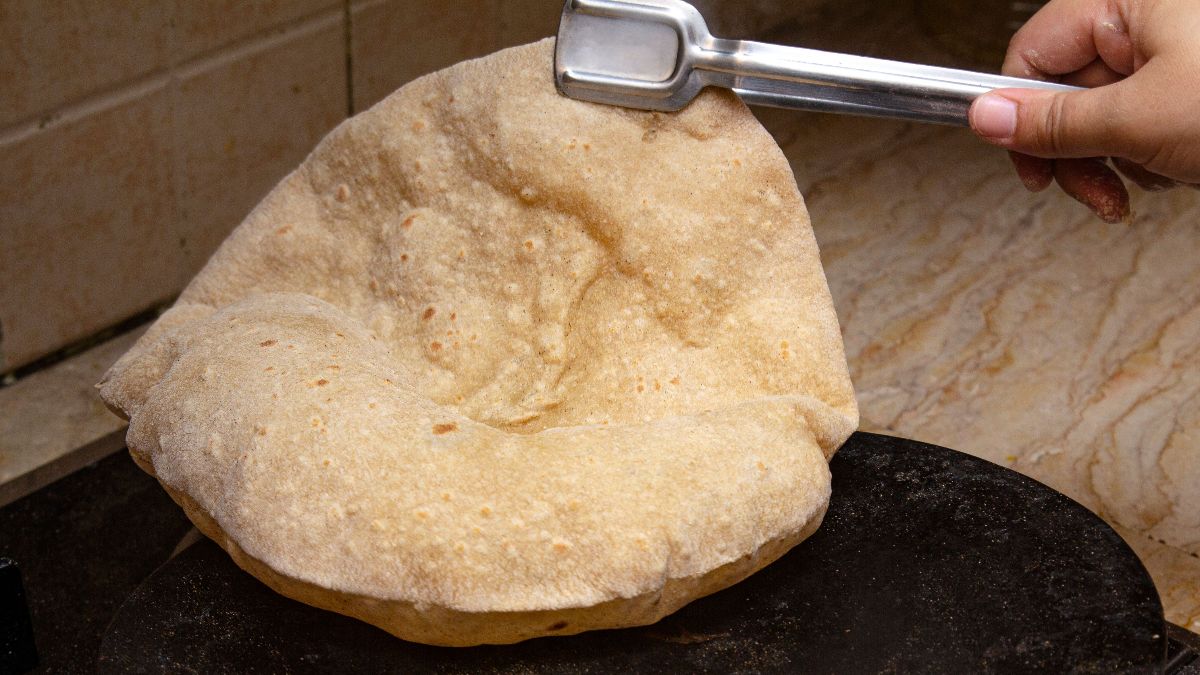
Does a Khapli Roti Need to Puff? What It Tells You About Cooking (Not Nutrition)
A fully puffed roti is satisfying to watch, but it isn't nutritionally superior. Puffing mostly tells you about moisture, rolling and heat — not the goodness of the grain.
For many Indian home cooks, few culinary moments are as satisfying to watch as the sight of a freshly rolled, perfectly round roti puffing over the tawa or flame. A puffed roti has long been treated as a sign of ultimate roti-making skill, earning approving nods from senior family members and awed gasps from younger guests alike.
But when it comes to Khapli wheat, does a roti have to puff up to be considered well made? More importantly, does puffing have anything to do with the roti’s nutritional value?
The short answer is no.
A beautifully puffed roti certainly tells you that several parts of the cooking process have come together well. But it is not a measure of how healthy, wholesome or nourishing the flour is.
Whether you are using regular whole-wheat atta or Khapli atta, puffing is largely influenced by dough hydration, rolling consistency, surface structure, heat management and timing, along with the characteristics of the flour itself.
As more Indian households experiment with ancient wheats such as Khapli, understanding what really makes a roti puff can make the learning curve considerably less frustrating.
Quick answer: Does a Khapli roti have to puff? No. A Khapli roti can be properly cooked, soft and enjoyable even if it only puffs partially or does not balloon dramatically at all. Puffing happens when steam becomes trapped between the cooked layers of the roti. It is mainly a sign that hydration, rolling and heat have lined up well — not a sign that the roti contains more nutrition.
What Is Khapli Wheat?
Khapli wheat, also known as emmer wheat, is one of the older cultivated wheat species and has a long history in Indian food traditions, particularly in regions such as Maharashtra and Karnataka.
Khapli atta has a slightly more grain-forward, nutty flavour than the flour some households may be accustomed to, and its dough can behave differently too. Aashirvaad Namma Chakki 100% Khapli Atta is a whole-grain Khapli wheat flour, and current Happy Tummy information lists its protein at 14.7g per 100g and fibre at roughly 10–11g per 100g.
But the thing that matters most for this particular story is not the nutrition panel. It is that different wheat flours can handle water and dough development differently.
That means first-time Khapli users may find that the amount of water, resting time or rolling pressure they use automatically with their usual atta needs a little adjustment.
A roti that refuses to puff is therefore not necessarily telling you that something is wrong with the grain. It may simply be telling you that the dough and your hands are still getting acquainted.
Why Do Rotis Puff?
Contrary to popular belief, a roti does not puff because the flour is “better”.
As the roti cooks, moisture inside the dough turns into steam. Meanwhile, contact with the hot tawa firms the surfaces of the roti. When enough steam becomes trapped between those cooked layers, the pressure separates them and the roti inflates.
Food-science research on chapati describes exactly this process: the surface sets through heating and starch gelatinisation, steam accumulates inside, smaller air spaces merge and the upper and lower layers separate into one large puff.
This is why several small things have to cooperate:
Properly hydrated dough
Adequate kneading
A useful resting period
Even rolling
A sufficiently hot tawa
Timely flipping
Enough moisture remaining in the roti to generate steam
If one of those variables is slightly off, steam can escape through a thin patch, crack or poorly sealed section before the whole roti has a chance to inflate.
Which is also why people who have been making rotis for thirty years still occasionally produce one that stares back from the tawa completely flat.
Does a Puffed Roti Have More Nutrition?
No.
This is perhaps the most important myth to clear up.
A roti does not become more nutritious because it puffs.
Its nutritional profile comes primarily from the flour and other ingredients used to make it. Puffing is a physical result of steam, heat and dough structure.
Cooking itself can affect moisture and some nutrients — that is true of almost any cooked food — but whether one roti inflates into a perfect balloon while another only develops a few bubbles is not a meaningful nutritional distinction.
So a fully puffed Khapli roti is not “healthier” than an otherwise properly cooked Khapli roti that remained flatter.
The puff is a cooking result.
Not a nutrition score.
Why Might a Khapli Roti Not Puff?
A Khapli roti can fail to puff for many of the same reasons any roti does.
The dough may be too dry. It may not have rested long enough to hydrate evenly. The rolled disc may be thinner at the edges and thicker in the middle. The tawa may be too cool, causing the roti to dry before enough steam builds, or excessively hot, setting and scorching parts of the surface too quickly. And sometimes the first few rotis are simply the price of learning how a different flour behaves.
Khapli dough can absorb a substantial amount of water, and Aashirvaad quality information for the product has reported water absorption around 73%. That does not mean every cook should follow one rigid water ratio — flour storage, climate and technique all affect what the dough needs — but it does explain why copying the exact hydration used for another atta may not always work perfectly.
The practical approach is much simpler: add water gradually until the dough becomes soft and pliable rather than insisting on a fixed measurement.
Does Resting Khapli Dough Help It Puff?
It can help, but not because the dough is fermenting.
A short rest gives the flour time to absorb water more evenly and allows the dough to become easier to handle and roll. Research on wheat dough more broadly shows that resting changes dough structure and rheology, which is one reason bakers and roti makers alike have long allowed dough some time before shaping it.
For Khapli rotis, around 20 minutes is a perfectly reasonable starting point.
Cover the dough after kneading so its surface does not dry out. When you return to it, knead briefly again and check the texture. If it feels stiff or begins cracking during rolling, the issue may still be hydration rather than a mysterious failure of your roti-making abilities.
And importantly:
A 20-minute rest is hydration time, not fermentation time.
Ordinary atta-and-water roti dough is unleavened. You are not waiting for yeast or bacteria to inflate it. The eventual puff comes from steam during cooking.
How to Help a Khapli Roti Puff
If your household enjoys the visual satisfaction of a ballooning roti, there is no reason not to chase it.
Just chase technique rather than nutrition.
1. Get the Dough Soft Enough
Khapli dough should be soft and pliable without becoming so wet that it sticks everywhere.
Add water gradually while kneading rather than pouring in a predetermined quantity at once. Different batches of flour and different kitchens can require slightly different amounts.
2. Give It Time to Hydrate
Cover the kneaded dough and allow it to rest for roughly 20 minutes.
This gives water time to distribute more evenly through the flour and can make rolling easier.
3. Roll as Evenly as You Can
Even excellent dough cannot compensate completely for a disc that is paper-thin in one corner and twice as thick in another.
Use gentle, even pressure and rotate the dough frequently as you roll.
The goal is not Instagram-perfect circularity.
It is reasonably uniform thickness.
4. Don’t Crush the Edges
Very thin edges can set and dry before the rest of the roti is ready, giving steam an easy escape route.
Try not to put all your rolling-pin pressure around the rim.
5. Use a Properly Heated Tawa
If the tawa is too cool, the roti can spend too long drying out before steam has a chance to build.
If it is excessively hot, parts of the surface may scorch before the inside has heated evenly.
A well-heated tawa somewhere around medium-high is usually a much better starting point than either extreme.
6. Flip at the Right Moment
Let the first side develop small bubbles and lose its raw appearance before flipping.
Once the second side has cooked enough to set the surface, the roti can be finished according to your normal method — directly on the flame, on the tawa with gentle pressure, or using whichever technique your household prefers.
There isn’t one sacred second at which every Khapli roti must move to the flame.
The useful skill is learning to recognise when the surfaces have set without allowing the roti to dry out.
What If My Khapli Roti Puffs Only in Patches?
That is completely normal.
Partial puffing generally means steam formed but was able to escape somewhere before the entire roti separated into two layers.
Common causes include:
Uneven thickness
Tiny cracks
Dry patches in the dough
An edge that became too thin
Uneven tawa contact
Timing that was slightly early or late
It does not mean the roti has failed.
If it is cooked through, soft enough to enjoy and tastes good with the dal waiting beside it, it has completed most of the assignment quite successfully.
Softness Matters More Than the Balloon
For everyday eating, softness is arguably a much more useful quality test than dramatic puffing.
A Khapli roti that folds easily, stays tender long enough to reach the table and tastes good with the meal is doing its job.
To help keep rotis soft, avoid unnecessary overcooking and stack them after cooking so they do not lose moisture rapidly. If your household likes ghee on rotis, a light brushing can be added before they are kept covered in a clean cloth or roti box.
A giant puff is gratifying. A dry balloon that becomes cardboard five minutes later is less so.
Khapli Roti Puffing Troubleshooter
What happened?
What may be going on
Roti cracks while rolling
Dough may be too dry or insufficiently hydrated
Edges stay flat
Edges may have been rolled too thin
Only one section puffs
Thickness or tawa contact may be uneven
Roti dries before puffing
Tawa may be too cool or cooking time too long
Surface scorches quickly
Tawa/flame may be too hot
Roti puffs beautifully but becomes tough
It may simply have been overcooked
Roti doesn’t puff but remains soft
Nothing necessarily needs fixing
Khapli Roti Puffing: The Final Verdict
The joy of watching a perfectly round roti puff will probably never fade. It reflects a lovely little convergence of kneading, rolling, moisture and heat.
But it should not become a test the flour has to pass.
With Aashirvaad Namma Chakki 100% Khapli Atta, proper hydration, a short rest, even rolling and sensible tawa heat can all help produce a softer, more evenly cooked roti and improve your chances of puffing.
None of them makes a puffed roti nutritionally superior to a flat one.
So if your Khapli roti rises into a perfect balloon, enjoy the moment. Your technique came together beautifully.
And if it doesn’t, have a look at the texture before declaring defeat.
If the roti is cooked, tender and tastes good, there is very little wrong with it.
After all, the real measure of a good everyday roti is not how much air you managed to trap inside it.
It is whether anyone at the table wants another one.
Frequently Asked Questions
Does a Khapli roti have to puff?
No. Puffing is not necessary for a Khapli roti to be properly cooked or nutritious. A roti can puff partially or remain relatively flat and still be perfectly enjoyable.
Why does a roti puff?
Heat turns moisture inside the dough into steam. Once the outer surfaces have set, the trapped steam can separate the layers of the roti and inflate it.
Why is my Khapli roti not puffing?
Common reasons include dough that is too dry, uneven rolling, a tawa that is too cool or too hot, cracks that allow steam to escape, or simply unfamiliarity with how the flour handles.
Does resting Khapli dough make it puff better?
Resting can improve hydration and make the dough easier to roll evenly, which may indirectly improve puffing. The rest does not work by fermenting an ordinary roti dough.
How long should Khapli roti dough rest?
Around 20 minutes is a useful starting point. The important thing is to keep it covered so it does not dry out and then judge whether the dough has become softer and easier to roll.
Does Khapli atta need more water than regular atta?
It can have different water-absorption behaviour from the flour you normally use. Aashirvaad has reported a water-absorption value around 73% for its Namma Chakki Khapli Atta, but home cooks are better off adding water gradually and judging dough texture rather than relying on one fixed ratio.
Is a puffed roti healthier than a flat roti?
No. Full puffing is not a meaningful marker of nutritional value. The flour and recipe determine the roti’s underlying nutritional composition; puffing mainly reflects how moisture, heat and dough structure behaved during cooking.
Can I puff a roti without putting it directly on a flame?
Yes. Rotis can also puff on a hot tawa, sometimes with gentle pressure using a clean cloth or spatula. Direct flame is a common phulka method, but it is not the only way steam can inflate the roti.
Why does my roti puff but still become hard?
Puffing does not guarantee softness. If the roti spends too long on the heat after its moisture has begun escaping, it can puff successfully and still end up dry or tough.
Disclaimer: This article provides general food and nutrition information and is not a substitute for personalised medical or dietary advice.
You are now being directed to an external website https://www.callr.live/aashirvaadexperts/premium-plan.
This link is provided for your information and convenience only and ITC Limited is not
responsible for the contents or services provided by Brand Touch India or any information that
you share with Brand Touch India.