Have you ever been bloated after a big meal, felt sluggish even though you have eaten enough, or felt less energetic than you would like to feel?
Small day-to-day ailments, such as irregular digestion and lack of appetite, fluctuating energy levels, tend to find their roots in a single system: the Gut.
Modern science now confirms what traditional food wisdom has always said:
Good digestion is central to overall well-being.[1]
Likewise, dietary diversity, sufficient fibre, whole grains, pulses, fruits, vegetables, and fermented foods are identified as an essential part of digestive and metabolic health and central in the ICMR-National Institute of Nutrition (NIN) Dietary Guidelines to Indians (2024).[2]
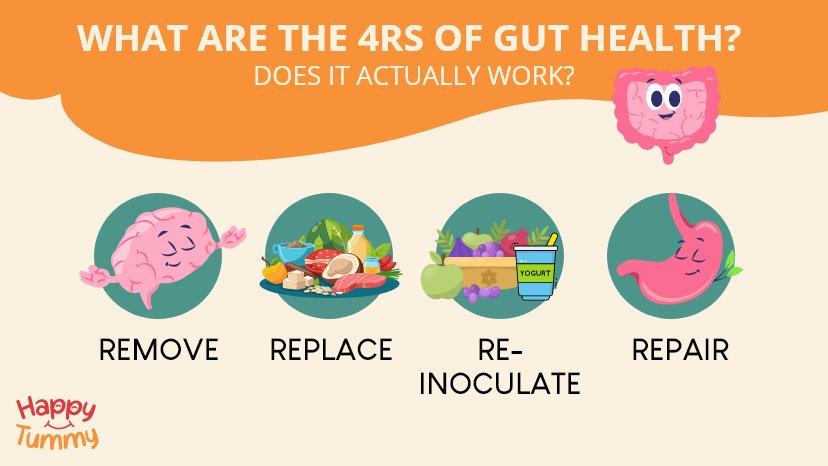
A popular systematic framework that has been explained in conjunction with the growing understanding of the subject of gut health is the 4 Rs framework, which consists of: Remove, Replace, Re-inoculate, and Repair.
The 4Rs model is a functional nutrition framework and not an official medical guideline.
Is it just a craze, however, or does it actually coincide with science?
Let’s explore.
The 4 Rs of Gut Health
1. Remove: Improving Food Quality, Not Eliminating Food Groups
ICMR-NIN (2024) suggests the restriction of extreme consumption of highly processed foods, refined sugars, and energy-dense snacks that do not contain fibre.
When taken regularly, such foods will affect the gut microbial balance. To a lot of Indian families, this step is as simple as:
- Less common use of packaged snacks.
- Eating more freshly prepared meals.
- Keeping a rhythmic meal time.
It also has lifestyle influences. The studies conducted by WHO and NIH point out that long-term stress, sleeping disorders, and inconsistent eating habits are capable of affecting the digestive system.
It is not about elimination but about sensible moderation and balance. [3]
2. Replace: Bringing Back Fibre and Diversity
Suppose there is a single nutrient that is constantly highlighted whenever research on digestive health is conducted, it is dietary fibre.
ICMR-NIN RDA 2020 and Dietary Guidelines 2024 emphasize the importance of proper intake of whole grains, pulses, fruits, vegetables, and nuts to contribute to digestive functions.[4]
Also, WHO, too, prescribes at least 400 g of vegetables and fruits a day for people older than 10years of age. [5]
Fibre is a source of nourishment for good gut bacteria. During fermentation, it generates short-chain fatty acids (SCFAs), which aid in maintaining colon health.[6]
In practice, the change of refined grains to whole grains can be considered a significant move.
As an instance, whole grain daily intake as a part of an overall meal can be supported by adding rotis prepared using whole wheat flour like Aashirvaad Whole Wheat Atta, which is made using whole wheat flour.
According to IFCT 2017, whole wheat includes dietary fibre, B vitamins, and essential minerals.[7]
Also, the substitution of low-fibre dishes with classic ones like roti-dal-sabzi or vegetable khichdi can easily increase fibre diversity without making eating habits more complex.
3. Re-inoculate: Supporting Good Bacteria Through Food
The third R is to support the development of positive microorganisms.
This happens in two ways:
- Prebiotics – fibres that nourish good bacteria.
- Probiotic foods – foods that are naturally fermented and which contain live cultures.
The ICMR-NIN Dietary Guidelines are recommended to educate Indians on the significance of adding fermented food items to their routine meals, including curd and buttermilk. These foods are not new to the Indian culinary practices. [4]
Likewise, pulses, legumes, vegetables, fruits, and whole grains contain prebiotic fibres, which are fermented by helpful bacteria to produce useful compounds.
Growing evidence (NIH) has proved that dietary diversity has a significant contribution towards microbial diversity. This is in line with the principle of encouraging balanced meals and regulating metabolism.[8]
Moreover, customary Indian thalis are already based on such a principle of re-inoculation: grain, dals, vegetables, and fermented curd placed on the same table.
4. Repair: Supporting the Gut Barrier Through Balanced Nutrition
The gut lining is said to be a shield in your body. According to the research conducted by NIH, the intake of sufficient amounts of protein, zinc, vitamin A, and D assists in keeping this lining healthy and ensures that the immune system works properly.[9]
According to the Dietary Guidelines of India (2024), this support should be established by the use of common foods that include pulses, dairy, nuts, vegetables, fruits, and seeds. [4] These are sources of protein, minerals, and essential vitamins, as well as healthy fats that are required for general digestion.
Rather than relying on a single superfood, the healing activity is concerned with consuming mixed meals.
Also, daily habits matter too. Digestion and metabolic well-being can be nourished through regular exercise, rest, and timely, delicious meals.
To put it plainly, there is no quick solution to repair; there is only feeding your body at every regular time with this kind of food and healthy habits.
So, Does the 4 Rs Approach Actually Work?
It’s a fair question. Because there are a lot of wellness trends on the market coming and going, it is only natural to ask whether the 4Rs strategy is actually effective, or just another health buzzword.
The comforting aspect is the following: the power of the 4Rs is the fact that it is not constructed by drastic norms and limiting patterns.
Moreover, every step, such as Remove, Replace, Re-inoculate, and Repair, is a close reflection of the suggestions already bearing the endorsement of such reputable organizations as ICMR-NIN, WHO, and NIH:
- By cutting down on highly processed food and returning to balanced, home-cooked foods, you will increase the general quality of the diet.
- By substituting what is refined with whole grains, pulses, fruits, and vegetables, you get more fibre, one of the most essential nutrients of digestive equilibrium.
- By incorporating fermented food products such as curd and attracting a healthy variety of food, you are assisting positive intestinal organisms.
And when you regularly consume a well-balanced diet, healthy sleeping, and exercise habits, you contribute to the health of your digestive tract.
That is, the 4Rs approach is successful not because it is a new finding, but because it puts the long-established nutrition principles in a neat and easy-to-practice context.
It is not a quick fix. It is not a cure. And neither is it based on extremely leaving things behind. Constant consistency is what makes it effective.
As a result, the health of the gut becomes better when meals are well-balanced, varied, and based on the ancient wisdom of food combined with the latest scientific knowledge.
Bringing It Home: Everyday Indian Plate, Everyday Gut Support
Imagine a simple lunch:
Warm roti, which is whole wheat flour, a bowl of dal, seasonal vegetable sabzi, a small portion of curd, and a side salad.
This meal reflects:
- Fiber from whole wheat and vegetables.
- Protein from dal
- Fermented food from curd
- Micronutrient diversity
Simply put, with the traditional balanced meals, there is already 4 Rs implementation with no need to name it so.
Gut health is not a fad. It involves coming back to food diversity, mindful eating, and simplicity.
Aashirvaad Atta Multigrains has developed the Digestion Quotient. This short 2-minute survey will help you evaluate your digestive system’s well-being and provide a digestion score based on your answers. Take the test today and have more information about your digestive health!
Practical Application for Indian Households
Here is how the 4 Rs can be realistically incorporated into daily meals:
Morning
- Whole wheat roti or vegetable upma
- Curd or buttermilk
- Seasonal fruit
Lunch
- Roti made with whole wheat flour such as Aashirvaad Whole Wheat Atta
- Dal or chole
- Mixed vegetable sabzi
- Salad
Evening
Dinner
- Vegetable khichdi or roti-sabzi
- Light fermented accompaniment (if suitable)
Aashirvaad Atta with Multigrains has partnered with leading dietitians to launch the My Meal Plan Test to determine your daily fibre intake. It will provide you with a diet plan tailored to your needs and help enhance your health and nutrition.
Frequently Asked Questions
1. How long does it take to notice changes in gut health after following the 4 Rs approach? Not all humans have the same response to digestion.
According to studies conducted by the National Institutes of Health (NIH), dietary interventions, in particular, the addition of fibre, have the potential to modify the microbial composition of the gut in a few days to a few weeks.[10]
Nevertheless, long-term and permanent enhancement of the digestive system generally presupposes the regular following of balanced eating habits, hydration, and persistence of the lifestyle in the long term.
2. Is the 4 Rs approach suitable for everyday Indian diets? Yes. As a matter of fact, the 4 Rs guests most of the traditional Indian meals. Indian dietary patterns already include whole grains, pulses, seasonal vegetables, fruits, nuts, and fermented food products such as curd.
Roti prepared using the whole wheat flour, dal, sabzi, salad, and curd provides the fibre content, dietary diversity, and digestive harmony without special dietary patterns.
3. Do I need probiotic alternatives for gut health? Existing dietary principles give more preference to food-based interventions.
In the dietary guideline on Indians introduced by ICMR-NIN, the consumption of naturally fermented foods like curd and buttermilk is suggested in the list of daily meals.[4]
According to WHO and NIH studies, dietary diversity and intake of fibres are the basis of maintaining the balance of microbes in the gut.
However, other alternatives do not necessarily have to be recommended on any regular basis unless a qualified healthcare professional recommends that.
4. Can fibre intake really make a difference to digestion? Yes. Fibre is a nutrient in digestive health that is researched the most.
WHO and ICMR-NIN guidelines claim that sufficient fibre from whole grains, pulses, fruits, and vegetables constitutes bowel regularity and aids in nourishing the advantageous gut bacteria.
One should eat these foods with other combinations of foods in a balanced diet, as this helps in maintaining a healthy digestive system.