What Your Gut Wishes You Knew Before Your Weekend Food Binge
Monday to Friday: virtuous, restrained, proud of yourself. Saturday lunch: you have eaten three servings of everything and are lying on the couch wondering what happened. Your gut was not surprised.
Monday to Friday: virtuous, restrained, proud of yourself. Saturday lunch: you have eaten three servings of everything and are lying on the couch wondering what happened. Your gut was not surprised.
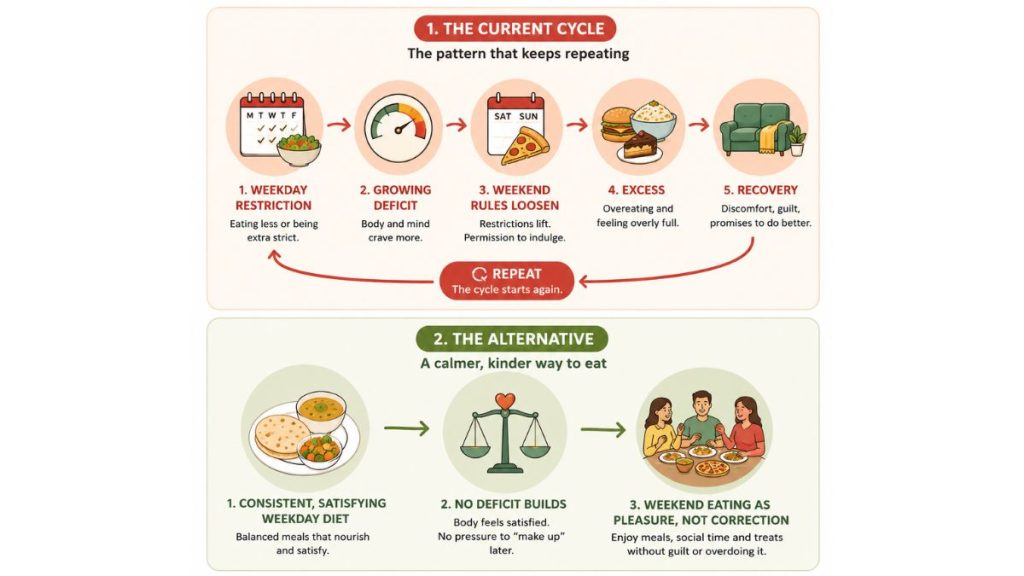
Here is how the week usually goes. Monday through Friday, you are broadly keeping it together. Reasonable meals, not too much of anything, perhaps even slightly smug about your discipline. And then the weekend arrives. The restrictions lift, or the social occasions appear, or you are just so tired of being sensible that the pendulum swings hard in the other direction. By Sunday evening you are somewhere between genuinely full and faintly regretful, and your gut is doing the specific work of processing two days of eating that undid five days of moderation.
Your gut is not judging you. It is just trying to tell you that the pendulum swing itself is the problem — not the weekend eating, but the cycle.
Why the binge-restrict cycle happens
The weekend food binge is almost always a response to weekday restriction, even mild restriction. When the body is held back during the week — slightly less than it wanted, slightly more controlled than its natural appetite, slightly more disciplined than it would otherwise be — it accumulates a deficit that the weekend feels like permission to address. The loosening of the rules does not produce moderate eating. It produces the specific excess that follows deprivation.
This is not a character flaw. It is a predictable physiological and psychological response to constraint. The stricter the weekday eating, the more pronounced the weekend swing tends to be. It is the body’s way of balancing the account. The problem is that the balance looks less like gentle correction and more like Saturday biryani followed by Sunday cheese toast followed by ordering one more thing because you are already off track and you might as well.
Why do I overeat on weekends? Weekend overeating is almost always a response to weekday restriction, even mild restriction. When the body holds back during the week, it accumulates a deficit that feels like permission to address when the rules loosen. The stricter the weekday eating, the more pronounced the weekend swing tends to be. It is the body balancing the account — a predictable response, not a character flaw.
What the gut experiences during a binge
A large meal produces large demands on the digestive system. Gastric acid production increases. The stomach expands beyond its comfortable capacity. Digestive enzymes work overtime. The small intestine receives more material than it can process efficiently at once. The gut’s normal rhythm — process, pass, move on — is disrupted by the volume.
The specific discomforts that follow a weekend binge — the heaviness, the bloating, the feeling that something is just sitting there, the sluggish Monday morning that has nothing to do with sleep — are the gut’s honest accounting of what it had to process. It is not punishment. It is just the physics of overloading a system that has a comfortable operating range.
And then there is the microbiome dimension. A weekend of significantly different eating — more processed food, less fibre, different combinations — produces shifts in gut bacterial populations that the weekday routine then has to recover from. The gut that was running steadily on its weekday diet needs several days to reestablish its preferred balance after a significant disruption.
The solution is not more discipline. It is less.
The counterintuitive answer to the weekend binge cycle is to loosen the weekday restrictions rather than tighten the weekend ones. A weekday diet that is satisfying, nourishing, and not experienced as deprivation produces a different weekend. The account is not in deficit. There is nothing to balance. The weekend meal that used to be a release valve becomes simply a pleasant meal.
This is where the quality of the everyday meal matters more than the quantity. A weekday lunch of rotis from Aashirvaad Chakki 100% Khapli Atta with a proper dal and a vegetable — eaten with some attention at a consistent time — does not produce the dietary dissatisfaction that ends in Saturday excess. It produces a week that feels adequately fed, which is the only foundation needed for the weekend to stop being an event.
This is the argument for Aashirvaad Chakki 100% Khapli Atta in the weekday diet: stone-ground from Emmer wheat, with the bran and germ intact, it produces a roti that sustains because of how the grain is processed, not how many you eat. Not because Khapli is magical. Because a meal that genuinely satisfies does not create a deficit that the next available opportunity has to fill.
On the weekends themselves
None of this means the weekend food should be joyless or carefully managed. The biryani is fine. The cheese toast is fine. Eating more freely on weekends is a completely reasonable approach to a balanced life. The gut’s objection is not to the weekend food. It is to the whiplash — the extreme of restraint followed by the extreme of excess, week after week, producing a gut that is never quite in its comfortable stride.
The weekend binge is not a weekend problem. It is a weekday problem. Feed yourself properly Monday through Friday and Saturday takes care of itself.
Your gut wishes you knew this not to make you feel guilty about the biryani, but to give you a way out of the cycle. The cycle is exhausting. There is a calmer version of the week available, and it starts with Monday’s lunch.
This article is part of the What Your Gut Wishes You Knew Before… series on Happy Tummy. For general informational purposes only — not medical or dietary advice.
You are now being directed to an external website https://www.callr.live/aashirvaadexperts/premium-plan.
This link is provided for your information and convenience only and ITC Limited is not
responsible for the contents or services provided by Brand Touch India or any information that
you share with Brand Touch India.