The Lunchbox Gut Check: What Makes a School Meal Feel Good?
What makes a school lunch easier on a child's gut? Explore the role of balanced food choices, water, eating pace, toilet habits and helping children understand their lunchbox.
Table of Contents
The school lunchbox is a fixed plate. Unlike a home meal, there’s no opportunity to add more dal or grab water from the tap if something’s missing. What goes in is what gets eaten — or doesn’t. And for most children, lunch is the meal eaten fastest, with the least adult supervision, at a table that may or may not be a calm eating environment. Getting the lunchbox right isn’t about perfection; it’s about a few deliberate choices that make it more likely lunch will leave a child comfortable, energised and not hungry again before the last class.
We’ll apply the same four-part plate framework this platform uses for adult meals to the specific context of a child’s school lunch: a whole grain, a protein or pulse source, a vegetable or fruit, and water. We’ll also look at what makes school eating different from home eating — timing, pace, environment — and how to talk to a child about why the lunchbox is packed the way it is, so that eventually they can think about it themselves.
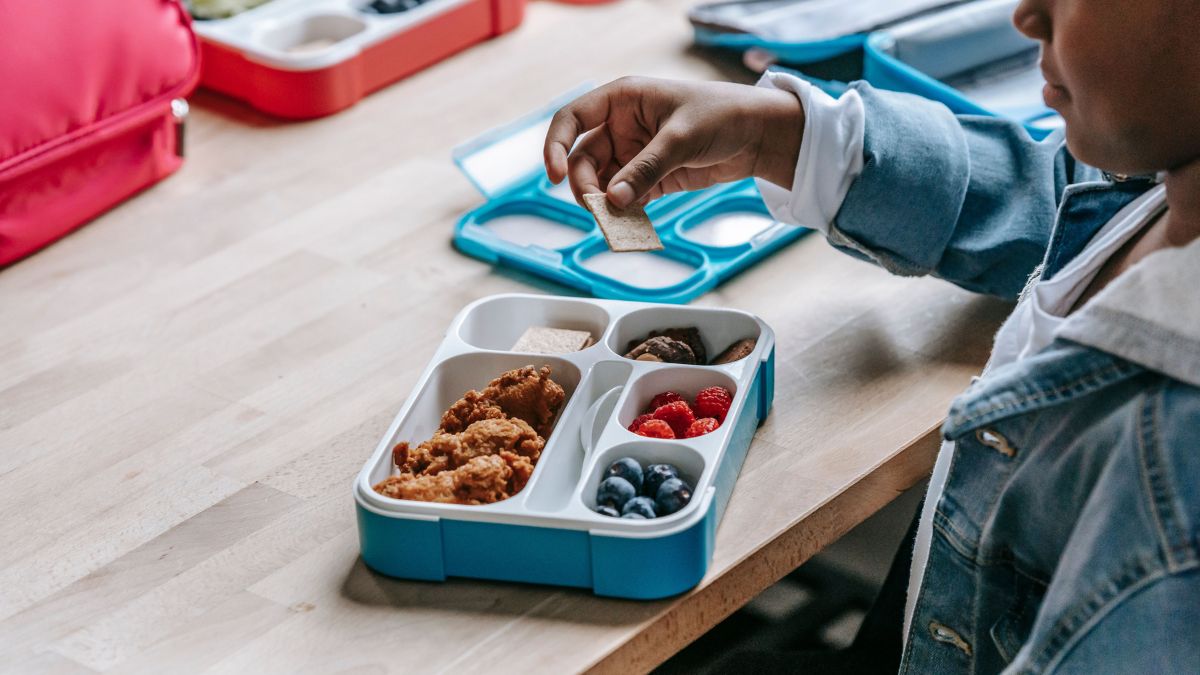
The same logic that makes an adult roti-dal-sabzi meal a reasonably complete plate applies to a lunchbox: a grain, a protein or pulse, a vegetable or fruit, and something to drink. In a lunchbox format, this might be rotis with a dal or paneer filling, a small portion of cooked vegetables or a piece of fruit, and water. None of this requires elaborate preparation; it requires one deliberate decision per part. The part most commonly missing from Indian children’s lunchboxes is the vegetable — which is also the most fibre-dense and the most likely to keep a child comfortable and full through the afternoon.
| ⓘ The Four-Part Lunchbox Check 1. A whole grain: roti, rice, dalia, multigrain or millet-based preparation 2. A protein or pulse source: dal, paneer, egg, chana, moong — keeps energy stable 3. A vegetable or fruit: the most commonly missing part; the most fibre-dense 4. Water, or a reminder to drink: essential alongside any fibre-containing food A lunchbox that covers all four is doing the job. A lunchbox that covers two or three is doing most of it. A lunchbox that’s rotis and pickle is doing one part. |
Many children at school avoid using the toilet, particularly for a bowel movement. Unfamiliar toilets, lack of privacy, the social risk of being seen going, and limited time between lessons all contribute to children actively suppressing the urge to go during the school day. This is worth knowing about as a lunchbox consideration, because a fibre-rich lunch eaten quickly and then suppressed for six hours while the child waits to get home is not an optimal situation for that child’s gut. It’s also worth talking about explicitly: letting a child know that using the school toilet for a poo is fine, normal and not embarrassing is a more effective intervention than any lunchbox adjustment.
School lunch is often the most rushed meal of the day: a fixed window, a noisy environment, friends to talk to, and the awareness that playtime begins when eating finishes. Many children eat in under ten minutes. As this platform has covered extensively in the Tummy Moods series (The Rushed Tummy), eating quickly means swallowing more air, missing fullness cues, and arriving at the afternoon in a state the gut hasn’t quite settled from. There isn’t much a parent can do about school canteen timing — but knowing this is the environment is useful context for why an afternoon snack after school is often genuinely needed, and why a child’s appetite at dinner may vary significantly depending on how lunch went.
Children who understand why something is packed are more likely to eat it than children who are simply told it’s good for them. ‘Dal keeps your energy going so you’re not hungry in maths’ is a more motivating explanation for a seven-year-old than ‘it has protein’. ‘A fruit gives your tummy something to work with after lunch so it doesn’t get grumpy by 3pm’ is better than ‘eat your fruit’. The language doesn’t have to be clinical; it has to be honest and specific. This series’ vocabulary piece (Piece #2) gives the tummy words that make this conversation easier.
| ⓘ Phrases That Work When Explaining the Lunchbox‘ “The dal keeps your tummy comfortable so you’re not hungry in the last class.” ”Fruit gives your tummy something easy to work with in the afternoon.” “Water helps everything move, so you don’t feel heavy after lunch.” “Rotis are what gives you energy — without them you’d run out by 2 pm.” None of these is a lecture. Each one is a one-sentence answer to the question ‘why do I have to eat this?’ |
The walk home or the drive back from school is often the moment when a child is most willing to talk, and the gut is a useful, non-threatening entry point. ‘How did your tummy feel at lunch today? Comfortable? Full enough? Still hungry by last class?’ These questions, asked regularly, give a parent data on how the lunchbox is actually landing, what the child is eating versus leaving, and whether anything in the school eating environment needs to change. They also practise exactly the vocabulary this series is trying to build. A child who has been asked these questions regularly enough will start volunteering the information without prompting — which is the whole goal. The lunchbox is a daily event with daily feedback available, and the after-school question is the simplest way to collect it.
A lunchbox that comes back uneaten most days is information worth responding to. It might mean the child isn’t hungry at lunchtime (which can have many causes: a large breakfast, anxiety, friendship dynamics at the table, disliking something in the box). It might mean the eating window is too short to finish. Or it might mean the child is genuinely unwell in a way that’s suppressing appetite. The conversation to have is curious and non-pressuring: ‘What did you eat? Did your tummy feel full enough? Were you hungry after school?’ — not a reprimand about wasted food. Patterns over time are more informative than any single day, and the questions are more useful than the instruction.
A child who regularly comes home from school complaining of stomach pain, who consistently doesn’t eat their lunch, or who has clear patterns of discomfort associated with school meals deserves a proper evaluation rather than a lunchbox adjustment. This piece is about the ordinary range of school lunch experiences; it’s not a diagnostic guide. Persistent, severe, or patterned gut symptoms in a school-age child are worth raising with a GP.
Disclaimer: This article is for general informational purposes only — not medical or dietary advice.
The same four-part plate logic as any other meal: a whole grain, a protein or pulse, a vegetable or fruit, and water. The vegetable or fruit is the most commonly missing part in practice.
Often because of eating pace — school lunch is typically rushed. Some hunger on arriving home is normal. An after-school snack with both a grain and a fruit or vegetable is a reasonable response.
Explain why each part is there in terms they relate to: energy, comfort, not being hungry in the last class. One honest sentence per item works better than 'it's good for you'.
No — fibre-containing foods (dal, roti, vegetables, fruit) are appropriate for children's lunches. The water reminder matters more: fibre without fluid can cause discomfort.
Toilet shyness at school is very common. Explicitly normalising it at home — telling them it's fine and expected to use the toilet at school, including for a poo — is more useful than any dietary adjustment.
While this piece is about packing for a child and communicating the why to the child, so they can eventually think about it themselves, the other focuses on adults packing for themselves or family, focused on food choices.