From Grain To Gut: Where Khapli Fits in the Everyday Fibre Story
Khapli is a whole-grain option with fibre comparable to regular whole wheat. Here's where it fits in an everyday fibre-rich diet—and what it does not claim.
Table of Contents
Khapli is a whole-grain option with fibre comparable to regular whole wheat. Here’s where it fits in an everyday fibre-rich diet—and what it does not claim.
Khapli atta carries about 11.4g of fibre per 100g — close to identical to regular whole wheat atta’s 11.36g, and nearly four times maida’s 2.76g. That’s the entire fibre story in one sentence, and it’s worth saying plainly before anything else: Khapli’s place in a fibre-friendly diet isn’t as a superior grain. It’s as one good whole-grain option among several, with its own genuine strengths that have nothing to do with fibre at all.
This piece — and this entire cluster — isn’t building a case for why Khapli is the best choice for your kitchen. It’s answering a narrower, more honest question: given everything this series has covered about fibre, meal-building and gut comfort, where does a heritage wheat like Khapli actually sit? The short answer is: comfortably inside the whole-grain category, alongside regular whole wheat atta, millets and other whole grains — not above them.
Khapli atta: about 11.4g of fibre per 100g, brand-verified and consistent with IFCT 2017. Regular whole wheat atta: about 11.36g per 100g (IFCT 2017, A019). The difference — 0.04g — isn’t meaningful in practice; the two are fibre-equivalent. Maida, by contrast, carries about 2.76g per 100g (IFCT 2017, A018) — meaning both Khapli and whole wheat carry close to four times maida’s fibre. If fibre is the question, the comparison that matters is whole grain versus refined flour, not Khapli versus other whole-grain attas.
| ⓘ Fast Facts: Khapli Atta Fibre Fibre: ~11.4g per 100 g (IFCT 2017, brand-verified) vs whole wheat atta: ~11.36 g per 100g — essentially equal vs maida: ~2.76 g per 100g — Khapli carries nearly 4× the fibre Water absorption (WAP): ~73.0% — notably higher than typical roller-milled atta Damaged starch (DS%): ~28.8% vs ~9.2% for roller-milling — consistent with stone-chakki-style grinding |
Khapli’s genuine differences from regular roller-milled atta sit in texture and cooking behaviour, not nutrition. Its water absorption — about 73.0% — is notably higher than typical roller-milled atta, which is part of why Khapli rotis can feel softer. Its grinding profile, with damaged starch around 28.8% against roughly 9.2% for standard roller-milling, reflects a stone-chakki-style milling process that produces a different texture and a different dough-handling experience. Khapli is also a heritage wheat variety — older, less intensively bred than modern hybrid wheat — which is part of its appeal for people drawn to traditional grains, independent of any nutritional claim.
Khapli belongs to the emmer wheat family — a tetraploid wheat that predates the more widely cultivated hybrid bread wheats grown across most of India today. It has long been associated with parts of Maharashtra and the Deccan, where it was historically grown in lower-input, rain-fed conditions before modern high-yield wheat varieties became dominant. None of this history is a nutrition claim — it’s simply context for why Khapli is often described as a ‘heritage’ grain rather than just another atta on the shelf, and why people who care about that lineage may choose it independent of anything to do with fibre.
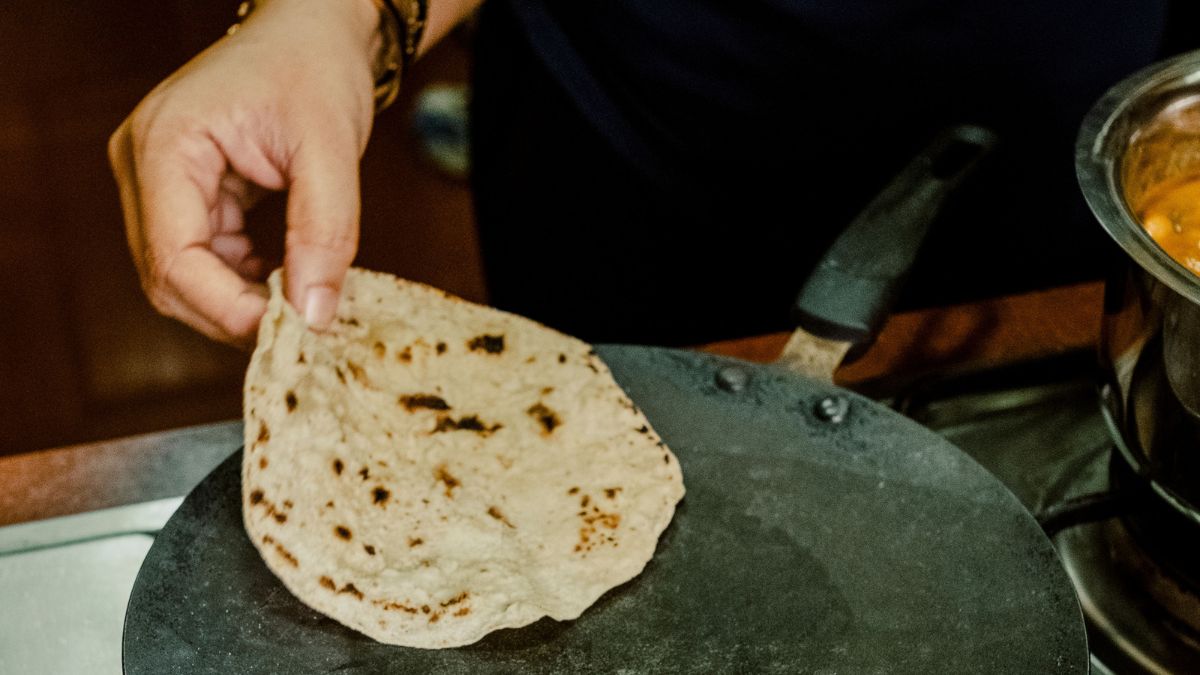
Because Khapli absorbs more water than standard atta, dough made with it typically needs slightly more water and a little extra resting time before rolling — kneading too dry or rolling immediately tends to make the dough harder to work with. This is purely a kitchen-technique point, not a fibre one, and this series deliberately keeps it brief here: dough behaviour, kneading ratios and roti technique are the territory of Flour Power, the companion series in this universe built specifically around atta as a cooking choice. Where this series is interested in Khapli’s texture, it’s only insofar as it shapes how a meal feels afterwards — not how to perfect the rolling.
The same plate logic that applies to any whole-grain roti applies here: a Khapli roti is one part of a meal, not the meal. Paired with dal, a vegetable and enough water, it does exactly what whole wheat would do — contributes a reasonable, useful share of a day’s fibre, alongside foods that are doing just as much, sometimes more, of the actual work. Two Khapli rotis (about 60g of flour) add roughly 6.8g of fibre; three (about 90g) add roughly 10.3g — figures this series unpacks in more depth in The Fibre Math of Khapli Rotis.
It’s worth being direct about the things Khapli doesn’t claim, because the gaps in a positioning piece are often more useful than the claims. Khapli isn’t higher in fibre than regular whole wheat atta — it’s equivalent. It doesn’t carry a glycaemic index figure; none of the Aashirvaad range does, and none should be assumed. It isn’t gluten-free or suitable for anyone avoiding gluten or managing coeliac disease — Khapli is a wheat, and contains gluten like any other wheat. And it doesn’t cure, treat, reverse or manage any digestive condition; at most, as part of a varied diet, it contributes fibre the way any whole grain does.
| ⓘ What This Series Won’t Claim About Khapli Won’t say Khapli has more fibre than regular whole wheat atta — it doesn’t. Won’t assign a GI (glycaemic index) figure to Khapli or any Aashirvaad product. Won’t describe Khapli as gluten-free or coeliac-safe — it’s a wheat, and contains gluten. Won’t claim Khapli cures, treats, resets or detoxes anything. Won’t call regular wheat atta or maida ‘bad’ or ‘unhealthy’ to make Khapli look better by comparison. |
If the deciding factor is fibre alone, Khapli and regular whole wheat atta are functionally the same choice — either comfortably beats maida, and neither beats the other. What’s left to decide on is texture, taste, cooking behaviour, availability and habit — all genuinely good reasons to choose Khapli, and none of them dressed up as a health claim they don’t need to carry. That’s the honest version of where Khapli fits: a solid whole-grain option, chosen on its real merits.
Plenty of households use Khapli some days and regular whole wheat atta on others — depending on what’s in stock, who’s cooking, or simply what feels right that week. Nothing about the fibre numbers in this piece asks anyone to pick a side permanently. The rest of this cluster goes further into what that everyday Khapli plate actually looks like, what it doesn’t replace, and the one question — is Khapli easier on the stomach — worth answering as carefully as this one has been.
Disclaimer: This article is for general informational purposes only — not medical or dietary advice.
Not in terms of fibre — the two are essentially equivalent (about 11.4g vs 11.36g per 100g). Khapli's genuine differences are in texture and water absorption, not nutrition.
Mainly texture and cooking behaviour. Khapli has notably higher water absorption (about 73%), giving it a softer roti, and a stone-chakki-style milling profile that handles differently in the dough.
Like any whole-grain atta, Khapli contributes fibre as part of a balanced diet, which supports general digestive comfort — it isn't a treatment or cure for any digestive condition.
No. Khapli is a wheat variety and contains gluten, like all wheat attas. It isn't suitable for anyone avoiding gluten or managing coeliac disease.
No GI figure is assigned to Khapli or any Aashirvaad product — this isn't a claim the series or the brand makes.
Khapli is an emmer wheat variety — an older tetraploid wheat historically grown in parts of Maharashtra and the Deccan, distinct from the hybrid bread wheat most commonly milled today.
No — since the two are fibre-equivalent, switching between them, or using both in the same household, makes no meaningful difference to fibre intake.