Ghee and Digestion: What’s True, What’s Tradition, What’s Overstated
Ghee has a long place in Indian cooking, but its digestive reputation deserves a closer look. Separate tradition, evidence and everyday culinary use without overclaiming.
Table of Contents
Ghee has strong opinions attached to it from two directions at once: the traditional Indian and Ayurvedic view that it’s actively beneficial for digestion, and the more recent Western dietary view that it’s simply saturated fat to be cautious about. The honest picture sits somewhere between both. Ghee is a normal, ancient, culturally embedded part of Indian cooking. It’s not a digestive remedy. It’s not a health risk in moderate, everyday amounts. And the more dramatic claims from either direction — that it heals the gut or that it’s harmful — don’t reflect the full, nuanced picture.
Ghee is clarified butter — butter from which most of the water and milk solids have been removed through slow heating, leaving almost pure butterfat. It has a higher smoke point than regular butter (making it more heat-stable for cooking at high temperatures), a rich, nutty flavour, and a very long shelf life without refrigeration. It’s been part of Indian cooking, religious practice and traditional medicine for millennia, which is part of why claims about its properties — in both directions — carry more cultural weight than a simple nutritional assessment would.
The Ayurvedic tradition’s view that ghee supports digestion rests partly on the idea that ghee, eaten in small amounts with food, helps the digestive process. Modern nutrition doesn’t have a direct translation for this framing, but there is a genuinely interesting underlying property: ghee contains a short-chain fatty acid called butyric acid (butyrate), which some research associates with supporting the lining of the gut and with gut bacteria generally. This is a real, published area of investigation — but research on dietary butyrate from food and its actual gut effects in healthy adults eating ordinary amounts of ghee is not settled enough for this series to cite as a ‘ghee is good for your gut’ claim. It’s an interesting piece of the picture, not a conclusion.
| ⓘ What the Evidence Does and Doesn’t Support Ghee contains butyric acid, which research is exploring for gut-lining associations — genuinely interesting This is NOT the same as ‘ghee is a proven gut health remedy’ — the evidence isn’t there yet Ghee is a normal part of a balanced Indian diet in moderate amounts — true, and sufficient Ghee is not a superfood, a detox, or a cure for any digestive condition This series doesn’t recommend ghee as a digestive treatment — it’s a food, not a medicine |
The most useful thing to say about ghee and digestion isn’t about what ghee does for your gut specifically — it’s about how much of it goes into a meal overall. A heavier, oilier meal — regardless of whether the fat source is ghee, oil or cream — is more likely to feel heavy and take longer to feel comfortable after, than a lighter one. This is covered in From Grain To Gut’s ‘When Your Roti Meal Feels Heavy‘ piece: the fat content of the meal as a whole is one of the five main factors in how a meal feels, and ghee is simply the most common high-fat addition in a traditional Indian plate. More ghee on a meal means a richer, heavier plate — not a more gut-healthy one.
Ghee has a higher smoke point than most unrefined oils and butter, which means it holds up better at the high temperatures common in Indian cooking — tempering, tadka, shallow frying. From a practical cooking standpoint, this is a genuine advantage for high-heat preparation. From a digestive standpoint, the fat content added to a meal is what matters, not whether the fat source has a high smoke point. This isn’t an argument against using ghee in cooking — it’s a clarification that the cooking-stability advantage and a claimed digestive advantage are two separate things.
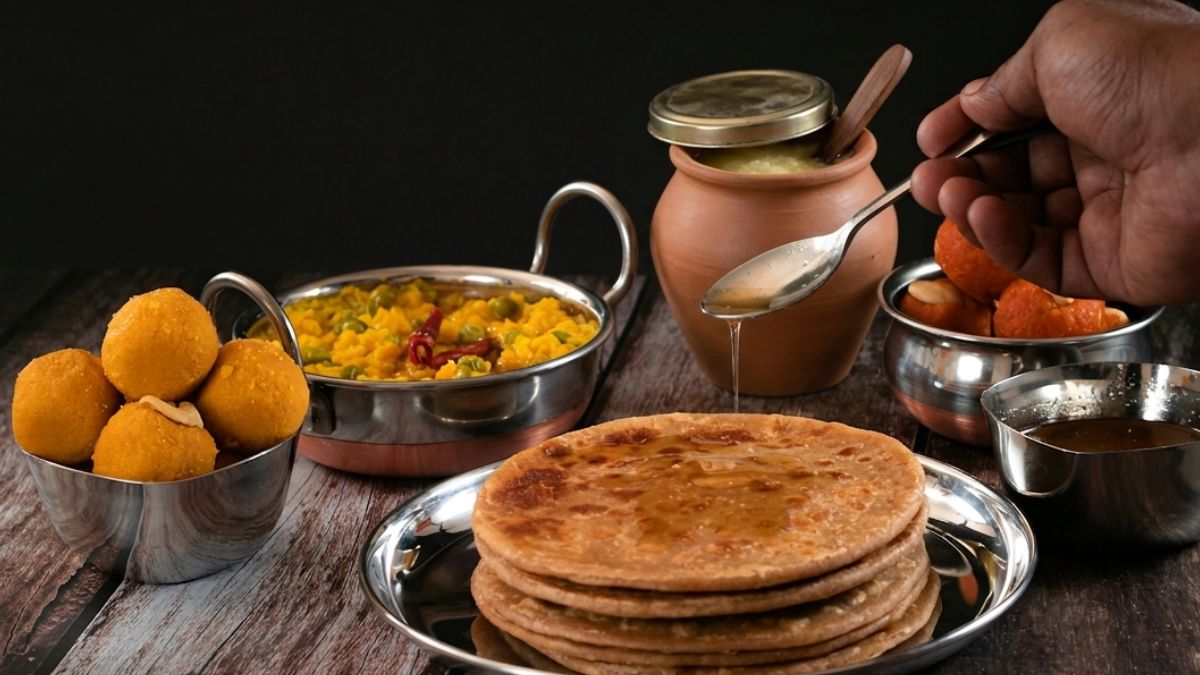
The cultural intuition behind ghee’s place in Indian cooking — that a small amount on hot roti, stirred into dal, or used in tempering makes a meal more satisfying and complete — isn’t wrong. Ghee adds flavour, richness, aroma and genuine palatability to food, and eating a meal that’s genuinely satisfying is part of what makes a sustainable, enjoyable diet. The case for ghee doesn’t need to be a medicinal one; it was always strong enough as a culinary and cultural one.
Ghee is a traditional, flavourful fat that has been part of Indian cooking for millennia. Used in reasonable, everyday amounts, it’s a normal ingredient — not a health risk, not a remedy, and not something that needs replacing with ‘healthier’ alternatives unless a specific medical reason applies. The digestive-remedy framing that circulates around it — from traditional claims to modern gut-health marketing — outstrips what the current evidence actually supports. And that’s fine: a food doesn’t need to be medicinal to deserve its place on a plate.
The most practical way to think about ghee and digestion isn’t about ghee specifically at all — it’s about the richness of the whole meal. A small amount of ghee on a hot roti, paired with dal and a light vegetable sabzi, is part of a balanced, satisfying meal that most people digest without any trouble. The same ghee, in a much larger quantity, in a very oily meal eaten late in the evening and followed closely by lying down, is contributing to a different kind of meal experience — one where the ghee’s role is one factor among several. This is the same frame this platform applies to all fats and rich ingredients: not elimination, but awareness of the whole plate and the whole meal.
Not all ghee is produced identically. Traditional hand-churned (bilona) ghee, made from cultured butter, is often cited as nutritionally superior in traditional food discourse; commercial ghee, including Aashirvaad Ghee, is produced at scale from direct cream. The nutritional differences between the two are modest in everyday use, and commercial ghee is a perfectly sound culinary choice for most households. The more important variable is how much of it is used and in what kind of meal, not the production method.
Disclaimer: This article is for general informational purposes only — not medical or dietary advice.
Ghee contains butyric acid, which is an area of active research in gut health, but the evidence isn't sufficient to call ghee a proven digestive remedy. In everyday moderate amounts, it's a normal part of a balanced Indian diet.
A richer, ghee-heavy meal can feel heavier and take longer to settle than a lighter one, which is true of any high-fat addition. Ghee itself isn't inherently a digestive problem in ordinary culinary amounts.
This series doesn't give a specific daily limit. General nutritional guidance suggests total fat (from all sources) ideally stays under about 30% of daily energy, weighted towards unsaturated fats. A small amount of ghee as a normal part of cooking is consistent with this.
For high-heat cooking, ghee's higher smoke point is a genuine practical advantage. From a digestive standpoint, the fat content of the meal is what matters, not whether the fat source is ghee or oil specifically.
Ayurvedic tradition assigns ghee significant digestive properties. Modern nutrition finds some interesting properties (butyric acid) but hasn't confirmed the traditional claims in controlled research. This series treats the claim as 'interesting but unconfirmed', not proven.
Aashirvaad Ghee is a quality, accessible option for everyday Indian cooking. The nutritional properties described in this piece apply to ghee generally, not to any particular brand specifically.
The nutritional differences between bilona and commercial ghee are modest in everyday use. How much ghee is used, and in what kind of meal, matters more than the production method.
This series doesn't make specific cholesterol claims. Ghee is a saturated fat, and general dietary guidance suggests keeping saturated fat intake in a reasonable range. For specific cholesterol concerns, a doctor or dietitian is the right source.